
Paris 2024, Uncle Sam's (winning) blades
The stars and stripes flag tops the medals table of the discipline celebrated on the platforms under the vaults of the Grand Palais

3' min read
3' min read
Paris - Women's Individual Foil Final? A Yankee derby between Kiefer and Scruggs (yes, the very athlete who eliminated our flag-bearer Arianna Errigo at the last and contested hit)! Team that triumphs in the same weapon always in the women's? Team USA, of course. And for now, there is the stars and stripes flag at the top of the medals table of the discipline celebrated on the platforms under the vaults of the Grand Palais. Without forgetting that it is also American blades that our boys will probably cross in the semifinals of the foil team event.
In short, in the multipolar world of post-modern sport, it turns out that now (actually, for some seasons already...) even Uncle Sam's nephews (and especially nieces) can fence, and how! It is therefore normal to wonder (and therefore to ask) why this growth, which at least this time, and even on the most significant occasion, has become a domain and perhaps even a school. To summarise: should we not now pack up and leave Jesi, Livorno, Mestre (just to name a few of the Italian fencing capitals) and fly to Wisconsin or Texas to learn how to throw a winning hit?
"No, we still know how to do the best fencing!", proudly emphasises multiple medallist foil coach and Olympic gold medallist Stefano Cerioni (who also has significant experience leading the Russian national team in his CV). But the elements he adds should not be overlooked: "It must be acknowledged that in the United States we are reaping the fruits of what has been sown in past seasons and decades, with the importation of many coaches and technical elements from Eastern Europe, in particular Russia and Ukraine, and the consequent assimilation of a fencing style that is perhaps less rich and complete but still allows us to touch, to hit the target thanks to dynamism, rhythm, and speed. And then look at the numbers: overseas coaches can choose from a very significant base of practitioners, even if that is a useful and necessary condition, but not sufficient to reach the top.
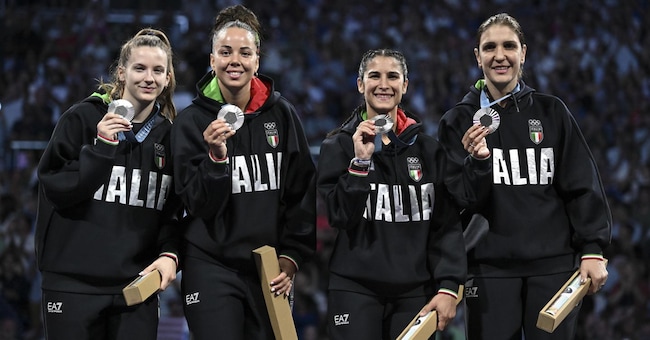
A speech supplemented by Federscherma president Paolo Azzi, still chatting in the (enormous) corridors of the Grand Palais: 'We have noticed that in the States young immigrants from Asia are approaching fencing above all, whose physical characteristics make them well suited to this type of very rhythmic dynamic interpretation of our discipline; and it should not be overlooked that at the level of youth competitions for some seasons now we have noticed the presence of the talent scouts from the main US universities, who offer scholarships to the most talented athletes from any country. And someone is starting to accept them, these proposals...'. In short, here they are almost placed side by side, the pieces of this unique fencing puzzle. The rest, which is the most important thing, is what happens on the piste. Alice Volpi, who returns home with the silver medal in the foil team event and the second wooden medal in a row at individual level, after her fourth place in Tokyo2020, seems to us to be significant: "On the piste against the Americans we do not see anything new from a technical point of view. We are still the reference tradition, but - and Volpi had told us this after the individual test - they always have hunger, determination, they are often able to throw more freely and resolutely".
Last piece of the American fencing puzzle at the Grand Palais, to be put back together and then immediately tried to take apart, in order to remain at the top of tradition on the piste. And of the medals table.


