Olympics and surroundings

Paris Games between media bubbles and false myths to be debunked

From the bathing of the Seine to sustainability at all costs, from transgender boxers to the slowness of the swimming pool

by Marco Bellinazzo

5' min read

5' min read

The Olympics is also a unique media venue, a sounding board in which news and orientations are formed and chased, which sometimes feed on themselves, resulting in bubbles or myths that no one has the strength to disprove with facts or valid alternative reasoning. The problem is that these news stories end up, in some cases, turning into axioms that generate partial visions of reality, consolidating into principles that on paper are absolutely shareable, but harbingers of erroneous evaluations if deprived of a due dose of flexibility.

The Paris Games are no exception. From the polluted waters of the Seine to sustainability as an irrefutable dogma, from gender equality to the (alleged) slowness of the Defense swimming pool, media bubbles have been created, while a more thoughtful and less superficial approach is needed to grasp all the nuances of the phenomena...

Loading...

Seine bathing

.

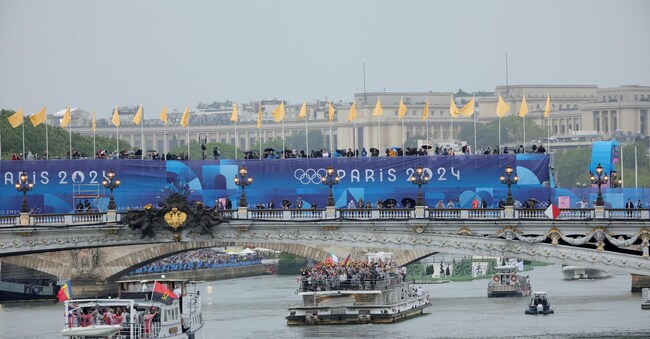
Much has been written about the French presumption of wanting to make theSeine swimmable and to hold triatholon and cross-country swimming races there. The former were held after some postponements. The latter, with Gregorio Paltrinieri expected to star in the 10 km, are scheduled for next week.

The effort to reduce pollution in the river that flows through Paris has cost around 1.5 billion. The dream of giving the citizens of Paris the 'sea', with equipped beaches and all the comforts of the case, comes from afar and clashes against a very complex water and sewerage system, as well as against a meteorology that can raise the level of Escherichia coli bacteria with rain and the mixing of waste water. In recent years, the institutions have spared no resources. Dams, weirs, purification and filtering systems have been created. It seems clear that the Seine will never have Christian waters and will only be swimmable for certain periods of the year.

However, the mere risk of not holding the scheduled competitions has been interpreted and narrated by the media as the failure of French grandeur. However, they underestimated a fundamental fact: the objective of those who worked on the Seine's bathing goes far beyond the Games, it is the improvement of the quality of life for citizens and the recovery of a fundamental city asset. An objective that is part of the so-called legacy and is perfectly in line with the new Olympic spirit sealed by the 2020+5 agenda: to leave cities hosting major events a lasting legacy, to make them better places after the events.

A merit that even if the 10-kilometre cross-country events were not held, and even if the triathlon events were not held - the health of the athletes comes first - would not be affected one iota.

Economic Sustainability

.

It is precisely for this reason that it is correct that the IOC wants to avoid mammoth events, with the construction of cathedrals in the desert, abandoned to themselves immediately after the competitions, with abnormal budget holes, favouring those dossiers in which the number of facilities to be built ex novo is reduced to a minimum. It must also be said, however, that major events, such as the World Cup or the Olympic Games, can be an opportunity for some countries to equip themselves with modern facilities to leave as a dowry to the territory. Therefore, a prospective, dynamic vision of the economic balance should be privileged in the IOC's evaluation.

It would be a mistake to rest on mere cost and revenue accounting. The profit and loss account of an event like the Olympics always sees in the immediate term a prevalence of costs (the initial estimates of which rise in most cases anyway) over direct revenue. But if one looks at the medium to long term enrichment for the territory, the socio-economic impact that media exposure generates over time for tourism, or the benefits ensured by the health and social prevention that a heritage of modern facilities and structures offers the population, then the discourse changes. And the IOC should favour this broader and deeper analysis, precisely in the name of true sustainability. Otherwise, no new country will be able to seriously appear on the Olympic scene, except those endowed with extraordinarily rich assets, such as the Gulf emirates.

Sul sesso degli atleti servono regole certe

Gender equality (at all costs)

.

An ideological view can generate inequalities. These Paris Olympics are the first Olympics with the same number of medals awarded to men and women. An achievement to be hailed with satisfaction. However, controversy has arisen over an overly ideological approach to this issue on the part of the IOC, which would have resulted in the assumption of more permissive standards than those of the international federations that govern the individual disciplines.

There are two cases of transgender boxers, the Taiwanese Li-Yuting and the Algerian Imane Khelif, who failed the gender test at the World Boxing Championships in 2023 but were admitted by the IOC to the Paris Games, as was already the case in Tokyo in 2021.

Scepticism about the lack of homogeneous parameters therefore risks instilling doubts about the affirmation of a 'woke' ideology that, far from emphasising a conscious fight against social injustice, mainly linked to issues of gender and ethnicity, ends up expiring in a mathematical accounting of egalitarianism that can itself be a source of inequality and injustice: such as that of making two human beings with incomparable basic physiological and biological conditions fight.

 The slow pool

A final note on the myth of the Defenze Arena slow pool. The hyper-technological and modular pool was built by Piscine Castiglione. A leading Italian company that for years has been designing facilities used in international competitions, including world championships and US Trials.

For sustainability reasons, the pool has been installed in a facility normally used by a rugby team, in order to meet the spectator requirements of an Olympic Games. It will then be dismantled, moved elsewhere and reused post-event for training young swimmers. In order to avoid breaking through the pavement and sinking into the car park below, the depth of the pool had to be limited to 2.20 metres due to the weight of the water (after the Games, international competitions will no longer be allowed to be swum in such shallow pools by regulation).

For days there have been rumours about the slowness of the pool in relation to the reduced height. There is probably some reason for this, but the technicians at Piscine Castiglione were convinced that in any case it was possible to achieve outstanding performances: well, in the last few days several Olympic records have been broken, and the Chinese Zhanle Pan shattered the world record in the 100 freestyle by four tenths to 46"40.

Of course there have been doubts about Chinese swimmers for years, but here a whole other story opens up, with media bubbles, false myths and (few) certainties...

Copyright reserved ©

Brand connect

Loading...

Newsletter

Notizie e approfondimenti sugli avvenimenti politici, economici e finanziari.

Iscriviti

Tutto mercato WEB