The Queen of Classics

Paris-Roubaix, the race of stones returns: new challenge between Pogacar and van der Poel

Paris-Roubaix, the race of stones, is an epic challenge between the new giants of cycling, who confront history and nature in a 259-kilometre race on cobblestones.

by Dario Ceccarelli

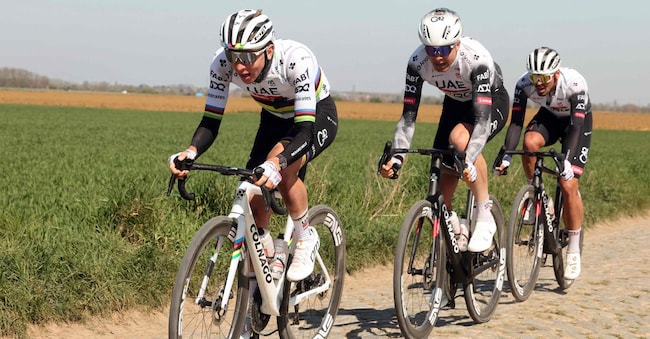
Il leader della squadra UAE-Emirates-XRG, Tadej Pogacar (a sinistra), e i suoi compagni si allenano durante un giro di ricognizione per la 122ª edizione della Parigi-Roubaix ad Haveluy, nel nord della Francia

5' min read

5' min read

It is the most watched road race in the world because it takes cycling back to the era of the pioneers: to that of ambushes, of fearless duels. And of the stepmotherly nature that gives no respite, with those stones vibrating in your stomach as if an invisible boxer kept throwing punches at you.

'In cycling races,' wrote Mario Fossati, unforgettable correspondent of the 'Gazzetta' and 'Repubblica', 'nature is only an object: in Paris-Roubaix it is the substance'.

Loading...

How much history there is in the 122nd Race of Stones, which takes place this Sunday, 13 April from Compiègne to the Roubaix velodrome along a route of 259 kilometres, 55 of which are cobblestones distributed over 30 sectors.

Every now and then there is always someone who wonders why this race, this so-called 'Reine', the Queen of the Classics, is so loved, so feared and so awaited. But rest assured that this time too, millions of fans (by the way: this time, after the embarrassing absence at Flanders, the race can be seen live on Rai2 as well as on Eurosport), millions of fans will turn on their TVs and various platforms to watch this latest folly of modern cycling. Maybe to ideally lend a hand to the riders who will end up in a ditch, who will call for help, who will swear for the second, third, fourth crash, for the umpteenth puncture or the umpteenth mechanical accident.

All the best

.

The protagonists will be the new heroes of the sport, champions such as the Dutch Mathieu van der Poel (triumphant in the last two editions and strongly in the hunt for a trio), the almost invincible Tadej Pogacar (rebounding from success at Flanders), specialists such as Mads Pedersen and Wout Van Aert. Along with our own Filippo Ganna, who won the Roubaix as an Under-23 in 2016.

They are the new giants, children of a globalised and computerised cycling completely different from the cycling of the origins, but also different from that of Francesco Moser, author of a historic trio in 1978-'79-'80. Moser's was still an almost 'pioneering' cycling, still little contaminated by the 'modernity' of the new millennium. The same as in the days of Roger De Vlaeminck, known as 'Monsieur Roubaix' because he leads the roll of honour with four successes together with compatriot Tom Boonen. The cycling of Bernard Hinault, the monumental Breton champion who, although he hated Roubaix, could not help but tackle it one spring day in 1981. He ended up winning it ahead of a strangely clumsy De Vlaeminck. But Bernard was not happy. He got off his bike and said with an offended air: 'This is rubbish, I will never come again.

Someone will say: this is the past, my friend, all very beautiful but the last legacy of a world that no longer exists, where one won by 'anger or love', as in that Luigi Grechi song.

Unpredictable Roubaix

In reality, this is not quite the case. Pogacar himself, an ever more Martian with already eight monument-classics on his CV, knows very well that in this race, where everything is precarious starting with the weather, no one guarantees anything to anyone. Not even if you are the strongest, or if you attack eight times in a row as you did in the Tour of Flanders.

Getting in your way are these damned uneven tiles, divided by red porphyry dust or black coal dust. Which if it rains turn to mud, turning your face into a scary mask. And even if you stand on the two vaguely cyclable quaysides at the edge, you are not protected from the falls of those in front or to the side.

In the cobbled sections you always have to be on your toes, particularly in the Aremberg forest (163rd km) where the merry-go-round of pleasure begins. Felice Gimondi, winner of the Roubaix in 1966, said: "When you approach the entrance to the Arembeg forest, it's as if a hoover is sucking you in. Because the passage is narrow, a kind of funnel, you have to do everything possible and impossible to find yourself in front of that wild bunch going faster and faster so as not to get cut off. Whoever falls behind at that point is almost out of the game. I used to dream about that bottleneck even at night'.

Just think that in this edition, before the Aremberg forest, there will be four ninety-degree bends. Better than that horrendous and dangerous chicane set up last year.

The Infinite Challenge

.

Only a week has passed since the Tour of Flanders, won in peremptory fashion by Tadej Pogacar, who, a fortnight earlier, had been beaten at Milan-San Remo by Van der Poel and Ganna. As you can see, we are always there: in an endless challenge that these giants replay in episodes like a TV series. This time the duel is more open. For Pogacar it is a real debut. It is in fact the first time that Tadej will face the stones of Roubaix. The Slovenian, before deciding for yes, had come in February to test the most famous and dangerous stretch, the Aremberg one. The successful outcome of the test removed all doubt from his mind. In his team, starting with sports director Fabio Baldato, they disagreed. But the great thing about Pogacar is precisely this: that he is not satisfied. That he always puts himself on the line, raising the bar of challenge. And when he does, he never does it by accident. The problem is that this time, as there are no Flanders climbs, the favourite is Van Der Poel, who is as motivated to hit the triumph as Moser, Merckx, Van Looy, Museeuw and Cancellara.

The Dutchman is not only a specialist, but also a favourite, having superior power, in the event of a sprint finish. In addition, apart from our Ganna, who has nine rainbow jerseys between road and track, pure sprinters such as Jasper Philipsen, who was second in both 2023 and the last edition in 2024, should not be excluded.

In short, let us enjoy this new dance of the stones. And may the best man win. If it were Ganna, after so much blue fasting, we really wouldn't mind.

We conclude with a tribute to Franco Ballerini, the former national team coach and favourite pupil of Alfredo Martini, who died at the age of 46 in 2010 during a motor rally. Ballerini, who dominated two editions (1995 and '98), remembered the Roubaix as follows: 'I could feel it in the air like spring. I used to train for months. It was my race, a fight with nature and with men. I lost so many, but in those areas everyone remembers my name...'.

Copyright reserved ©

Brand connect

Loading...

Newsletter

Notizie e approfondimenti sugli avvenimenti politici, economici e finanziari.

Iscriviti

Tutto mercato WEB