The summit in Brazil

Parolin at Cop30: 'Climate change generates more displaced people than conflicts'

The Vatican Secretary of State draws attention to climate refugees, who according to the World Bank could exceed 200 million by 2050. Spanish Prime Minister Sanchez: "Climate is the bread that is missing when there is a drought or a house destroyed by flooding"

by Gianluca Di Donfrancesco

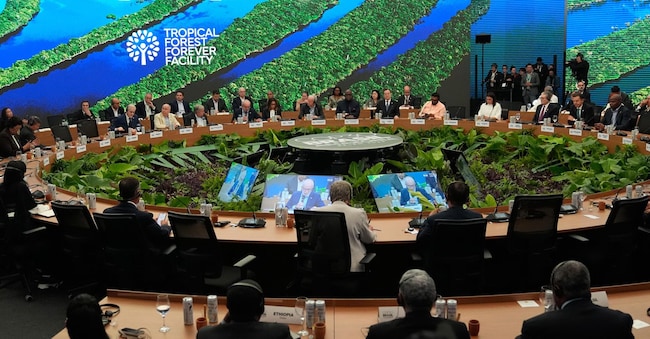
Una tavola rotonda durante la COP30 delle Nazioni Unite a Belem (AP)

3' min read

Translated by AI
Versione italiana

3' min read

Translated by AI
Versione italiana

Warming causes 'more displaced persons' than conflicts: it is the turn of the Vatican Secretary of State, Cardinal Pietro Parolin, to emphasise the humanitarian dimension of the climate crisis. He does so from the pulpit in Belem, on the second day of the political summit that anticipates the Cop30.

Speaking to the Vatican media, Parolin thus recalled that natural disasters drive millions of people from their places of origin, especially in poor countries that are less able to respond to the challenges of adaptation. These are climate refugees, fleeing poverty generated not by war, but by the effects of global warming.

Loading...

200 million climate refugees

As early as 2021, the World Bank estimated that this fate could befall more than 200 million people by 2050. One example: the South Pacific island nation of Tuvalu is a candidate to become the first uninhabitable state due to rising sea levels. Since 2023, the Australian government has offered unlimited residence permits to 280 Tuvaluans each year, with the prospect of resettling all 11,000 inhabitants within 40 years.

The World Bank also warned in 2024 that almost one in five people globally is at risk of experiencing a severe weather shock in their lifetime, from which they will struggle to recover economically.

The UN Refugee Agency, also in 2024, estimated that three quarters of the 120 million people already displaced worldwide live in countries severely affected by climate change, adding to crises of another nature, such as Ethiopia, Haiti, Myanmar, Somalia, Sudan and Syria. Not only that. Competition for control of increasingly scarce primary resources, such as water and arable land, risks multiplying and exacerbating conflicts.

Reaching the stage of the climate summit, where political leaders from almost all over the world took turns on Thursday 6 and Friday 7 November, Parolin read out a message from the Pope, who emphasised that peace is also threatened 'by the lack of due respect for creation, the plundering of natural resources and a progressive decline in the quality of life due to climate change'.

Just on Friday 7, the European Climate Service, Copernicus, said that 2025 "will almost certainly be the second or third warmest year" ever, confirming predictions by the World Meteorological Organisation (Wmo). Last month, an average temperature of 1.55 degrees above the pre-industrial period was recorded. All of the last 12 months have exceeded the 1.5 degree ceiling set by the Paris Agreement. Although 2025 may remain below the threshold, it is likely that the global average temperature for the period 2023-2025 will do so: it would be yet another 'first'.

Sanchez: climate change kills

In Belem, Spanish Prime Minister Pedro Sanchez recalled what global warming means in people's real lives, even in advanced countries. "Climate change," he said, "is killing more and more people. In Spain it has cost more than 20,000 lives in five years'. In 2024, the Valencian community was hit by 'the terrible storm Dana' and this summer, fires devastated half a million hectares of territory. Sanchez pointed out that in the seven years of his government, Spain has increased its installed solar and wind energy capacity by 140% and multiplied its self-consumption capacity. At the same time, Spain is one of the fastest growing advanced countries in years.

'The climate,' concluded the Spanish premier, 'is much more than a statistic. It is the bread that is missing when there is a drought or the house that is lost when there is a flood'.

Sanchez also announced plans to tax commercial flights and private jets. "We are collaborating with other countries: it is fair that those who have more and pollute more, pay the fair share".

In his speech, German Chancellor and leader of the Christian Democrats, Friedrich Merz, who has a much more conservative approach to the energy transition, emphasised the role of innovation and the needs of the economy.

Copyright reserved ©
Loading...

Brand connect

Loading...

Newsletter

Notizie e approfondimenti sugli avvenimenti politici, economici e finanziari.

Iscriviti