
Partenope at the San Carlo in the sign of Vanessa Beecroft and Ennio Morricone
The scene sculpted in essential and hypnotic tableaux vivants for the libretto by Guido Barbieri and Sandro Cappelletto

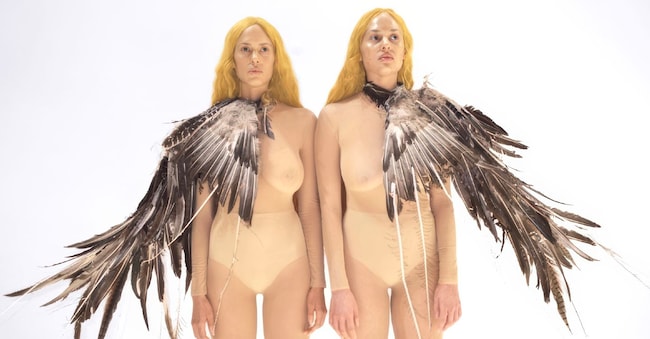
At the San Carlo in Naples, Partenope is transformed into a visual and sonorous ritual: Vanessa Beecroft's staging and direction project sculpts the scene into essential and hypnotic tableaux vivants, where bodies become sacred architecture. Ennio Morricone's music, composed thirty years ago, intersects with this rarefied world, deciphering the myth of the Siren in a musical code that has the fragment as its language.
Absolute first
Partenope, an unpublished work on a libretto by Guido Barbieri and Sandro Cappelletto with music by Ennio Morricone, appropriates all the visual dramaturgy of Vanessa Beecroft, her powerful and implacable research on the female universe, which transforms the body into icon, gesture, ritual presence. The vestals that appear as if evoked on stage, s-veil and re-veil her sign, shaping a figure - at once generative and iconoclastic - of the Siren.
The visual concept
From this conceptual genealogy, an interpretation of myth takes shape that finds in the collective body of the characters, repetition, seriality, attention to detail, the tension between anonymity and identity, and transforms it into a scenic act. It is the artist's logic, in which the body becomes a code, a pattern, an archetypal gesture that innervates the scene, a silent lexicon, an alphabet of presence that speaks without saying, that reveals precisely through reticence. Entities united by a nudity that is both exposed and protected, real and symbolic. The costumes, designed together with Daniela Ciancio and in collaboration with Chemena Kamali (Chloè's creative director), support the sense of movement.
The sound concept
As Beecroft's imagery is revealed on stage, the music becomes a necessary counterpoint that responds to an aesthetic of silence and suspension, a place where bodies are not merely shown, but heard. Their apparent mobility, their hieratic compactness, cracks under the pressure of a sound and siren song that advances through scraps, fractures, held breaths. The music and a fabric constructed by omissions, broken lines, by returns and distant resonances that graft the Greek and Neapolitan languages. Each fragment is a threshold, not a residue of the past, but a germ of possibility, a device that opens and closes, that reveals and subtracts. In this hybrid space, the female figures, including the voices of the two sirens interpreted by Jessica Pratt and Maria Agresta, become auroral presences, embodied memories, suspended between ancient iconography and the contemporary image.
Shape and Sound
In the ideal dialogue between artist and composer, image and sound discover themselves moved by a common architectural matrix, a logic of arranged bodies, organised elements, ritual forms that escape psychology to become structure. In both, the matrix of body and sound becomes objective matter, an element to be combined, superimposed, rarefied. Beecroft models presence as a living icon, a temporal sculpture, Morricone sculpts sound as a landscape of forces, a wounded and vibrant topography that finds expression in the thundering voice of Mimmo Borrelli. It is a fractured time, in which what emerges is not melody but residue, not continuity but echo. Thus the work takes the form of a secular ritual, in which fragment and figure coexist, without recomposing themselves in a constellation of essential signs, a field of tension in which what is guarded and what is revealed meet to generate a new form of vision.

