
Patients with fragile eyesight, the academy for specialists
The Genoese company Fonda has created a training centre for opticians that aims to grow specialised centres for the visually impaired. The company specialises in customised glasses for those at risk of blindness

3' min read
3' min read
Customised spectacles designed to meet the needs of people who are at risk of losing their ability to see or who wish to actively prevent future damage, in the face of degenerative eye diseases such as maculopathy, glaucoma, diabetic retinopathy or others linked, in most cases, to advancing age. This is what the Genoese company Fonda has been doing since 2012. In addition to being a benefit company, during the period of the Covid pandemic it developed the Academia Fonda, which organises an annual training course on the management of patients with reduced visual capacity, addressed to optometrists and orthoptists from all over Italy, with the aim of building a national network of professionals experienced in the management of patients with fragile vision (visual capacity between 7/10 and 4/10) and low vision (below 3/10).
The company was founded by Biagio Jurilli, who imported into Italy, and applied in his optical centre, the practices learnt from the American ophthalmologist Gerald Fonda, who was the first to realise that it was possible to optimise the visual residual of a patient with an advanced visual pathology (low vision) and allow him to maintain a certain degree of autonomy.
But it was Biagio's son Michele who developed the concept of 'fragile eyesight' (which was later registered as a trademark), which is also aimed at those in the early stages of the disease.
"With the concept of fragile eyesight," explains Michele Jurilli, "we intend to intervene at the early stages of the disease, when the person's life still has a guaranteed quality of autonomy. We are talking about people who are still living fully satisfactorily. It is very important to intervene when one is still at this point, because it allows us to work in advance and not on the final effects that the pathology brings, when the person can no longer read or move independently and experiences a real disability. Our aim is to intervene as early as possible to do, this is also a term we coined, functional prevention, which means preventing the loss, or rather the serious decline, of sight-related abilities'. It is a matter, continues Jurilli, "of stimulating the patient's visual function, activating continuous sight training, with the aid of specific tools, such as high magnifying lenses and constant coordination between the work of the ophthalmologist and the optician, as well as the orthoptist to flank medical therapies with a sort of early rehabilitation". In short, the target is to actively intervene in visual impairment.
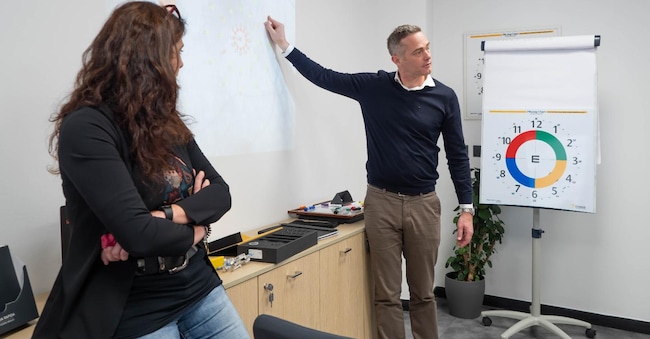
In order to expand the number of opticians specialised in working with patients with fragile or low vision, Jurilli founded the Academia, by attending its year-long courses (with in-person, in-lab and online classes), an optician can turn his or her shop into a Fragile Vision Centre. "With the Academia Fonda," adds Jurilli, "we have exceeded 150 training participants. Not all of them have opened fragile eyesight centres, but of these, in Italy, we now have 40, to which others will be added, with specialists we are training: we expect 10 in the next six months. We are now present in almost all Italian regions, missing only Val d'Aosta, Sardinia, Molise and Calabria. And there are now 20,000 Fonda glasses travelling around Italy and Europe. In 2020 we were producing 1,800 a year; in 2024 we will exceed 5,500'.


