Interview

Patuelli: 'The ECB cut rates more than expected. Bigger effect on the cost of mortgages"

ABI president highlights a recovery in home loans in August, against the expectation of a cut that had already been reflected in rates

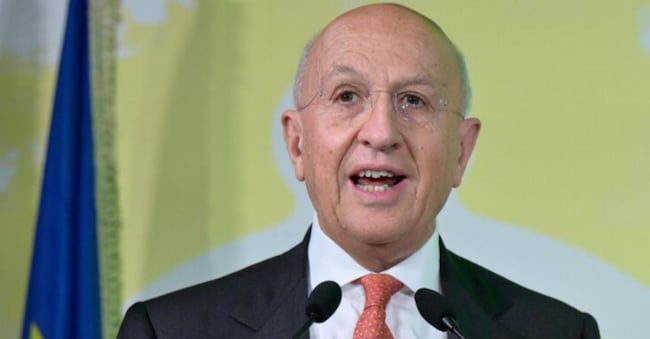
Il presidente dell’Abi Antonio Patuelli

6' min read

6' min read

"The ECB cut interest rates more than expected, reducing the rate for refinancing operations by 0.6 per cent. It can do no more until the Fed starts to reduce the cost of money". This was stated by Antonio Patuelli, president of Abi, who pointed out a recovery in August of home loans, against the expectation of the cut that had already been reflected in market rates. 'An eventual statle imposition of high interest charges on accounts and deposits would be unlawful,' the president added. In the first 7 months of 2024, the growth especially of time deposits has increased the revenue for the State from 1 to 4 billion'.

President, do you think the ECB's rate cut is still too timid?

Loading...

The cut is 25 basis points on overnight bank deposits at the ECB. But the refinancing rate dropped by 60 basis points. The width of the 'policy' rate corridor, i.e. the difference between the deposit rate and the main refinancing rate, has been reduced and will now be 15 basis points compared to the previous 50. Thus, as of 18 September, the interest rate on deposits with the ECB will be at 3.5 per cent (-0.25 per cent) from 3.75 per cent and that on main refinancing operations will fall to 3.65 per cent (-0.6 per cent) from 4.25 per cent. This is to say that the central bank reduced rates more significantly than was imagined, because it was thought that there would be an across-the-board reduction of 0.25 per cent. Instead, the ECB differentiated reductions ranging from 0.25 per cent to 0.6 per cent. At this stage, one of the most relevant aspects of monetary policy globally is the balance of rates between the two major blocs in the West. The EU countries that are outside the euro generally have higher rates. In the US, interest rates have not been reduced: the rate is at 5.5 per cent. That is why it is difficult for the ECB to cut more now, even if the inflation level is close to the 2% target, because of the competition between the two currencies internationally. American monetary policy conditions European monetary policy.

What will be the impact on the cost of credit?

The highest value of the 3-month Euribor since September 2023 was 4%; it then fell progressively and the lowest value was 3.45%, on the eve of the ECB decision. The 10-year Irs index, which is widely used to calculate the mortgage rate, was at 3.52% in October 2023; it fell progressively and has now sunk to 2.38%, a contraction of 115 basis points, against an ECB reduction that, adding up the two different cuts (0.25% and 0.60%) did not go beyond 0.85%. The market had therefore anticipated much more. The rate on the 6-month BOT reached 3.18% in recent days, down 87 basis points from 4.05% a year ago. The 10-year Btp fell 153 basis points (from 4.99 to 3.46%), resulting in a very significant saving on the cost of new issues. The most significant contractions are on the Irs index for the cost of mortgages and the 10-year Btp.

ECB cuts rate by 0.25 points, on deposits it drops to 3.50 per cent: new monetary policy measures

Could the cost of mortgages therefore fall more than the calculations we read?

Banks must be declined in the plural, they are many, diverse and in competition with each other. And the differences are significant, even between fixed and variable rates. It is clear that the downward trend has been anticipated by the banks: already in August, on the other hand, there was an upturn in house purchases due to the reduction in the cost of mortgages.

Will the 0.6 % cut in the cost of refinancing operations have a significant effect on banks?

The reduction of the refinancing rate to 3.65% is good news for banks borrowing from the ECB, but the reduction of the deposit rate to 3.5% reduces the yield for institutions. Banks are very liquid at the moment, so the effect of the reduction in the yield on deposits is more important than the benefits of the lower refinancing cost.

It is believed that even as rates fall, after years of decline, loan growth will resume from 2025. Is that so?

A distinction must be made between businesses and households. Households were very much looking forward to this latest reduction in rates and already in August they started buying and taking out mortgages again because they saw advantageous rates. For businesses the picture is more articulated: there are those who had more resources and put them aside during the pandemic, and those who are in greater difficulty. In Italy there was great expectation for the Industry 5.0 subsidies that are now in place and we will see what response businesses will give.

The modalities for accessing those incentives are not straightforward.

There are complexities, but better to have a measure with implementation complexities than not to have it.

The Italian government is not satisfied with the ECB cut. Even for FI leader Antonio Tajani, the European treaty provisions on the role of the central bank need to be changed.

I have been saying this for years. The founding treaty of the ECB gives centrality and importance, for the purpose of rate decisions, to the fight against inflation, which is an absolute and essential element. Along with inflation, however, support for development must also be included. The ECB's founding treaty must be revised, there is no doubt about that.

Of this reform, however, there is no trace in Mario Draghi's report on competitiveness from the EU....

The Draghi report is very courageous, but it could not but be respectful towards the ECB, since he is the past president. That report is a courageous and innovative political manifesto he himself called 'radical reforms'.

After the rate cut, banks' conditions will adjust. Will interest expenses on current accounts and deposits therefore fall? 

Again I remember that there are many banks and they have competitive funding policies. In the past year, 6-month and 12-month time deposits have grown a lot. They had a high remuneration: for the remaining 6 or 12 months they will keep higher rates. The share of these time deposits has grown so much that it has also brought in more government revenue on 31 July 2024. The tax revenue on the interest paid (rate at 26%) this year increased from 1 billion to 4 billion by 31 July 2023. Those who kept money in their current account maintained the daily availability of liquidity against lower rates: however, these contracts are also different in all banks.

In the past few months there had been rumours about a government initiative to recover resources by imposing a high threshold of interest expenses on accounts in order to derive public revenue from the higher income paid to customers. Is this still conceivable in light of the recent ECB cutback?

That would be an offence. However, those rumours were denied by the Ministry for the Economy. No subject in the European market can impose identical or homogenous prices on subjects that are in competition. These subjects in turn cannot make cartels, otherwise they become punishable cartels. There are four supervisory authorities: in Italy the European Antitrust Authority, the Italian Antitrust Authority, the ECB and the Bank of Italy.

Ursula Von Der Leyen intends to integrate the indications of the Draghi report into the mission of the new EU Commission. In the document the indication of the 28th regime for banking regulations is back, i.e. a dedicated framework to facilitate mergers between the biggies. Unicredit, however, made an early move by buying a stake in Commerzbank. 

In Germany the state has decided to sell a stake in Commerzbank, just as in Italy foreign banks have bought institutions in the last 10 years. In the EU it is free to buy, but it is difficult to make mergers and integrate activities in the group because the regulations are different. For years I have advocated the need for single codes in European banking and financial law.

Will the Italian government manage to get a commissioner and executive vice-president in the EU?

I hope that an overall balance will be achieved that will give strength to the new Commission. We do not only need no accidents for any candidate for European Commissioner. We also need a strong Commission unambiguously supported by the European Parliament. If we do not have a Commission in strong consonance with the Parliament, it would not have all the capacity to tackle the issues that Mario Draghi courageously pointed out.

Copyright reserved ©
Loading...

Brand connect

Loading...

Newsletter

Notizie e approfondimenti sugli avvenimenti politici, economici e finanziari.

Iscriviti