
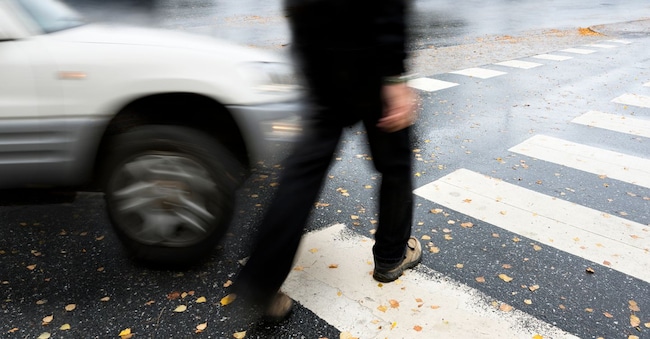
A pedestrian on the zebra crossing must stop and check that they have been seen
The proposed reform of the legislation imposes a duty of care on those who cross the road

In the draft for the new Highway Code, considerable attention is paid to the behaviour of pedestrians. The draft legislation does not merely reproduce the rules on correct pedestrian behaviour currently set out in Article 190; rather, the legislator has endeavoured to set out a series of additional specific behaviours, rooted firmly in the reality of everyday experience, asking citizens to cooperate with road safety.
Let us not forget that pedestrians are the most vulnerable road users of all. Leaving aside the behaviour already covered – namely the obligation to use pedestrian crossings if they are no more than one hundred metres from the point of crossing, the prohibition on crossing intersections, squares and open spaces diagonally outside pedestrian crossings, crossing the road in front of buses, trolleybuses and trams stopped at bus stops, or the obligation to give way to vehicles if they are outside pedestrian crossings – let’s take a look at the new provisions set out in the future Highway Code.
Caution is essential
Firstly, before starting to cross the road, pedestrians will be required to stop and to check that they have been seen by drivers of vehicles, and that they are stopping to give them way. And whilst crossing at designated pedestrian crossings, they must avoid making sudden or unpredictable movements, or changes in direction.
The prudential rules do not end there: there are also behavioural obligations, some of which already exist but are nevertheless little known and, in some respects, even rather curious.
Breaking stride on bridges
Even now, formations marching on foot are not permitted to keep in step on bridges. This is to prevent the frequency of footsteps from coinciding with the bridge’s natural frequency of oscillation, giving rise to the physical phenomenon of mechanical resonance, which could greatly amplify the structure’s vibrations, with the consequent risk of causing structural damage to the bridge.

