Interview

Pedranzini: 'This is why Popolare Sondrio is worth more than Bper's offer'

For the CEO, of the 1 billion synergies of the merger 'only 16% will be recognised to our shareholders'.
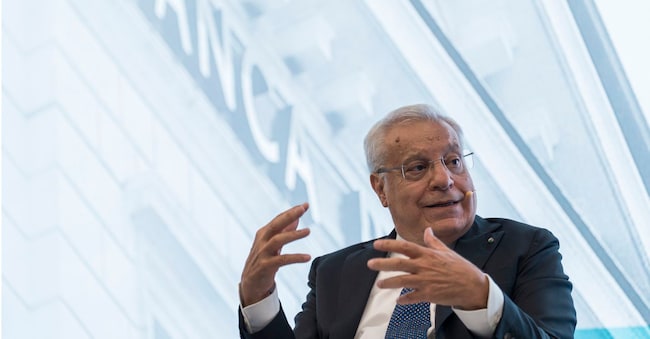
by Monica D'Ascenzo

5' min read

5' min read

'I have the utmost respect for merchant banks and fairness opinions, but I am aware, as is the board of Popolare di Sondrio, that there are methodological limitations in these processes. But then, in fact, the right price of an offer is expressed by the market and investors'. Mario Alberto Pedranzini, CEO and general manager of Banca Popolare di Sondrio, is clear on the issue of the price of the Ops launched by Bper on the institute: 10.80 euro (the equivalent at last night's closing on the stock exchange of the exchange offered by Bper) does not reflect the value of the bank and the prospects for future development, put black on white in the new 2025-2027 industrial plan designed stand alone by the management. "We have constant meetings with investors and we know that right from the start they have asked for more than the price offered. This is demonstrated by the value gap in our favour, which is expressed by the stock market performance of our share, which closed yesterday at EUR 11.52."

The board of Popolare di Sondrio "while considering congruous the consideration from a financial point of view, on the basis of the 'fairness opinions' of BofA Securities and Morgan Stanley, believes that the valuation" of the bank by Bper "does not fully recognise the real value". What is not valorised by Bper's offer?

Loading...

I know the bank I helped build very well and I know that it is also worth more in perspective. The market is expressing a different value and in this it is sovereign. We can then argue vocabulary in hand about the terms 'congruous' and 'adequate', but I would say that what sets us apart is the value that analysts and investors recognise in us. Our task is to speak clearly with our shareholders, be they small shareholders or funds, so that they can fully evaluate the offer, which we consider dilutive and which does not recognise the synergies of the aggregation to our shareholders.

In what terms are synergies not recognised for your shareholders?

We could not see a combined business plan in this offer, although it was delivered in the ECB. The synergies will reportedly amount to one and a half billion, but only 16% will be recognised to our shareholders. Instead, 70-80% should be ours because the synergies will be the result of the merger with Popolare Sondrio, but we do not even get half. Furthermore, Sondrio has a productivity of its personnel almost double that of Bper and a very competitive cost/income ratio: we are currently at 39% compared to Bper's 54%, because we have always been extremely prudent in our spending so as not to penalise investment. The high productivity of our staff has also been supported by the initiatives that the bank has pursued in the digital area, which is an enabling factor for improving processes and thus productivity, relieving staff of more repetitive tasks to leave room for consulting. Our staff, highly professional and attached to the shirt, continually manages to refocus on the issues that are most satisfying for customers and provide a qualified service, which is reflected in the level of loyalty of our customers. We have always placed our customers at the centre, because we are convinced that if you listen to customers and their needs and try to satisfy them, you create that alignment of interests that facilitates the bank on one side and the customer on the other.

What obstacles do you see in this aggregation?

We believe there are obvious execution risks: it is not easy to integrate Popolare Sondrio into a reality like Bper. We, stand alone, are confident that we can bring home the results we have set out in the new 2025-2027 plan with a cumulative net profit of around EUR 1.8 billion over the three-year period and EUR 1.5 billion in dividends, doubling the distribution made in the last three years. Bper's extraction of value would not be easy to achieve, all the more so since at a time when an anomaly such as that of the price in the Italian banking system's bidding landscape is being highlighted, that minimum threshold condition at 35% + 1 adds difficulty to difficulty.

The retail shareholders' association of Popolare di Sondrio continues to complain not only about the lack of a premium but also about the alignment with market values, calling for a relaunch at Bper. How do you think they will move? .

Our shareholder base is very fragmented, apart from the major shareholder Unipol, which controls 19.7%. For retail shareholders, the paper-for-paper swap is a bit of an unknown and it is also costly because they then have to honour the tax aspects by putting their hands in their wallets to pay the capital gains tax if they join. Today, the shareholder is in a disadvantageous situation: taking the paper at a discount instead of selling in the market at a higher price and having liquidity immediately.

Long-standing shareholders, who have invested in the bank, have always held on to their shares because throughout history they have always received a significant dividend, because Popolare Sondrio has always looked at the profit and loss account and the distribution of a coupon. In the 2025-27 business plan we aim for about EUR 1.5 billion in dividends over the plan period and a pay-out ratio of 85% each year . Our shareholders looking at our plan and dividend prospects would have a higher payout than Bper's 75%. This explains the dilutive effect of the transaction, on the terms currently offered by Bper.

How is this period being experienced at the headquarters and branches of Popolare di Sondrio?

Clearly, the structure is suffering a little at the moment: we have 900 people working in the bank's central structures in Sondrio, and the prospect of having to merge into another reality is not the best one for them. The bank, then, has pursued a logic of organic growth for 154 years, and here we differ from Bper, which for the past 35 years has followed a path of growth through some twenty aggregations, most recently with Ubi's 500 branches and with Carige. In Sondrio we have built value by starting with 50-60 branches and arriving at the current 500 with our own forces. An important difference that reflects the economic literature in practice: in this operation with Bper there would be more synergies from costs than from revenues. We have estimated that staff cuts could impact around 800 people, and given some territorial overlaps, the closure of many branches is also likely. This is a new situation since our institution has never resorted to redundancies and has never activated the redundancy fund. On the contrary, we continue to open branches because our philosophy is based on developing both a physical presence in the territory and a digital one. We have in our business plan the hiring of over 200 new employees and we always focus on meritocracy with the aim of matching the needs of individuals with those of the bank. Added to this is the fear of branch managers that being absorbed into the aggregation will result in losing the typically entrepreneurial autonomy and spirit that they have achieved over the years in our bank.

What is your commitment now?

However the Ops goes, our duty is to continue to serve our customers to the best of our ability and to ensure the best perspective for all stakeholders.

Copyright reserved ©
Loading...

Brand connect

Loading...

Newsletter

Notizie e approfondimenti sugli avvenimenti politici, economici e finanziari.

Iscriviti