
Pedro Almodóvar: 'I am afraid of death. Shooting this film was a relief".
Fresh from winning a Golden Lion for 'The Room Next Door' on euthanasia, the Spanish director talks about the set in the USA, his love for Neorealism and the music of Vanoni and Mina
6' min read
Key points
6' min read
The Room Next Door, with which he won the Golden Lion at the 81st Venice Film Festival a week ago, marked a point in Pedro Almodóvar's filmography. Seventy-four years old - as he is fond of pointing out when someone rounds up, since his birthday falls on 25 September -, forty years of career, twenty-three films, an unmistakable cinematic figure for which the term almodovarian has been coined, and, before a week ago, not a shred of a Palme, Bear or Golden Lion, except that for lifetime achievement, received on the Lido in 2019. Across the Atlantic, in truth, they had celebrated his rebellious and amused genius, always sensually close to founding themes such as love and death, with two Oscars, one for Best Foreign Language Film for All About My Mother in 2000 and one for Best Screenplay for Talk to Her (2002). In Europe it had ranged from Baftas to Davids, Césars to Goyas. But the sophisticated European festivals had always relegated him to minor prizes.
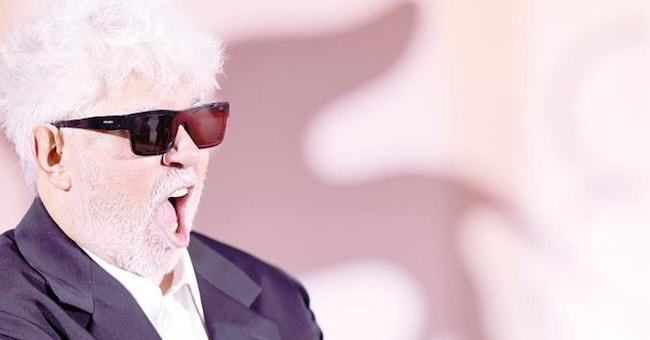
He arrives with a dishevelled white mop, his hair standing on end, as always, and a red T-shirt, the colour the writer associates him with (as with Antonioni), among the many garish ones he prefers. He makes an effort to speak in Italian: 'Thank you very much. I am very tired, but I hope it doesn't affect you. I don't guarantee, however, how my brain is working now'.
"In Italy I always feel very loved"
.In the cinema he received a standing ovation of almost twenty minutes, but he demurred: 'Every time I come to Italy I feel very much loved'. But here it is not a matter of elective affinities between brotherly Latin countries: La stanza accanto, in theatres from 5 December, won the highest award in the Venetian palmares because it is an excellent film, on a very delicate subject, euthanasia, with a sober screenplay, written by the director himself, inspired by the book Through Life (Garzanti, 2022) by Sigrid Nunez. "It is my most restrained film," he explains, "It is from Julieta (2016 ndr) that I identify most with this form of filmmaking. Fortunately, when I was young I made very crazy films,' he laughs.
Almodóvar tapers feelings, calibrates them, there is participation but no laceration. His baroque vein, with its tragic and comic tones at once, the strong women with stubborn faces, the men in make-up, the flashy costumes and furnishings, are eclipsed to crystal-clear sculpt a message of humanity and hope. It is also Almodóvar's first film shot in English with English-speaking actors: international stars Tilda Swinton and Julianne Moore.
Swinton is Martha, a war correspondent, suffering from terminal cancer, and Ingrid, played by Moore, is a former colleague of Martha's, a renowned writer, who resumes seeing her friend as soon as she learns of her illness. The central theme is freedom: the primary right to be able to choose how to end one's life with dignity when pain makes it unbearable. "The legacy Tilda leaves Julianne is the courage to face death. I don't believe in reincarnation, in 'transferring' from one person to another. But Julianne receives from Tilda the gift of continuing her relationship with her daughter, regenerating it in the name of her friend'.


