Defence

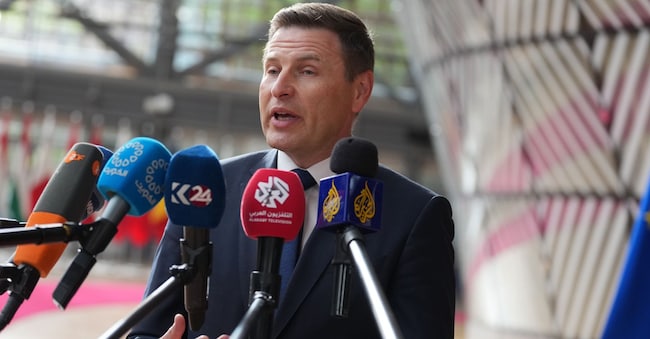
Pevkur (Estonia): 'Europe can defend itself, just invest 4 per cent of GDP'

Lennart Meri Conference in Tallinn tests European defence without the US

by Antonio Talia

Il ministro della Difesa estone Hanno Pevkur  APN

4' min read

Translated by AI
Versione italiana

4' min read

Translated by AI
Versione italiana

"If the US wants to change its posture, that is its right. We Europeans must focus on what we are already doing. We already know that the US is reorganising itself globally, the process is ongoing, but until we know everything in detail I think it is more important to focus on what Europe has to do'.

Hanno Pevkur, Estonia's Defence Minister since 2022, summarised the position of many in front of the audience at the Lennart Meri Conference, the high-profile conference that over the years has brought together heads of government, ministers, diplomats, military personnel and analysts in Tallinn to become a benchmark for European security and defence.

Loading...

According to Pevkur, European countries do not have to reach the psychological threshold of 5 per cent of GDP invested in defence that was plotted last year to please Donald Trump: 4 per cent, invested by all, can bring investment to around a trillion, a figure sufficient to secure themselves.

The 2026 edition of the Lennart Meri Conference, which began yesterday, is taking place at a time with all the characteristics of the perfect storm: first the Pentagon, which suspends at the last moment and without explanation the sending of 4,000 American soldiers to Poland, a move that seems to take most Europeans by surprise and comes only two weeks after the announcement of the withdrawal of another 5,000 soldiers from Germany.

Then the words of Mario Draghi, who in his acceptance speech for the Charlemagne Prize in Aachen made it clear that Europe must defend itself.

Finally, NATO Secretary General Mark Rutte, who - according to rumours published by the Financial Times - is convening European defence industry summits in Brussels next week, with the aim of increasing production as much as possible ahead of the Atlantic Alliance summit planned for early June in Ankara.

Weighing on this climate are the war in Ukraine whose end is not yet in sight, the MAGA intolerance expressed in the American National Security Strategy document that points to the European Union as a threat, Donald Trump's dissatisfaction with the European nations' refusal to get involved in the war in Iran. That is why in the corridors and halls of the Lennart Meri Conference, the question that resonates most frequently in these hours is not to what extent the rift with the United States can be recomposed, but how long Europe has to stand on its own two feet.

"Sometimes I read in the media that politicians and generals say 'we will be ready to defend Europe alone in 2029'. But I don't like these deadlines," says General Ingo Serhartz.

A German in his sixties, Gerhartz is the commander of the NATO Allied Joint Force Command in Brunssum, the Netherlands, and thus in charge of more than one million soldiers deployed from the Gulf of Finland to Hungary and Slovakia, from the east of the Netherlands to the Atlantic, placed to protect more than 50 per cent of the European population. "Especially here in the Baltic countries, people don't care what may happen in 2029; they care what happens today. I think it is important to bring the views of the eastern flank nations to all European agendas, to the shared opinion that we have to be ready today, not in 2029. Which does not mean that at the same time we should not evolve and improve our capabilities'.

According to General Gerhartz, an increasingly European-driven NATO must take an example from the eastern flank nations such as the Baltic States, Scandinavia and Poland not only in terms of military preparedness, but above all in terms of societal awareness of a possible Russian threat, made more and more relevant by the American disengagement.

But for Robert Wilkie, president of the Center for American Security, former deputy secretary of defence in the second Bush administration and director of the National Security Council under Condoleezza Rice, the Europeans' call to responsibility does not mean a clean break with America, despite MAGA's extremist positions: 'Signs that the United States might have questioned military spending in Europe have been going on for decades,' he told Il Sole 24Ore.

"The GDP of the other NATO countries is one and a half times that of the US, and overall you have many more inhabitants than the US. Therefore, it is mandatory for Europe to take a stand. And at the same time the US must remain close to Europe, culturally, emotionally and financially. You are our main economic partners, and we face the same threats, because those who attacked Ukraine are part of a group that believes that the West is dead and wants to replace the post-World War II global order with another system'.

If all these alarms about Russian aggression seem excessive, many of the analysts and military personnel attending the Lennart Meri Conference have little doubt: the conflict in Ukraine is not going as Vladimir Putin hoped, but the threat from Moscow will not abate in the short term.

"We all need to understand that between a missile hitting Tallinn and one hitting Madrid there are not hours, but a few minutes difference," concludes Estonian Foreign Minister Pevkur. "That the alert for a ship full of drones in the Mediterranean does not have a reaction time of two hours, but two minutes. This is the reality, and if we do not understand it, we cannot really feel safe."

"If I were Putin, I would act in the coming weeks," says Carlo Masala, professor of international politics at the Bundeswehr University in Munich and author of the geopolitical bestseller 'If Russia Wins', interviewed by AdnKronos on the sidelines of the conference. "We have upcoming elections in France with an uncertain outcome, a short-lived Starmer government, a US president who tells his followers every day on Truth Social that he does not intend to defend NATO, and the US already distracted and running out of ammunition in the Persian Gulf. Strategically, it is the perfect context to provoke something in Europe'.

Copyright reserved ©
Loading...

Brand connect

Loading...

Newsletter

Notizie e approfondimenti sugli avvenimenti politici, economici e finanziari.

Iscriviti