
Pelliconi's caps ready to land in sub-Saharan Africa
In Bologna

3' min read
3' min read
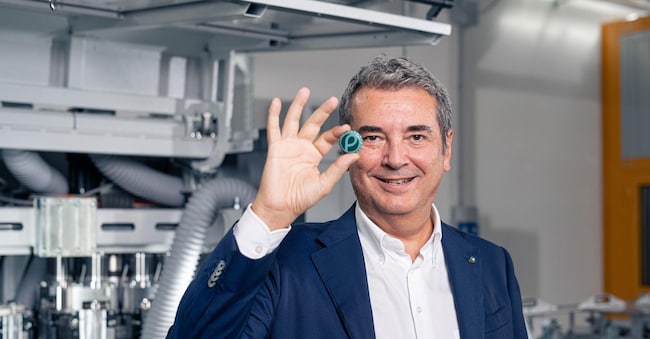
A world export champion, a leader in its own manufacturing niche and a forerunner of innovation in the sector, cannot sleep peacefully because trade wars to the tune of duties and logistical assaults by sea - which are coupled with armed conflicts on land - make the supremacy conquered in 85 years of activity fragile, as never before. This is the starting point for Marco Checchi, CEO of Pelliconi, to explain the challenges facing the brand born in 1939 in Bologna, at the outbreak of the Second World War. It started from the dream of a small manufacturer of small metal parts, Angelo Pelliconi, to replicate a crown cap found on an American bottle, and has come to be a small Italian empire that produces 32 billion metal and plastic caps and closures for the food and beverage industry every year worldwide. The undisputed number one in terms of volume, innovation and quality on global markets, with 700 employees and eight factories in Italy, China, the USA, Canada and Egypt.
"We export up to 95 per cent of our volumes to more than 100 countries with a direct sales network, our customers are large beer, mineral water and beverage conglomerates, tens of billions behemoths like AB Bev or Carlsberg, with whom we contract in Amsterdam and then supply their factories all over the world. We are leaders, with 13.5% of the global market, always pioneering every new solution that others then copy us, but we cannot preside over a market that is increasingly concentrated in terms of customers but parcelled out in terms of competition, remaining at the mercy of costs and logistical blocks that are now unpredictable. We have to open plants where demand is growing, local on local, and the next port of call will be sub-Saharan Africa,' Checchi explains. He has been with the company for forty years and is the husband of the granddaughter of the founder of the Pelliconi Group. The mayor of Bologna, Matteo Lepore, recently awarded him with the Turrita d'argento, an honour bestowed by the municipality on personalities or organisations that have distinguished themselves for their contribution to the progress of the city.
In an industry such as the beverage industry, which in the space of a few years has gone from 5 thousand players to less than a thousand, with the skyrocketing cost of raw materials and packaging suppliers playing catch-up, it is not easy for those who, like Pelliconi, are leaders but have to calculate to the penny to save the margins of a niche business (turnover does not reach 250 million euro) without ever sparing on research and innovation. From that of product and process, carried out in five R&S centres in Italy, the USA and China (where the tear-off cap much loved in China, the flower-cap with the bevelled crown, and customised digital prints on the entire cap were born) and in the LAP-Laboratorio Angelo Pelliconi academy for continuous and interdisciplinary training, to social innovation. Last month, a pilot integrative contract was signed at the Ozzano headquarters, which will lead to experimenting, from 2025, the reduction of working hours for the same salary by halving night shifts.
"We operate in a market with few attractive M&A opportunities to support our growth," the CEO points out, "because we compete with a plethora of small local companies with excellent margins because costs are cut to the bone. These are not sustainable operations in the long term, we prefer to grow on our own strengths'. The acquisition completed at the beginning of the year of the American Novembal, specialised in plastic caps (55% of Pelliconi's volumes are anchored to metal caps), which brought as a dowry two new sites, one in Arizona and the other in Quebec, will not therefore be the beginning of an unprecedented global shopping policy. 'Our strategy,' Checchi confirms, 'aims to open numerous small foreign production units in many countries over the next few years.
The mega plant at Atessa in Abruzzo, the largest crown cap plant in the world with a capacity of 23 billion pieces per year, will therefore remain unique. "Today," he adds, "we need small spaces and great flexibility, and in this we are also helped by the massive investments in AI, which we were the first to use in the sector, for quality control and remote predictive maintenance, which guarantee enormous savings in reducing production stoppages even in factories in distant countries. The first target is South Africa, where Pelliconi is ready to land soon, 'but all markets with high population numbers and growing consumption are interesting for us, we respond to a need that is at the base of Maslow's pyramid, so Mexico, Brazil, India and all of South-East Asia are potential targets,' the CEO concludes.

