
Penelope has unravelled the whole cloth
A poetic collection of multiple Italian-speaking and migrant voices and one of stories from the diaspora challenge the myth of lyrical subjectivism and offer the reader a fresh and vital reflection on literature, solidarity and our humanity

There is Candelaria Romero's Penelope who 'has stopped working/ she no longer weaves/ she no longer unravels threads': now she 'rewinds skeins/ protects colours/ guards treasures' she no longer tries to bring Ulysses home, but 'has gone back to the sea to swim'. Or Mia Lecomte's Rapunzel looking out of the window, but only to imagine her home behind her. Or, again, Brenda Porster's indomitable Eve, who writes bluntly: 'I'm still convinced, my dear,/ that it's all about power/ your friend, God,/ he sneaks into our garden/ to spy on us when and how he pleases,/ without a modicum of restraint./ he puts absurd prohibitions on you/ then he feels great when he sees/ how you, like a good, obedient boy/ always listen to him', denouncing the 'man pact' that would never work with her. And, polemically, she asks: "Can you explain to me, then,/ why of all fruits/ it is knowledge that is forbidden to us/ to be able to distinguish good from evil,/ to be able to choose what is right?" She finally exonerates the snake and takes responsibility for having wanted to make a definitive cut: "Enough/ of the enclosed garden, the perfumed air,/ commanded delights, sex/ innocent, insipid, spied./ I couldn't catch my breath./ Come on, let's go this way -/ out there is the world: divided, mortal,/ free".
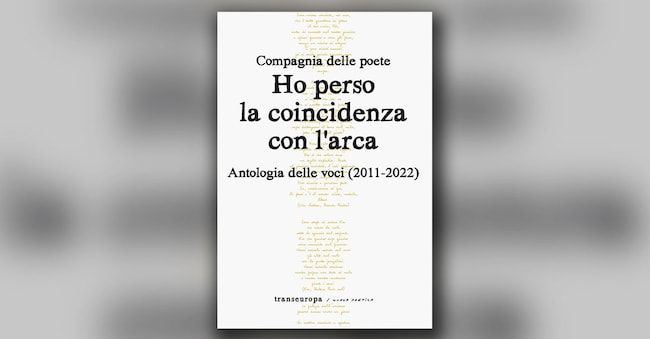
They are some of the original Italian-speaking poetic voices of non-Italian mother tongue, or not only Italian, who for fifteen years have been uniting around the idea of "making poetry a collective organism, alive, capable of transcending cultural and authorial borders". Under the name of Compagnia delle poete, intertwining, they have given shape to four performances now brought together in the book Ho perso la coincidenza con l'arca.
Some of them are well-known authors, others less so: they are Prisca Agustoni, Ubah Cristina Ali Farah, Livia Bazu, Anna Belozorovitch, Laure Cambau, Vera Lúcia de Oliveira, Adriana Langtry, Sarah Zuhra Lukanić, Helene Paraskeva, Barbara Pumhösel, Begonya Pozo, Melita Richter, Francisca Paz Rojas, Barbara Serdakowski, Jacqueline Spaccini, Paulina Spiechowicz, Eva Taylor, in addition to the poets already mentioned, and come (also) from Austria, Argentina, the United States, Romania, Switzerland, Brazil, Poland, Somalia and France, with routes that also include stops in Morocco, Quebec and Sweden.
The poems are either written on purpose or chosen according to the theme and recomposed by Lecomte, who has succeeded in giving substance to a polyphony of fresh and airy female voices, to "a poetic word that knows no frontiers or distances, but overcomes languages and borders to touch the heart of existence". They speak of "mothers, stepmothers, godmothers", of the "nausea of domination", of houses without stairs to get from one floor to another, of "spiced meats of thoughts, words, dreams", of double words like "the opposite shores of the ocean", of women in bits and pieces in which "no fragment will know more than the others", of heroines of myth who finally speak their mind, and girls who beg: "Do not unravel my weave, fire and smoke its embroidery".
An artistic but also social and ethical experiment that challenges the fetish of the authorial personality. Subjectivism is countered by a lyrical collectivism, which flourishes in a context of multiple, migrant, evolving identities, which seek themselves not in national or cultural belonging, nor even in linguistic belonging, but in measuring and agreeing with the other, with the elsewhere, in the variety of mother tongues and acquired languages, in a solidarity that enhances differences, which are a wealth for all. Ugo Fracassa, in the introduction, quotes a phrase by Amelia Rosselli, a translingual poet: 'If the relationship becomes plural, one can speak to an audience; if it is not plural, one might as well not do it'. And de Olivieira writes a manifesto-poem: 'He had learnt to observe the swallows, always there to leave, always there to migrate, then they return, not the same ones, maybe others, of the same family, of the same species, they transmit the smell of places, they transmit the dimension of things, the memory, the measurements of fullness and emptiness, the return was always a reconnaissance, as if each owed the other, the road to be taken and the road already taken'.


