
Pepi Merisio and glimpses of Italy in the boom years
Shots by the master of Caravaggio on show in Bergamo document the recovery in the post-war period and the following decades: the common thread linking them is the human factor
4' min read
4' min read
The journey from Cogne to the province of Enna, from the peaks of Lavaredo to the southernmost point of the country, Portopalo di Capo Passero, unfolds before your eyes. One is moved and reflects observing the faces, pausing in front of the landscapes, dwelling on the transformations of Italy as it rises in the post-war period and moves towards the well-being of the boom years. The shots of Pepi Merisio (1931 - 2021), the photographer from the Bassa Bergamasca area who trained in the formidable gym of magazines (when they existed, and invested in articles and photo shoots) and then landed in books, becoming a signature of the Touring Club, are on display in Bergamo in the Museo delle Storie, in the exhibition set up thanks to the Fondazione Sestini, whose Archives had acquired the maestro's collection in 2017.
It is really worth going to see it, for the gratification of the eye and the exercise of memory. Attraverso l'Italia, this is the title taken from a historical Touring series to which Merisio contributed by immortalising some central and northern regions. But in the rooms of the Convent of San Francesco, in the Upper Town (which, needless to say, is worth a visit in itself), the Italian territory is all there. And the figure of those who portray it, loving it and capturing its essence emerges well: the human factor. Even when you cannot see it, it is there. To enliven the glimpses and characterise the transition from post-war depression to modernity. Work, the community dimension, children's games, means of transport, traditions and religious rites, the advent of consumption: an Italy that wants to grow. Even without rules (at least according to today's canons), as in the incredible shot of Piazza del Plebiscito in Naples (1971): a thick blanket of cars turns it into a car park, erasing its beauty.
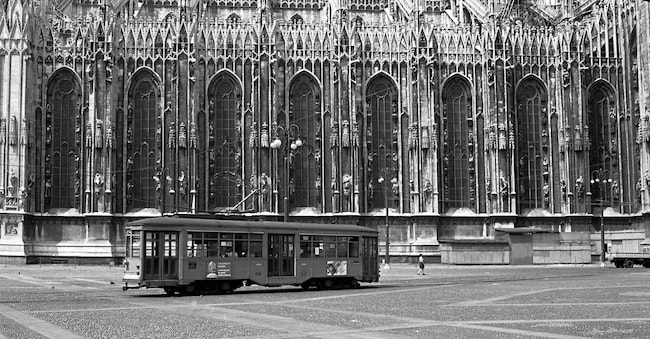
Or how he reveals the Cinquecento literally on the seashore at Praia (Cosenza), in the same year, conveying the impetus of someone who wants to enjoy a comfortable holiday that has perhaps been denied for too long. However, there is also the order of the rows of vines in Appiano, in Alto Adige, the imprint of work where man is not: the result of his dedication speaks for him. Just as the viaduct on the Colle di Cadibona (Savona) shows the quantum leap in transport and mobility, just like the tram that skirts Milan Cathedral or the lambrettas that Italians can finally afford. If the harmony and originality of the architecture conquers, even in its details, and forces one to stop in front of the rustication of the Palazzo dei Diamanti in Ferrara, the perspective depth of the porticoes in Bologna, the geometries of San Gimignano, the processions and rituals make one rediscover a sense of community.
This is what the ascent of the monks up the steps of the Sanctuary of La Verna (Arezzo) conveys, behind them the exuberant nature of the forest. Or Piazza del Campo during the Palio: how many images have we seen everywhere, yet few make us feel at one with the jockeys around the bend, in that unbridled race, and at the same time inside the crowd gathered in a spectacle that has been renewed in Siena for centuries.A white staircase and a 1950s atmosphere: an old woman dressed in dark, her head covered, and a little girl holding hands with a gentleman take us to Ostuni. But the Dash bottle in the man's other hand is a telltale sign that we are a couple of decades later, when washing machines revolutionised everyday domestic life.
The Sasso Barisano of Matera is blackened, silent, abandoned: it is indeed 1963, the evacuation established by the special law of the De Gasperi government in '52 has been accomplished. A radical gesture, the first step of a long and slow rebirth, until the redemption of 2019 when the Lucanian city became European Capital of Culture: a goal that was unimaginable at the time. From North to South and backwards, you walk through the spaces (one of which is reserved for Bergamo, the land of Merisio, who was born in Caravaggio), looking at the 136 photos, constructing your own itinerary, reordering your thoughts and feelings. Catalogued and digitised by the Sestini Foundation, the images are almost all in black and white: there are a few exceptions, such as the colourful Festa dei ceri in Gubbio. We return to the Alps, to Cogne and the two women balancing a basket of hay on their heads, rake in hand. One descends towards the Marches, to the life that animates Piazza del Popolo, in Ascoli. We continue to Lecce, where the elegant Piazza Duomo opens up, to find ourselves in Sicily next to the fishermen of Favignana, working in circles with their nets. One crosses Italy, accompanied by the depth and sensitivity of the master.


