
New BTp Valore: coupons rising in three stages. How it differs from the BTp Valore Insieme
The Treasury has published the information memorandum on the bond being offered from 19 to 23 October: a step-up structure with an increase in yield from the third and fifth years onwards

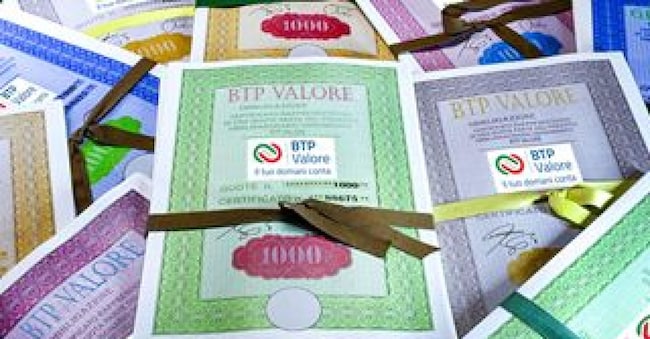
Key points
The coupon payments for new BTp Valore, in on offer from 19 to 23 October.
In its now traditional form, the government bond aimed at households and small investors will feature the usual step-up mechanism, which causes the yield to rise over time according to a predetermined trajectory. Despite its relatively short maturity of five years, the Treasury has opted for a three-stage structure, which until now had only been proposed for BTps with longer maturities, such as the seven-year bond maturing in October 2025 and the six-year bond issued last March. However, in a buoyant market, a system of this kind allows for better modulation of supply, striking a balance that should make the bond attractive to investors without generating excessive costs for the public budget. On this basis, the coupon on the new bond will see its first increase from the third year onwards, and will rise a further notch at the start of the fifth and final year.
Double offer
The information provided by the Treasury in the factsheet published this morning, 6 October, thus adds to the factors that those assessing the rival bid will also need to take into account. In fact, during the same week, from 19 to 23, the “BTp Valore Insieme”: characterised by a mechanism – unprecedented for these government bonds intended for retail investors – of a single coupon payable at maturity, which will be paid at the end of the five-year term.
Both securities are aimed at an audience of small investors with a predominantly long-term investment mindset, but they may meet different needs. The traditional bond provides a return that can be realised in the short term, suggesting the idea of a sort of additional income thanks to the classic quarterly rhythm of coupon payments. The BTp Valore Insieme behaves in the opposite way: it capitalises the return over time without paying it out in instalments, but instead concentrates it at maturity in present value terms.
The calculation
This last point deserves further consideration. Because, from the point of view of total return, the two securities are equivalent; but precisely for this reason, the final coupon on the BTp Valore Insieme is not equal to the simple nominal sum of those paid out in the meantime by the traditional bond. This is because it must take into account the waiting period required of the investor, compensating them, so to speak, for their ‘patience’.
From a financial perspective, the time factor also has value. This is because the money from periodic coupons can be used immediately or reinvested, generating a further return. A euro earned today, therefore, is worth a little more than a euro that will not be received for five years: all the more so in times of inflation.
To give a numerical example – obviously a theoretical one, intended solely to illustrate the mechanism – if the ‘classic’ BTp Valore offers one euro per year in coupons during the first two years, two euros per year during the second two years and three euros in the final year, the BTp Valore ‘insieme’ will not simply pay a final coupon of nine euros – that is, the algebraic sum of its twin’s periodic coupons – but will pay a little extra to compensate for the time elapsed.
Free choice
In any case, the dual offering does not present savers with a dilemma. As the two BTps are independent of one another, each has its own ISIN code, and it is therefore, of course, possible to split the capital to be invested between them in whatever proportions each investor deems best. Both, as always, will then be redeemable at any time on the secondary market, at market conditions, with the yield accrued up to the time of sale being paid out. Otherwise, the rules are the same as usual: the minimum purchase denomination, which during the issue week is at par and commission-free, is one thousand euros. Returns are subject to the reduced tax rate of 12.5%, and there is an exemption from inheritance tax and from the ISEE calculation for total portfolios comprising government bonds and similar instruments up to 50,000 euros.


