Stitching together a performance: when tailoring meets cinema
He has established one of the most recognisable styles in contemporary couture: Robert Wun designs monumental garments. But the element of surprise is never an end in itself.

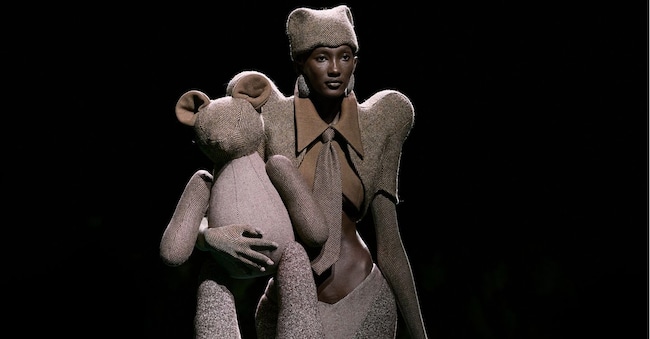
Her work straddles the boundary between fashion and performance. The silhouettes of the dresses she designs are often taken to extremes – monumental shoulders, sculpted corsets, billowing trains, waists constructed with surgical precision – yet they are not merely about spectacle. Rather, they reveal a rare understanding of the body and the way in which fabric can interpret it. Robert Wun, born in Hong Kong in 1991, moved to London to study fashion at the London College of Fashion and it was here, in 2014, that he founded his eponymous brand, gradually establishing himself as a leading figure in haute couture, thanks to his ability to transform every collection into a visual, emotional and cinematic narrative. His pieces are worn by artists and performers who view fashion as a form of transformation, not merely as styling: Lady Gaga, for example, who in *The Devil Wears Prada 2 wears one of his highly theatrical couture dresses from the Spring/Summer 2026 collection in the official video for *Runway* magazine .
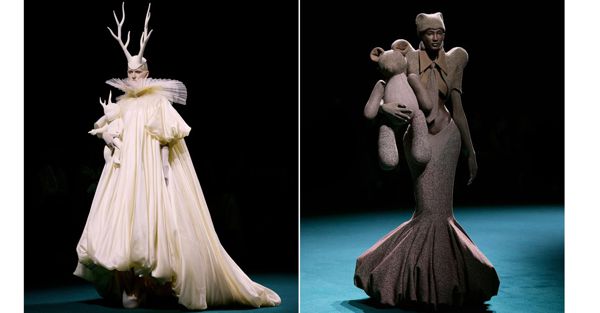
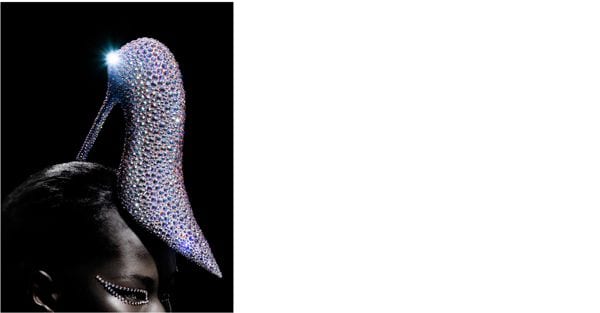
His garments do indeed create a character, it is true, but what is the origin of each of his designs? First comes an idea, an emotion, a fantasy. Then comes the garment, built around that inspiration just as a house is built around an intuition. In his hands, the body is never a neutral entity: it is reshaped, protected, exaggerated or almost concealed. A shoulder becomes architecture, a skirt expands into a circular volume, a corset becomes armour, a sleeve extends until it merges with the body’s anatomy. Hence the immediacy with which his work has become instantly recognisable over the years. In June 2022, Wun won the ANDAM Prix Spécial, which, in addition to the €100,000 prize, secured him a year of strategic mentorship with Bruno Pavlovsky, president of Chanel’s fashion division, and his official debut (as the first designer from Hong Kong) on the Paris haute couture calendar in January 2023 with the ‘Fear’ collection. Fear was the central theme, with the clinical purity of white marred by cuts, stains and fake wounds. His cinematic tailoring was already evident in the lines of the garments, with the interplay of headwear accessories that bordered on the mask-like. From then on, season after season, the same stylistic hallmarks have returned: theatricality that is never gratuitous, but always anchored in a construction that makes the garment the protagonist of a narrative rather than merely a costume.
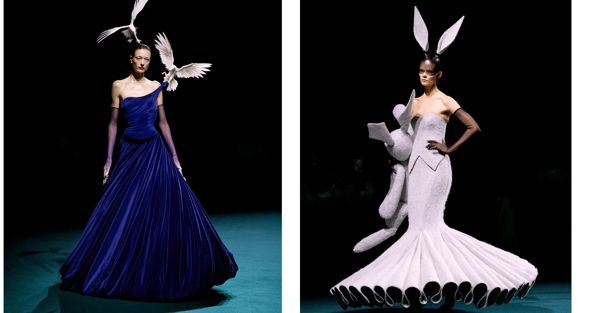
Before the colour, the embroidery and the technique, it is the silhouette that stands out in her garments. And within that silhouette, there is a constant tension between restraint and excess – a rhythm that alternates between the most fitted tailoring and sudden bursts of volume, creating a dialogue between the body and the space around it. The threshold – the balance between opposites – seems to be one of her defining visual elements. It is from this dialectic that the emotional charge of her collections arises. The garments may appear protective, almost like armour, and a moment later expose or accentuate the body: the contrast between vulnerability and defence runs through much of his work. This contrast also applies to colour: black and white form the basis of the most graphic looks, a clear boundary that allows line and structure to dominate; but when another colour appears, it is rarely subtle – rather, it becomes a way of regulating the emotional temperature of the garment.
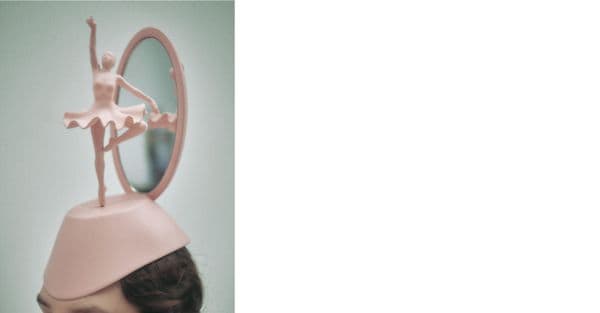
Next come corsetry, draping, embroidery, beading and sculptural construction: nothing is mere decoration; everything is a means of shaping form. It is craftsmanship that brings imagination to life, and in an age capable of producing an infinite number of images through digital means, Wun’s garments serve as a reminder of how irreducible an idea remains when translated through the hands of skilled artisans.
His sources of inspiration — cinema, nature, childhood memories, the storm — are never reproduced verbatim. Wun draws on them to create a vocabulary: the narrative provides the framework, but the garments remain the protagonists. Over time, the designer has learnt to repeat and refine his signature styles without them becoming formulaic; indeed, those recurring elements are evolving into the language of a designer with a now instantly recognisable signature. Evolving without losing one’s way is, for a young designer, one of the most difficult feats to achieve.