
'Constitutional concerns shared with the Quirinal': towards Meloni's no to the Board of Peace
Meloni will reflect to the last on whether to attend the Word Economic Forum currently taking place in Davos, Switzerland: she may stop by tomorrow before the important EU Council if a vis a vis with the US president is possible

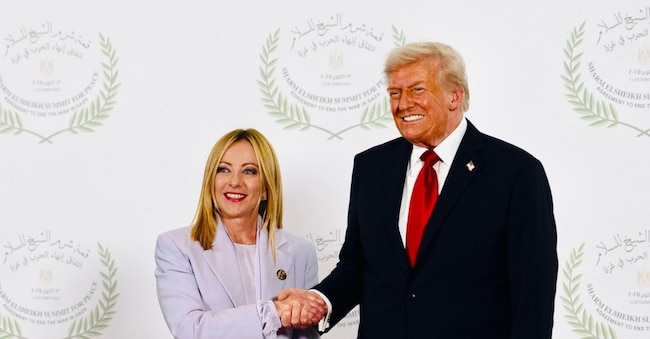
In the hours in which the clash between Europe and Donald Trump's United States becomes total, from the repeated threats to the territorial integrity of Greenland and therefore of the EU to a new tariffs war, the role of 'bridge-builder' between the two sides of the Atlantic assigned by Prime Minister Giorgia Meloni risks wobbling to the point of irreparable collapse. Palazzo Chigi's line remains that of agreeing with the US on a security strategy for the Arctic that involves NATO and of negotiating to avoid an escalation on tariffs. This is also why Meloni will reflect until the last minute on the opportunity to attend the Word Economic Forum underway in Davos, Switzerland: she could stop by tomorrow before the important EU Council in the event of the possibility of a vis a vis with the US president.
Not only the Arctic and tariffs. At the centre of these hours' reflections is the response to the invitation sent by Trump to join the Board of Peace for Gaza after Emmanuel Macron's great refusal that cost France the revenge of 200% tariffs on wine and champagne. On the other hand, British Prime Minister Keir Starmer and German Chancellor Friedrich Merz are also moving towards a rejection of the heterogeneous and risky body that, according to Trump's intentions, would build a lasting peace in the Middle East but that in fact would batter what remains of international rules by replacing the UN. Precisely with Merz, as well as with the other EU partners and Commission President Ursula von der Leyen, Meloni's contacts in these hours have been constant. The presence on the board of Vladimir Putin and his loyal Belarusian ally Lukashenko, then, makes two ministers committed to the defence of Ukraine such as Antonio Tajani (Foreign Affairs) and Guido Crosetto (Defence) more than wrinkle their noses. It is precisely from Forza Italia, of which Tajani is secretary, that the strongest resistance comes, in line with the European People's Party of which the Azzurri have been a pillar for many years.
But it is not only a question of political expediency, or rather of the impossibility of sitting together with the anti-EU dictator who bombs Kiev every day, breaking with his European partners. There are also obstacles of a juridical and constitutional nature, which the Quirinale has taken care of and which Meloni must take into account. Article 11 of the Constitution, the same oft-cited article that sanctions the repudiation of war as an instrument of offence and dispute resolution, allows Italy to be part of international bodies that pursue peace and international justice 'on equal terms with other states'. The opposite, that is to say, of the Board proposed by Trump, where and he would be primus inter pares, and which looks like a sort of private UN with a billion dollar entrance 'token' on top. Not to mention that the ratification of international treaties must go through a parliamentary vote with an ordinary law.
All perplexities of a constitutional nature that have been shared with Meloni in recent hours by President of the Republic Sergio Mattarella. One can imagine what the President, who is strongly pro-European and a defender of international rules, thinks of Trump's initiative. But the Quirinale is keen to let it be known that there is no stop to the Board but, precisely, 'a shared perplexity of a constitutional nature'. For the rest, the choice remains political, and for Meloni it remains a choice - in fact - between Trump and the EU at the limits of the impossible.


