Peschiera, record-breaking aqueduct: the 1.5 billion Acea tender
The tender for the upper section of the network serving Rome and other provinces in Lazio gets underway. Palermo: "It will be a cutting-edge work in Europe thanks to robotics and artificial intelligence

3' min read
3' min read
A revolution for the water supply of Rome, the entire metropolitan area and the provinces of Lazio for decades to come. But also a sustainable, technologically advanced and climate change and earthquake-proof project: drones, artificial intelligence and robotics will be hired to preserve the already excellent quality of the capital's water and improve the service for over 3 million people. Published today in the Official Journal of the EU is the call for tenders for the new upper section of the Peschiera Aqueduct, the section running from the springs near Cittaducale, in the province of Rieti, to the Salisano branch junction.
The 1.449 billion euro infrastructure, 850 billion euro of which financed by the Italian Ministry of Economic Development and the remainder recognised in the tariffs, sees Acea as the central purchasing body and Acea Ato2 as the contracting station, and takes off after the conclusion of the authorisation process certified at the end of June by the "reasoned determination" of the Special Committee of the Higher Council for Public Works.
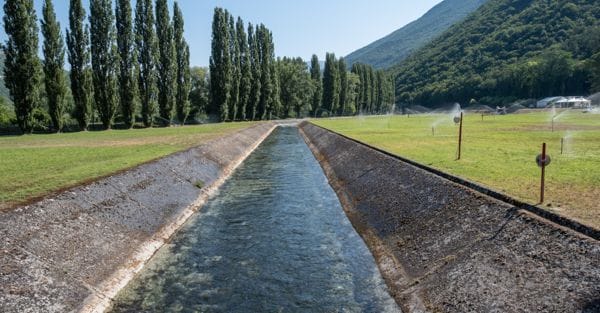
"This is the largest water infrastructure project in Europe," Acea's CEO, Fabrizio Palermo, explained to Il Sole 24 Ore. "We will invest €1.5 billion to build the New Peschiera Aqueduct, which will replace the existing water network that has brought water to the homes of 70% of Romans for over 80 years. An industrial commitment under the banner of the most advanced engineering solutions in the field of robotics, automation and artificial intelligence. The distinctive feature of the work is safety, the main objective of all new generation infrastructures built by Acea".
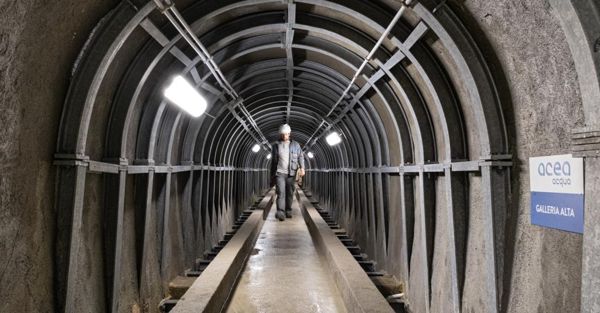
The new aqueduct will replace the old 1937 section, which will however remain as a backup, and will be built through a hydraulic tunnel as long as 27 kilometres, with a 13-kilometre-long driveway section with a steel pipeline to transport the water resource, and will be completely passable by means of an electric vehicle specially designed during the construction phase. The water flow rate will be 10 cubic metres per second, as stipulated in the concession, although it is currently around 9: it will mean recovering over a thousand litres per second. Goodbye, moreover, to pumping equipment, taking full advantage of gravity. And everything will be piped to Rome, bypassing the sections with the highest seismicity.
The work, in fact, is designed to reduce seismic and hydrogeological risk, strengthening the resilience of the system. The winning criterion in the tender phase will be the implementation of the geotechnical-structural, qualitative and quantitative water monitoring system through the development of a data collection and analysis system. With an architecture that will allow, also with the use of AI models, the collection and transfer of data in real time and the interpretation, from a predictive perspective, for maintenance purposes. A crucial aspect that, like inspections, will see specially designed drone systems in the field and will not require service interruptions.