


I tentativi estremi di rianimare i negoziati tra Usa e Iran
dal nostro corrispondente Marco Masciaga

3' min read
3' min read
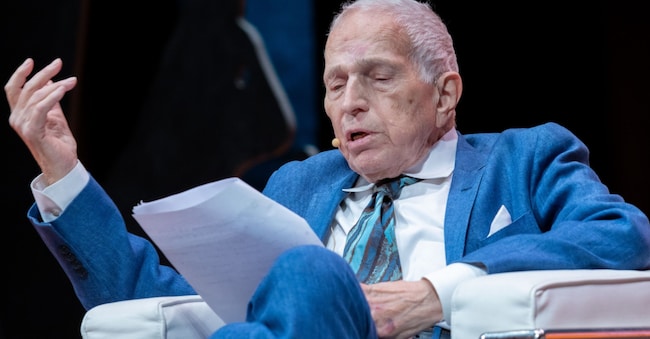
How to grow the economy and productivity, which are now stagnating in Italy and much of Europe? Not with artificial intelligence, as many simplistically think, but with 'dear old' human creativity, which is the basis of widespread innovation and personal satisfaction, from which the lasting economic growth of a dynamic country derives. These are the words of Edmund Phelps, 2006 Nobel Prize winner for Economics, acclaimed yesterday at the Teatro Sociale on the first day of the Trento Festival of Economics.
In the front row, distinguished American and Italian economists, two of whom - Giovanni Tria and Richard Robb of Columbia University - took the stage at the end to pay tribute to him 'for founding modern macroeconomics', said former minister Tria (now president of the Enea Tech and Biomedical Foundation). In the hall and on the stages, there were many young university students, who showed their appreciation for Phelps' Gen Z-friendly theories.
"To have a 'mass flourishing' of society and economic systems," Phelps said in his keynote lecture, "we need widespread innovation from below, from ordinary people who have ideas that enable them to work better or achieve greater satisfaction and results. But we also need higher salaries for more satisfying and engaging work, scalable hierarchical chains if you have a good idea and want to take it to top management, free space for imagination and creativity. When this is realised on a large scale, it fosters solid economic and social growth'.
As was the case in post-war Italy, then Olivetti, the 1980s and the Italy of industrial districts, budding from widespread entrepreneurship, outside official research centres . Models that Phelps is well acquainted with, having spent a sabbatical year in Italy, in 1984, working with Governor Carlo Azeglio Ciampi's Bank of Italy, and getting to know a young researcher like Tria, who then led him to explore the Eastern interpretation of his 'endogenous innovation theory of creativity' (not 'exogenous' to business as that which famous economists, from Schumpeter to Solow, believed to be successful). The study of the 'Chinese way to growth' has added further theoretical pieces to Phelps' theories. "Not surprisingly, he is appreciated and studied all over the world," Tria said.
Moreover, the economist born in 1933 - who took to the stage with courage and determination despite his age making him fragile and therefore all the more valuable - developed his theory of innovation and dynamism well after he was awarded the Nobel Prize (obtained for having substantially improved on and filled in the gaps of economic giants such as Phillips and Keynes, first and foremost). Rather than sit on his laurels, Phelps chose the path of innovation himself, exposing himself to strong criticism for 'bombing' the prevailing traditional neoclassical theory. And for going beyond even the beloved Keynesian theories, with his 'neo-humanism based on individualism (not to be confused with egoism), vitality (seeking a working life that guarantees satisfaction and not just a salary) and self-determination', he explained.

