
Philippines: 7.8 magnitude earthquake, at least 32 victims, buildings collapsed
President Ferdinand Marcos Jr. called on the population to evacuate immediately to higher ground in Philippine areas vulnerable to the tsunami

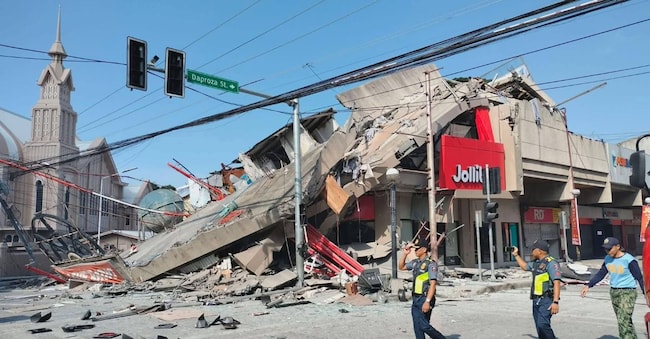
A 7.8 magnitude earthquake with epicentre at sea shook part of the southern Philippines in the early hours of Monday, causing damage in a major coastal city, power outages and generating metre-high tsunami waves along the nearby coastline. This was reported by local authorities. The death toll is at least 32, while there are also more than 100 injured and several missing. According to the authorities, a tidal wave of about one metre hit along the nearby coasts. Casualties were mostly due to collapsed buildings, while no damage or casualties were reported due to the tsunami. Among the hardest hit areas was the port city of General Santos, one of the country's main cities, a nerve centre for the tuna export industry and other commercial activities, with a population of around 700,000. Numerous aftershocks followed and the earthquake was felt as far away as Malaysia. The Philippines is often hit by earthquakes because of its location on the so-called 'ring of fire' in the Pacific.
Sarangani police spokesman Roland Catoburan told France Presse that two people died when a wall collapsed in Alabel, a municipality near General Santos. Robert Dagon, police chief of General Santos, a large city on the island of Mindanao, had earlier reported one fatality and four injured. 'Several buildings collapsed. Some houses have also collapsed,' he said, pointing out that he could not yet give a more detailed tally.
Tsunami waves also possible in Indonesia, Taiwan and Japan
The Pacific Tsunami Warning Center (PTWC), based in Hawaii, warned of the risk of tsunami waves along the coasts of the Philippines, Indonesia, Taiwan and as far as Japan.
Philippine President Ferdinand Marcos Jr. suspended classes in the affected areas of Mindanao and urged coastal residents to evacuate immediately. "Take shelter in higher areas immediately. Do not wait. Your lives are more important than whatever you leave behind," he said.
In Kiamba, a coastal city close to the epicentre, about 50,000 inhabitants have taken refuge away from the coast. "At the moment, 80 per cent of the population has moved to the highlands," Agripino Dacera reported.

