
Phillips derives 46 per cent of its revenue from watches, whilst Artcurial is rediscovering antiques
The two international auction houses generate lower turnover than Sotheby’s and Christie’s, but are showing strong growth in specific sectors

Key points
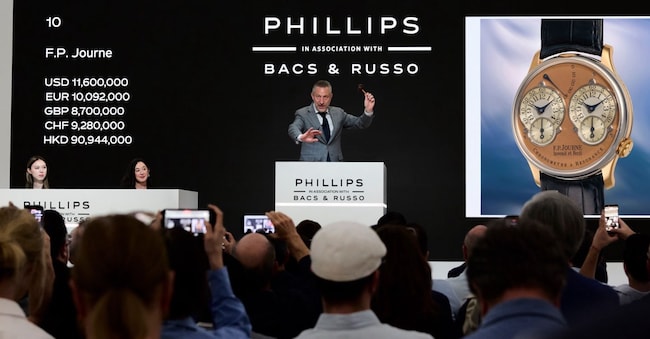
Phillips has closed the first half of 2026 – the year of its 230th anniversary – with sales totalling $507 million. This figure is a fraction of the sales achieved by its larger counterparts, Sotheby’s and Christie’s, but represents a 60 per cent increase compared with the first half of 2025, with an overall lot sale rate of 90 per cent, rising to 94 per cent when considering evening sales alone. New buyers accounted for 40 per cent of the total; of these, almost a third were millennials or Gen Z (new buyers also made up a third of those at private sales). There was also a growing number of buyers from Hong Kong, mainland China, Taiwan, Japan, Singapore, Vietnam and the Philippines. However, it is when breaking down the revenue that the striking figure emerges: $235 million – or 46 per cent of total proceeds – is attributable solely to the watches department, Phillips in Association with Bacs & Russo.
The strength of Phillips’ watch department
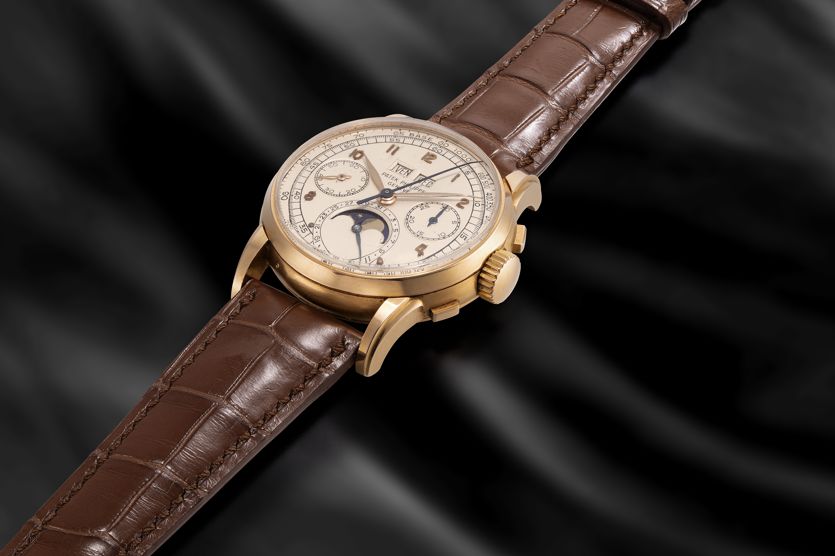
It was May, and in Geneva, Phillips Watches set a new world and all-time record for a single watch auction: the ‘Geneva Watch Auction: XXIII’ raised the equivalent of over 96 million dollars – a figure never before achieved by any watchmaker – with more than 15 lots exceeding one million. Records then followed one after another across different regions, with the Big Apple hosting ‘The New York Watch Auction: XIV’ – the highest-value watch auction ever held in the Americas – and, shortly before that, Hong Kong. In fact, at its Asian outpost, the division sold the most expensive watch ever sold at auction in Asia: a 1951 rose-gold Patek Philippe 2499, ‘The Pink First Series’ (US$10,255,212 at the exchange rate of 31 May 2026). An interesting fact: the watch claimed the title of the second most expensive Patek Philippe ever, by less than ten dollars; it ranks just ahead of the Patek Philippe Ref. 2523 ‘South America World Timer’, which was also sold by Phillips in Geneva three weeks earlier for US$10,247,000.
Photography, multiples, jewellery
With the $645,000 paid for Tina Modotti’s ‘Bandolier, Corn, Sickle’ (1927), Phillips sold the most expensive photograph of the half-year, confirming its leading position in the global art photography market (although the all-time top lots belong to the two major auction houses: the most expensive photograph ever, for example, is a shot by Man Ray sold by Christie’s in 2022). In the multiples and editions sector, there were two ‘white-glove’ auctions. In the jewellery sector, private collections from a single owner performed well – a trend common to all categories and all auction houses – with a 98 per cent sell-through rate and 81 per cent of lots sold above the upper estimates. In Hong Kong and New York, designer jewellery sold out completely, with 74 per cent of lots sold above the upper estimates.

If they cost more than 15 million, they’re sure to sell
At Phillips, too, works of art have continued to prove popular with collectors, particularly at the high end of the market. As CEO Martin Wilson reveals: “Since 2019, we have sold 100 per cent of works with an estimate in excess of $15 million”. The new ‘Priority Bidding’ system has also “boosted sales by generating momentum and engagement even before the first lot was presented, with pre-auction bids more than tripling compared with the same period last year”. The New York Evening Sale of modern and contemporary art in May was a ‘white gloves’ auction, doubling the result achieved in 2025. Leading the sale was the work ‘Sixteen Jackies’ by Andy Warhol. Overall, modern works achieved a sell-through rate of 93 per cent, whilst Impressionist and American works both recorded 100 per cent.
Artcurial: Antiques on the rise, luxury in demand
The French auction house, founded in 2002 (and based in Milan, on Corso Venezia, since 2012), has not yet officially released its results, but Il Sole 24 Ore has obtained a preview. Artcurial’s sales for the first half of 2026 remained broadly stable: €105 million, compared with €104 million last year. The modern and contemporary art segments also showed stability, whilst, as the auction house’s Italia director, Emilie Volka, reveals: “Antique art is becoming increasingly popular, both in terms of paintings and furnishings. Sales of antique art have risen by around 10–15 per cent compared with the first six months of 2025, thanks above all to the quality of the private collections on offer”. In line with this trend, on 22 September in Paris the auction house will dedicate a sale to a collection from the Rothschild family, ‘Le goût Rothschild en héritage. Un pied-à-terre sur le Champ-de-Mars”: furniture, old master paintings, porcelain, decorative objects and rare books, which are expected to boost sales of both antiques and old master art. For now, the highlight of the year remains one of the quintessential vintage supercars, a 1956 Mercedes-Benz 300 SL ‘Seagull’. In January, someone paid 4,407,800 euros for this masterpiece of automotive engineering.

