
Photos, text, productivity and entertainment. This is what Ai Phones really offer
With Apple's entry, we are ready to explain what smartphones enhanced with generative artificial intelligence promise and do.

4' min read
4' min read
It took time, for some too long, for others too little, but in the end even Apple has entered the big tech race for generative artificial intelligence. A market that, according to Counterpoint Research analysts, will dominate the scene in the coming months. The premium segment of smartphones, the models equipped with GenAI, rose by 6% in the first quarter of 2024, i.e. in a period for which the only real big player was Samsung. From there on, the sector has seen the Pixel update with generative artificial intelligence functions, the arrival of the Gemini app also in Italian, the extension of Galaxy AI on models prior to the Galaxy S24, and the faint, but concrete, debut of Xiaomi, Vivo, Honor, Oppo and, above all, Apple, although on iPhones, AI will only make itself known in the autumn and not in all countries.
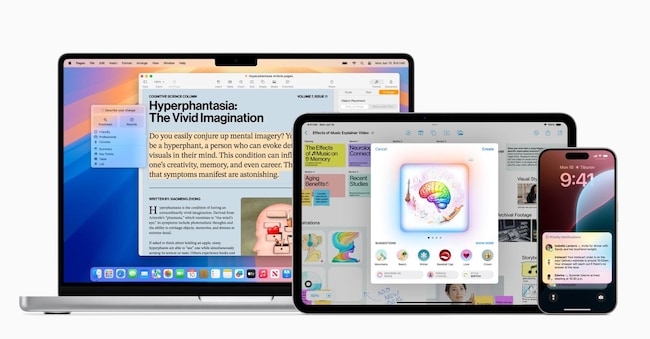
To date, the generative artificial intelligence landscape sees on the one hand the use of tools such as Copilot on the desktop, on the other the editing of photos, incipit for texts and emails and little else on mobile devices. Success will probably be played on the integration of models, openness and the absence of the technological lock-in on which many companies have based their strategies for years. Apple itself has pointed out its willingness to develop Apple Intelligence at the same time as the various partnerships, from the official one with OpenAI for ChatGpt to the possibility of bringing Google Gemini into iPhones.
A heterogeneity of opportunities that does not risk distorting Apple's very absence, quite the contrary. The impression is that Apple Intelligence is the best way to fuse hardware, traditional software and the power of generative artificial intelligence on smartphones. Something that, to date, had only been achieved by Google. It is no coincidence that these are the only two companies that build their products from top to bottom, starting with semiconductors and ending with the release of software updates. In such a scenario, Samsung and Oppo remain furthest behind, despite their evolution work at system level.
Introduced in May, Gemini represents Google's next-generation artificial intelligence. Replacing the previous Google Assistant, Gemini arrives on Pixel smartphones with a wealth of innovative features and a revamped user interface. One of them is the recorder app, which uses generative technology to offer more detailed and accurate transcriptions, including the names of interlocutors and facilitating the summarisation of conversations. Gemini is able to understand the tone of requests and provide relevant search results, suggesting useful actions and information based on activities. It is possible to use the chatbot to create draft emails, social media posts, and respond contextually to conversations via 'Smart Reply' automated responses. It is thanks to Google that there is 'Circle and Search', a way to find online any kind of content that passes by the phone screen, even a YouTube video or a TikTok post, thus obtaining peculiar information via search. With the new Magic Eraser, unwanted elements are removed from photos, with the AI compensating for what is missing while preserving the context. Pixel 8, 8 Pro and 8a are the only models with full Gemini functionality.
Galaxy AI is a set of artificial intelligence features built into Samsung Galaxy devices, including smartphones, tablets and smartwatches. In addition to the usual 'search and search' in collaboration with Google, Samsung has developed specific functions for Galaxy AI, which pervade many apps. The most noteworthy are found in Notes and the Recorder. The latter can transcribe audio files, even those already recorded, translate them into other languages and synthesise them. The same happens with the Notes, where it is also possible to feed the app a very long text, even in Pdf format, to obtain a summary by points. Embedded in the Samsung keyboard, the AI can help when writing a message or an email, choosing the tone. Unique to date is the real-time translation of phone calls, with AI Live Translate Call.

