
Photovoltaics, there is agreement on panels in agriculture
Emergency Decree. Green light for emergency measures. Lollobrigida: 'Stop wild onshore installations and OK for green energy in non-productive land such as quarries and abandoned mines'

3' min read
3' min read
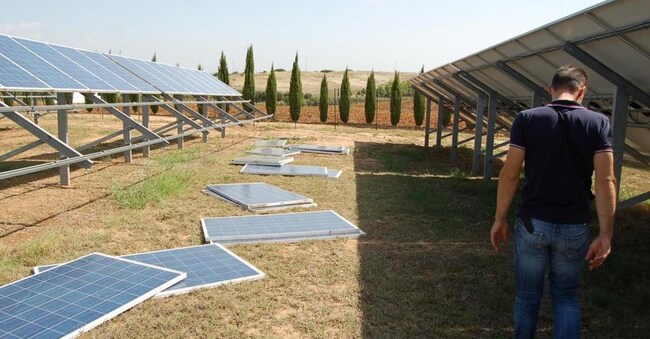
After a tight confrontation between technicians that went on for the entire weekend, an agreement has been reached, albeit a minimal one, on the block on new photovoltaic installations with ground-mounted modules included in the decree on emergencies for agriculture approved yesterday by the Council of Ministers and signed by the Minister of Agriculture, Francesco Lollobrigida. A stop initially not agreed with his colleague for the Environment, Gilberto Pichetto Fratin, and much criticised by sector associations (from Italia Solare to Elettricità Futura and Utilitalia), which contested the heavy repercussions on the development of renewables.
In the end, however, an agreement was reached between the two ministries, which Minister Lollobrigida summed up in the press conference following the CDM as follows. "With this measure we put an end to the wild installation of photovoltaics on the ground and we intervene pragmatically, safeguarding certain areas".
The compromise identified stops the installation of ground-mounted panels on productive land, allowing, instead, the development of renewables in areas such as quarries or mines that have ceased to exist, but also on land at the disposal of the FS group or airport operators, as well as those inside industrial plants or production facilities, including those areas within a perimeter of 500 metres from the aforementioned environments or facilities. Green light, then, to new green plants also in areas adjacent to the motorway network, within 300 metres, and in sites on which plants already exist for reconstruction, modification or overhaul without further land occupation.
With the reformulation, which the technicians worked on, the procedures that have already been authorised are safeguarded, but "a procedure will be needed to assess what to include and what not to include," Pichetto Fratin explained at the end of the CDM, after clarifying that the decree also safeguards the investments envisaged in the NRP, in particular those related to renewable energy communities (Cer). The stop, the decree reads, 'does not apply in the case where plants with ground-mounted modules are the subject of self-consumption and Cer configurations'. Nothing detracts, the Forza Italia exponent then assures, "from the fact that the Pniec to 2030 remains the same with a renewables target on the solar front of around 38 gigawatts". Which, in Mase's plans, should come from photovoltaics in agricultural areas, with an occupation of 0.35 per cent of the total agricultural surface.
The government decree introduced a series of emergency measures to support farms in difficulty. The most important chapter is the moratorium on mortgages for farms that, between wars, production cost escalation and inflation, have suffered a cut in their turnover of at least 20 per cent by 2023. The resources will guarantee a one-year moratorium on loans taken out by the companies and help them meet interest payments.


