
Photovoltaic panels, so the government slows down the development of installations on agricultural land
The latest contradictory signal, compared to the announcements of wanting to run on the road to sustainability and energy independence, is an article included in the draft decree on emergencies in the agri-food sector prepared by the Ministry of Agriculture.
by Laura Serafini
 Aggiungi Il Sole 24 Ore
ai preferiti su Google
3' min read
Key points
3' min read
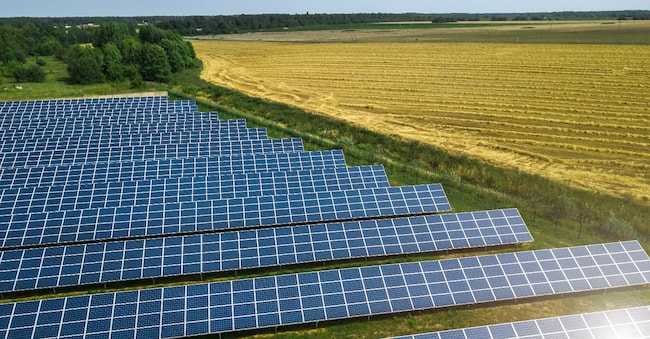
The government pledges to triple Italy's renewable energy targets at the G7 energy summit just concluded at the Reggia di Venaria in Turin. And at the same time it takes a new step to block the way for the installation of ground-mounted photovoltaic systems, the development of which has now been at a standstill for almost two years. The latest contradictory signal, compared to the announcements of wanting to run on the road to sustainability and energy independence, is an article included in the draft decree on emergencies in the agri-food sector prepared by the Ministry of Agriculture.
The draft Agri-Food Law Decree: farmland is not an eligible area
The article seems to enter into the delicate issue of identifying suitable areas, the definition criteria of which are contained in an inter-ministerial decree of the Ministry of the Environment (in collaboration with the Ministry of Culture and the Ministry of Agriculture) that has been in the water for two years. The intention seems to be to overcome all the discussions that have been going on for months between ministries and regions in order to establish that agricultural land is to be considered unsuitable areas. But it is an intent, because in substance the rule does not seem well written. Article 6 states that 'areas classified as agricultural by current urban plans are areas that are not suitable for the installation of photovoltaic systems with ground-mounted modules, as per Article 6-bis, letter b) of Legislative Decree no. 28 of 3 March 2011. The authorisation procedures in progress at the date of entry into force of this decree are concluded pursuant to the regulations in force'. It is not very clear whether the plants in question are already built, because the reference to the 2011 law concerns plants that have already obtained the Dila, the declaration of commencement of work, and therefore have already been built.
Decree on eligible areas at a standstill for two years, regions block plants
In any case, the rule is causing discussion because it was Legislative Decree 199 of 2021, which implemented a European directive aimed at speeding up the permitting of renewable plants, that established the need to set criteria for identifying suitable areas in an inter-ministerial decree. It has been almost three years that there has been a debate on how to identify those criteria, with the regions (which are called upon to give an opinion on the decree) unable to find a balance. So much so that, starting with Sardinia, they have been pushed to issue moratoria of up to 18 months on the authorisation of new plants. The Ministry of Agriculture decree passes over all this and introduces an amendment to the 2021 legislative decree, which seems to establish by law that photovoltaic plants cannot be installed on agricultural land. In fact, this is not exactly the case: because eligible areas are simply areas where obtaining permits is easier and faster, not areas where it is possible to install and others are not.
Draft decree law in the Cdm by mid-May
Moreover, last February's Energy Decree for the first time admitted photovoltaic plants built on land for agricultural use to the incentive auctions. So either the right hand does not know what the left hand is doing, or the interests of the various parties involved are trying to take root in the most sensitive department. Moreover, in an election campaign period. According to rumours, the draft decree-law should go before the Council of Ministers by mid-May, but it is not known whether Article 6 will ultimately be confirmed. Not least because it seems that it is not looked on favourably at the Ministry for the Environment.

