Breeding

Photovoltaics and biogas but not only: how milk co-ops offset greenhouse gas emissions

Guarneri (confcooperative): greenhouse gases produced by animals cannot be compressed but productivity has increased and significant investments have been made to mitigate the environmental impact of stables and dairies
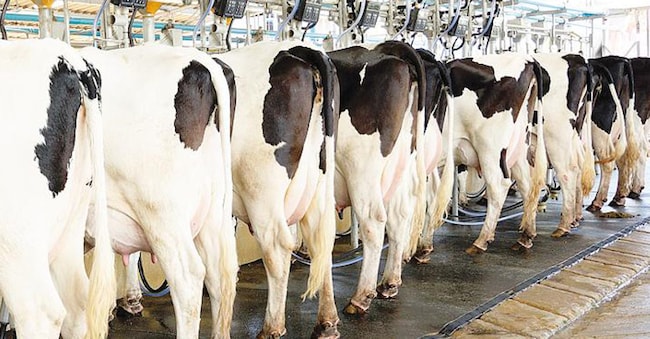
by Emiliano Sgambato

Fanno parte del  sistema cooperativo circa 17mila stalle che producono 8,3 milioni di tonnellate di latte all’anno

4' min read

4' min read

In the breakdown of the amount of greenhouse gas emissions by sector, in Italy agriculture accounts for 8.4%, placing it below manufacturing industry (13.1%) and well behind transport, which pollutes more than 28% of the total. These are the figures released by Ispra (the Higher Institute for Environmental Protection and Research) a few weeks ago. Looking at the last 35 years, however, the primary sector has cut emissions by 15.6% against the average -26.4%, far from the 40% peaks of industry, although still more than the 'Residential and services' category (-12.6%) and better than transport, which has even worsened its contribution.

The finger is often pointed at livestock farms (especially the so-called 'intensive' ones), which account for three quarters of agricultural pollution: 80 per cent of emissions from livestock farms - says Ispra - are divided between dairy cows (35 per cent), other cattle (32 per cent) and pigs (13 per cent).

Loading...

"Emissions from dairy cows and livestock farming in general are related to a biological cycle and not to the consumption of fossil reserves. This is an important difference that is often forgotten,' says Giovanni Guarneri, president of the dairy sector of Confcooperative, 'and when comparing our sphere with that of, for example, industry and transport, it must be considered that it is not possible to change the physiological factors linked to cow metabolism. In short, a farmer cannot change the main production plant, which, let's say, remains the animals. "However productivity and thus the quantity of milk produced per head reared has increased. In the last ten years, Co2 equivalent emissions per litre of milk have decreased by about 20 per cent,' says Guarneri.

Green investments

.

To further limit the environmental impact, with production being equal, all that remains is to compensate for the gases introduced into the environment with the production of clean energy. According to Ispra, 19% of livestock manure from dairy cows in 2023 was sent to anaerobic digestion, so much can still be done on this front.

"Thanks to biogas, some supply chains produce more energy than they consume, and the stables allow large roofs (about 10 square metres per head, ed) for the installation of photovoltaic panels. There has been a strong investment from this point of view, also because more energy is produced precisely when it is warmer and this is used to cool the animals'. Among other things, this increases their well-being and productivity.

"Nor should we forget the efforts made in the dairy processing stages. In addition to photovoltaics," adds Guarneri, "cogeneration plantshave become widespread, combining the need for heat with the need for electricity. In addition, by reusing the water contained in the whey, consumption has been reduced by up to 40 per cent.

What is still lacking, however, is a systematic count of the savings in terms of Co2 equivalent produced by these good practices. According to the Effort Sharing (Esr) 857/2023 regulation, an overall cut across all sectors of 43.7% should be achieved by 2030 compared to 2005 levels.

The 'Think Milk, Taste Europe, Be Smart' project is implemented by Confcooperative with EU co-financing also to promote good practices and communicate the efforts made. "The implementation of sustainable practices," Guarneri continues, "does not end with zootechnical activities alone, but passes through the care and survival of the territories of which the cooperatives are custodians, as well as the small realities located in mountain communities, the valorisation of traditions and the maintenance of employment.

The turnover generated by the cooperative system in the dairy sector is 45% of the total turnover of the sector, which exceeds 17 billion. Approximately 17,000 dairy farms belong to the cooperatives, from which 8.3 million tonnes of milk are collected annually (65% of the Italian total, primarily for PDO).

EU Best Practices and Projects

Paradoxically, with the same production and therefore the same emissions per head reared, it is precisely the larger and more structured farms, often under indictment, that are able to have the financial resources, planning and expertise to carry out sustainability measures. Among the best practices are those of the co-ops Pieve Ecoenergia and Plac Fattorie Cremona.

In the first case, thanks to a biogas plant for the production of electricity, use of digestate as fertiliser, district heating and a photovoltaic plant, the farm was able to maximise synergies to promote animal welfare, sustainability and quality of work for operators. In collaboration with the Milan Polytechnic, a carbon footprint monitoring system per litre of milk has been adopted, which accounts for the CO2 emissions required for production and those recovered thanks to the systems installed: the impact currently ranges from 0.5 to 0.7 kg CO2 per litre of milk produced.

"This is a result that, when compared to data from the scientific literature according to which an average of about 1.37 kg of CO2 equivalent is emitted for every kilo of milk produced, confirms that we are on the right track, even if the future goal is to become carbon neutral milk," says coop president Danilo Federici. "In addition, the introduction of state-of-the-art milking machinery, automated food kitchens, feeding robots and ventilation systems improve both animal welfare and the quality of the operators' work.

Animal Welfare

.

Another important pillar of the 'Think Milk' project is the valorisation of the actions taken to improve animal welfare.
"We chose to draw up our sustainability report before the regulatory obligation came into force," says Cesare Baldrighi, president of Plac Fattorie Cremona, "in order to monitor our work and to adopt or adjust further preventive measures. In 2023 the animal welfare score guaranteed by the member farms (which among other things is linked to an incentive mechanism of differentiated payment for milk, ed.) is clearly growing. And water consumption has dropped by 70% over four years in the largest of the four production plants thanks to a whey concentration plant.

Copyright reserved ©
Loading...

Brand connect

Loading...

Newsletter

Notizie e approfondimenti sugli avvenimenti politici, economici e finanziari.

Iscriviti