Interview

Pianigiani: from parquet to enterprise, the real competitive advantage is knowing how to be a team player

Multi-talented coach combines sports and business experience to teach how to build winning teams and deal with change with management skills and effective communication

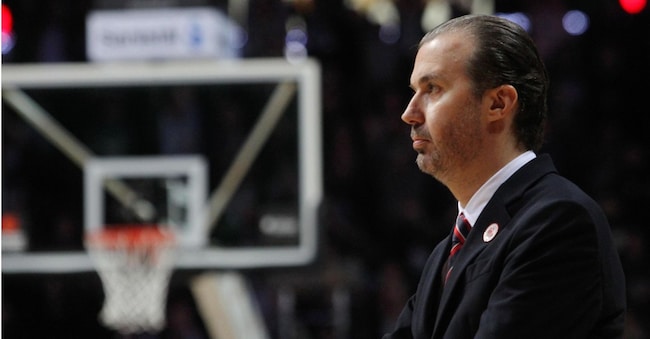
Simone Pianigiani. (Ansa)

4' min read

Translated by AI
Versione italiana

4' min read

Translated by AI
Versione italiana

In the world of sport, as in the world of business, the real challenge is to get to the result. Together. A concept that also finds among its supporters Simone Pianigiani, one of the most successful Italian basketball coaches (twenty titles in four different countries and never an entire season on the bench without raising at least one trophy), who in his first book - "Essere Coach", Roi Edizioni - has built a solid bridge between the dynamics of the parquet and those that characterise the corporate world.

In an era dominated by individualism and the quest for instant gratification, the need to be a team player, to value different skills and to create a collective identity capable of withstanding complexity must be put back at the centre. The book, which opens with a preface by Marcello Lippi, who emphasises the importance for a coach to be a manager of human resources, is a real manual for managers that interweaves episodes from Pianigiani's career with lessons in organisational leadership. It starts from some precise assumptions: sport, once self-referential, is evolving into increasingly articulated structures that require widespread managerial skills; at the same time, companies need to adopt the spirit of sport to face markets and scenarios in continuous and rapid change. What emerges is a topical reinterpretation of the fundamentals needed to achieve results, namely effective communication, empathy, trust, the ability not to stifle talent and the ability to build a winning mentality from day one.

Loading...

The former coach of Olimpia Milano and the national team, guides us to explore the key themes of teamwork (motivation, organisation, change management, conscious delegation, cultural sensitivity), offering concrete parallels between the 'machine that never stops' of a professional basketball team and the needs of modern businesses

In the book we read that pachydermic organisations, slow in their reaction times, are no longer suitable for constantly changing scenarios: the solution to adapt?

Let us make a comparison with sport, which has had and still has its criticalities, such as being self-referential. The key point is that different skills are needed, because scenarios change and so do the people one has to deal with. What the two worlds have in common is the need to arrive jointly at a result: we live in a society that is perhaps the most individualistic ever and in which individual satisfaction always wants to be immediate. Never before has there been such a need to arm oneself with different skills and to create a good team spirit. The solution to the great need for flexibility and dynamism is to welcome new talents and not leave them to their own devices for lack of regular evaluation of their level. Every opportunity for confrontation is a chance to improve the way of working, but not all organisations have the courage and the ability to really launch young people and put them to the test in the field, putting them in the team game in a position to give their best and to do the right thing, including through a direct and decisive approach.

To make a (good) team, is a good leader or good players more important?

It takes both. The figure of the leader is the one who is responsible for getting the people who have to work and perform together to express and interact in the best possible way. Teamwork enhances the merits, the strengths, and covers the flaws, the weaknesses, because the end result is not the summation of everyone's talent. To do this requires great energy and conviction on the part of the leader, starting with the concept that teamwork also benefits the individual. And this happens in a team and in an organisation. Is it easier to do this in a start-up? Yes, because it goes in the direction of an enterprise that is born and has a dream to create something. But the concept is also the same in a large organisation that is made up of several working groups and departments and wants to innovate and change. Each micro-working group must have a dream and a goal, have a leader and individuals who must work as a team: a team is a delicate mechanism in which a thousand factors and a thousand professional skills converge.

Is it more difficult to be a leader today or 20 years ago? 

It is always difficult to manage people. Today the complexity is the continuous media exposure, the acceleration and frenzy dictated by technology and social media. Today is certainly different than before, not least because of generational values that change very quickly and impose constant challenges in the need to evolve and shape oneself, to continuously improve. The key is to get out of the comfort zone to acquire new skills and upgrade the level of the challenge. Think about what it means to win and win again in sport, knowing that winning again is much more difficult.

The prerequisites for being a successful 'coach'...

Each one of us is a coach and, as such, must have specific characteristics, from the ability to communicate effectively to that of maintaining a high level of attention, from the awareness of not 'doing too much', giving too much information and creating confusion, to the ability to create empathy and relationships based on mutual trust. And then the fundamental skill, that of never stifling individual talent. Whether a sports coach or a company manager, a leader cannot know everything, he must have the ability to find and coordinate people who work with him with specific characteristics and to whom he entrusts responsibilities. In a group there are different figures and all of them must be put in a position to express themselves, while the leader is left with the task of creating a positive climate, of reading the emotional intelligences of the people working with him, of thinking transversally.

You spoke of effective communication, what exactly do you mean?

A number of factors. A change, for example, must be clearly explained and transferred from the leader to the group to avoid distorted interpretations. Effective communication is also the act of courage required to delegate an important decision to one's co-workers. And finally, cultural sensitivity, which means being able to understand and respect the different cultures to which team members belong and their modes of expression.

Copyright reserved ©
Loading...

Brand connect

Loading...

Newsletter

Notizie e approfondimenti sugli avvenimenti politici, economici e finanziari.

Iscriviti