
Picasso, the 'brilliant kleptomaniac' who loved circus and theatre
The 'Theatre Picasso' exhibition is at the Tate Modern until 12 April

One of the first disconcerting images in the Theatre Picasso exhibition at Tate Modern is a film from 1937, signed Man Ray, showing the Spanish artist smoking disguised as Carmen. In another photo taken thirty years later he is shirtless, with a large minotaur head on his shoulders. Picasso in a way always acted, skilfully constructing the character of the creative, unpredictable, famous and omnipresent yet mysterious artist.
His Spanish origins, his love for theatre, circus and dance, especially flamenco, have been a constant in an ever-changing artistic trajectory. The ingenious kleptomaniac has been able to borrow elements from all the arts and many cultures to interpret them, use them and, by phagocytising them, make them his own. This is why the Tate has created the most scenic of exhibitions, which takes us from a dark entrance through a labyrinthine backstage route to the stalls, from which we can look up at the stage, where instead of actors and actresses we see Picasso's paintings and a film of him drawing and painting for the camera.
The artist's vast oeuvre
The exhibition route deliberately does not follow a chronological order, but explores different themes in Picasso's vast oeuvre. Such as his obsession with women, the models and life companions ceaselessly portrayed but also dissected, twisted, dissected, dissected and then reassembled in an attempt to understand (or perhaps subjugate) them. Or his interest in violence, from the brutal spectacle of bullfighting to the tragedy of war. And of course his love for dance, with his collaboration with the Ballet Russes company, and theatre, and in particular the commedia dell'arte and the tragicomic character of Punchinello.
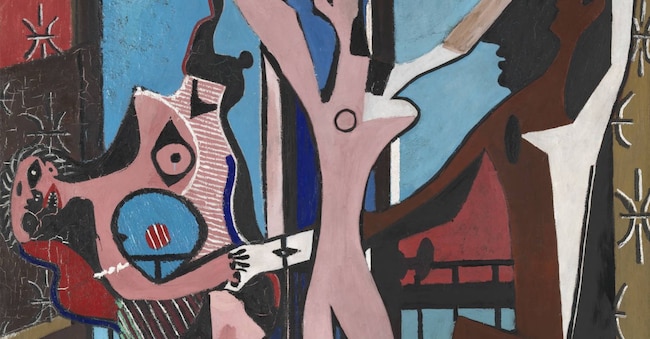
The pièce de résistance of the exhibition is The Three Dancers, an extraordinary painting painted a century ago that manages to express the ecstatic joy of dance and at the same time allude to tragedy. Picasso at the time was mourning the death of his friend Ramón Pichot.
The Acrobat, from 1930, shows a human figure bent in an impossible contortion, reduced to the essential in black and white. In a way, the painting can be seen as a self-portrait: the acrobat constantly experiments and pushes his body to its extreme limits, just as Picasso always continued to break taboos and search for new forms of artistic expression.

