
Pichetto Fratin: 'Decree on eligible areas in early July on renewable changes'
The Environment Minister's speech together with the CEO of Terna, Giuseppina Di Foggia. "Investing in networks to keep pace with the green transition".

5' min read
Key points
- Pichetto Fratin: Tar intervened to say regions have plenty of space
- Di Foggia: working with Mase, distributors and operators on shared solution
- Pichetto Fratin: agreement reached with EU on energy release
- Di Foggia: 2.3 billion investment for network security
- Pichetto Fratin: nuclear power needs to work on several fronts
- Di Foggia: don't give up renewables, diversification guarantees security
5' min read
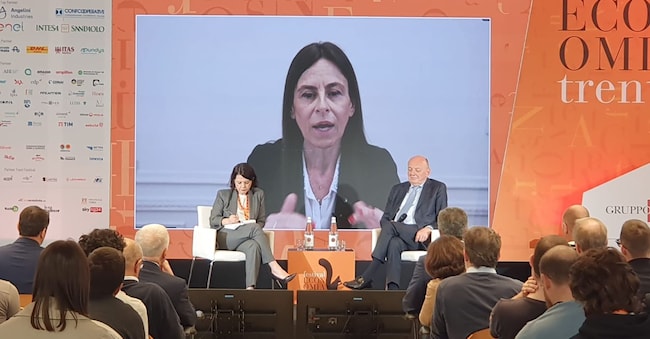
On the issue of suitable areas, after the rejection by the administrative judges, he is confident that he will 'be able to have a debate by mid-June in order to arrive at my decree in early July, also because I have to sign it before 12 July'. While, on the subject of virtual network saturation, the deadline is much tighter ('the measure is ready and will be included in the first useful vehicle'), as well as on nuclear power, where the proxy bill is expected to reach parliament shortly. "It is ripe for passage through Parliament in a few days, which then dictates the timing on its own and on this the government cannot intervene". In front of an audience at the Trento Festival dell'Economia, organised by the 24 Ore Group and Trentino Marketing on behalf of the Autonomous Province of Trento, the Minister for the Environment and Energy Security, Gilberto Pichetto Fratin, dictated the government's forthcoming agenda, speaking together with Terna's managing director, Giuseppina Di Foggia.
Pichetto Fratin: the TAR intervened to say that regions have so much space
The stringent topicality, with the recent pronouncements of the Regional Administrative Court of Lazio, immediately calls for reflection on the next developments in renewables with a decree to be rewritten and the risk, as feared by the minister himself, that the regions will go in no particular order with respect to the path that will allow the green targets to be met. "Normally the regions protest because they do not have much space, and this time the Regional Administrative Court has intervened to say that we have given them too much space," the minister notes. "The call is to be more stringent and from the next day we are at work to draw up the first adjustment document, I have contacts with the regions to see us all and find solutions."
In short, times must necessarily be tight, also because the road ahead is long and winding. The Pniec requires us to install a further 64 GW of photovoltaic and wind power plants compared to the 43 GW in 2023, and so, says Terna's CEO Giuseppina Di Foggia, we need to speed up. "In the last three years we have observed a marked increase in renewable energy sources. Between 2014 and 2021, the installed power had been about 1 GW per year, starting in 2022 there was a remarkable progression: 3 GW were installed in 2022 and we then doubled the bar in 2023, reaching 5.7 GW in 2023 and almost 8 GW in 2024. From January 2022 to today, therefore, the increase in installed renewable capacity is 54%. These are significant numbers,' notes the top manager, 'which give the dimension of what we have put in place and give us confidence that we can achieve our ambitious targets.
Di Foggia: working with Mase, distributors and operators on shared solution
Di Foggia also recalls, then, the high number of grid connection requests (354 GW to which 42 GW from data centres are added) that re-propose the theme of virtual grid saturation with Terna, which, as is well known, had proposed a change of approach to manage these instances more efficiently. "We are working with Mase, distributors and operators to find a shared solution to virtual grid saturation," says Terna's CEO, who then returns to the approach proposed by the grid operator and based on dividing the territory into 76 micro-zones. "We are convinced that this is a valid tool for ensuring efficiency in the implementation of the works enabling the connection of new resources, minimising costs for the system and the impact of the infrastructure on the territory," the top manager clarifies.
As Pichetto Fratin goes on to explain, a substantial change of direction will be incorporated in the forthcoming measure. "The micro-zonal approach does not change," explains the minister, "The amendment was stopped because it only concerned the high voltage grid and it was necessary to hear the opinion of the medium and low voltage grids. And the table he himself wanted worked on a solution that safeguards the proposal put forward by Terna.


