
Pierantozzi wins the Strega Deutschland prize and celebrates his 80th birthday alongside the Italia Republic
The winner of the 80th award will be announced tomorrow in Piazza del Campidoglio. The shortlisted candidates are Teresa Ciabatti, Michele Mari, Matteo Nucci, Bianca Pitzorno and Elena Rui. Sales have soared following the shortlist announcement.

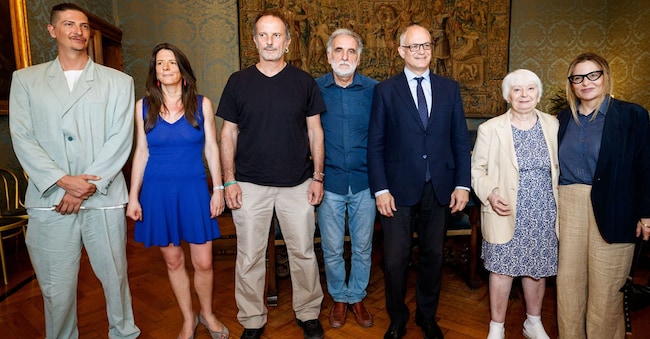
Alcide Pierantozzi is the winner of the first Strega Deutschland Prize, a new initiative of the literary award ‘founded 80 years ago, alongside the Italia Republic’ (as highlighted by the president of the Bellonci Foundation, Giovanni Solimine). His raw autobiographical novel *i* *Lo sbilico* (Einaudi), which succeeds in conveying what it means to be neurodivergent, to suffer from mental health conditions, and to live a life dominated by medical treatment and in isolation because there is neither understanding nor solidarity towards those considered ‘different’, was selected by 70 lecturers and students of Italian studies from eight German universities.
The press conference to announce the event was held at the Campidoglio, in front of the square where a few workers were busy setting up the stage for tomorrow evening’s event. It is here, in fact, that the winner of the most famous prize for Italian fiction will be announced. This venue differs from the traditional Nymphaeum at Villa Giulia and was chosen to symbolically emphasise the link with the city of Rome. “It is a responsibility,” said Mayor Roberto Gualtieri, “to host the 80th edition of a prize at the Campidoglio that has spanned the history of the Italian Republic, accompanying its birth, its growth and its consolidation, becoming the country’s leading literary prize and fuelling an intellectual debate that has been intertwined with the events of our history and has enriched them.”
To mark the occasion, an agreement was signed between Roma Capitale, the Bellonci Foundation, and Strega Alberti Benevento, which provides for support for the Prize amounting to 50,000 euros a year for three years, as well as various initiatives, for example at the Casa delle Letterature and in Rome’s libraries, where members of the public will be able to meet the authors and where reading groups will be able to vote to select the winners.
Libraries, which are “a widespread cultural institution”, are something that Mayor Gualtieri said he cares deeply about and for which he has launched numerous modernisation projects: ‘Our libraries will increasingly become a forum for debate, discussion and social interaction,’ he said, emphasising how the city is discovering a love of literature that exceeds even their expectations, referring to the ‘La Tempesta Silenziosa’ initiative which, on 17 June, saw tens of thousands of people gathered at sunset in over 300 locations across the city to read in silence and simultaneously The White Nights by Fyodor Dostoevsky, and to the success of the Letterature festival: ‘We need to engage with language,’ he said, ‘with literary form, and with the themes explored in novels. It is a sign of a reaction to the way we are being sucked into a digital language. It reflects a need for a relationship with reading, for more thoughtful reflection. The Strega Prize allows authors to engage with the public and creates a forum for literary discussion – something there is a great need for – which this year has been filled with works of the very highest calibre.”
The shortlist includes Teresa Ciabatti, with Donnaregina (Mondadori); Michele Mari, with I convitati di pietra (Einaudi); and Matteo Nucci, with Platone. Una storia d’amore (Feltrinelli), Alcide Pierantozzi and Bianca Pitzorno, with La sonnambula (Bompiani), and Elena Rui, with Vedove di Camus (L’orma).


