
Pietro Rescigno, a leading authority on Italian civil law, has died
He was Professor Emeritus at the ‘La Sapienza’ University of Rome, where he taught from 1970 to 2005, a national member of the Accademia dei Lincei, and in 2014 he was awarded the title of Knight Grand Cross of the Order of Merit of the Italian Republic

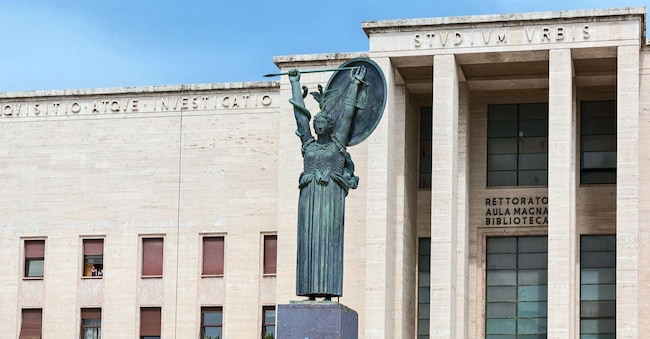
The legal scholar Pietro Rescigno, one of the great masters of Italian civil law, regarded as one of the most authoritative civil law scholars of the 20th century and author of a monumental work on private law, has died at the age of 98 in Rome. He was Professor Emeritus at the ‘La Sapienza’ University of Rome, where he taught from 1970 to 2005, a national member of the Accademia dei Lincei, and in 2014 was awarded the title of Knight Grand Cross of the Order of Merit of the Italian Republic. The distinguished civil law scholar, as reported by Adnkronos, passed away today at the Gemelli Medical Centre, where a lying-in-state will be held from 9.30 am on 26 August until 9.30 am on 28 August. The funeral service will be held at 11.00 am on Friday 28 August at the Church of the Divine Wisdom at Sapienza University of Rome. “Bye, Dad. I’ll miss you,” wrote his daughter Francesca Rescigno on social media. .
A point of reference for generations of students
Generations of law students have been educated using Rescigno’s civil law textbooks. In ‘Introduction to the Civil Code’ (Laterza, 1991), Rescigno provided a critical assessment of the fifty years of its application and traced its developmental stages. By examining the individual books of the Code and in the light of the Republican Constitution and special laws, Rescigno, whilst aware of the diminishing ‘centrality’ of the Civil Code within the legal system, drew a positive comparison between the enduring relevance of the solutions adopted by the 1942 codification in certain areas and the sometimes radical transformations that had taken place in others. Born in Salerno on 15 January 1928, he graduated in law from the University of Naples in 1948, having studied under Francesco Santoro-Passarelli and Alessandro Graziani,
Rescigno began his academic career in 1952, teaching civil law at the University of Macerata and subsequently at the universities of Pavia and Bologna, before finally taking up a post at ‘La Sapienza’ in Rome in 1970. Co-editor of several leading specialist journals in the field (Rivista di Diritto Civile, Giurisprudenza Italiana, Rivista di Diritto Commerciale, Il Diritto dell’Informazione e dell’Informatica, Gius, Rivista Critica di Diritto Privato), he was editor of the Biblioteca di Diritto Privato, the Civil Law section of the Enciclopedia Giuridica published by the Istituto dell’Enciclopedia Italiana Treccani, the Trattato di Diritto Privato, and the Trattato dei contratti co-authored with Enrico Gabrielli.
Solicitor since 1951
Rescigno was a member of the Academy of Sciences of the Institute of Bologna, the Venetian Institute of Sciences, Literature and Arts, the Pontaniana Academy in Naples, the Lombard Institute of Sciences and Literature, the Peloritana Academy in Messina, the European Academy, and the Italian Arbitration Association, where he chaired the Scientific Council. He was also president of the Scientific Committee of the Italian Institute for Philosophical Studies in Naples and a member of the National Committee for Bioethics from 1990 to 2006. He served on scientific commissions and committees at the Ministry of Justice and at other state and international organisations. From 1951, he also practised as a lawyer. Rescigno was editor of the *Treatise on Private Law* (23 volumes, 1982–88, Utet).
In his early works, he examined the natural causes limiting a person’s capacity (“Natural Incapacity and Performance”, 1950) and undertook studies in the field of succession (“Interpretation of Wills”, 1952) and on the law of obligations (“Studies on the Assumption of Debt”, 1958). His wide-ranging interests also included the study of modern trade unionism (“Trade Unions in the Modern State”, 1965) and the property aspects of family law (“Lectures on Property and the Family”, 1977). Other notable works include: ‘The Individual and the Community’ (1966 and subsequent editions); ‘Handbook of Private Law’ (1973 and subsequent editions); ‘The Abuse of Rights’ (1998); ‘Marriage and the Family: Fifty Years of Italian Law’ (2000); ‘Damage Arising from Procreation and Other Writings on Ethics and Law’ (2006); ‘Individuals and Social Groups’ (2006). The academic has been awarded numerous honours in Italia and abroad, including an honorary doctorate in law from the University of Bologna in 2001 and the appointment as honorary professor at the University of San Marcos in Lima and the Externado University in Bogotá. (by Paolo Martini)

