
Sam Altman’s Pinocchio as seen through the eyes of Luca Guadagnino
The highly anticipated *Artificial* wins over the New York Film Festival

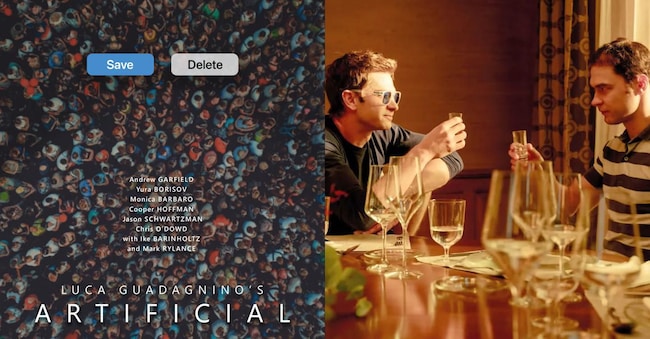
New York – “Do you remember the three qualities Pinocchio needed to become a real boy? To be honest, kind and selfless.” 2003, University of Toronto. Ilya Sutskever (Yura Borisov), then aged seventeen, burst into the lecture theatre of Professor Geoffrey Hinton, the “Geppetto of artificial intelligence”, a Nobel Laureate in Physics awarded by the Royal Swedish Academy of Sciences, in search of a job as a research assistant. Hinton (Mark Rylance) sends him away, inviting him to come back a few days later. Ilya reappears – no sooner had he closed the door behind him – and writes an equation on the blackboard that had taken the professor five years to work out. It is Hinton’s love for Pinocchio and for his status as a puppet ‘in the land of hope and equality’ that heightens *Artificial*’s focus on reality. In the words of Mariuccia Ciotta when she reviewed the 1940 Disney cartoon – “Walt’s Pinocchio is caught in a double trap, being made of wood and paper, and his aspiration to escape the coldness of inanimate matter makes him a hero of Wonderland” – we glimpse the blind force of Brotopia – the Silicon Valley of toys – rising above Wall Street, the cloud and hardware.
John Carpenter
A joke or a John Carpenter-style nightmare? The horde of mischievous youngsters who dream of creating a ‘Matter’ in the lab – which could soon turn us all into donkeys – results in news stories like the one from a few days ago: Amazon has waived its confidentiality agreements with the authorities to launch the Data Centre Commitment programme and ensure greater transparency on energy and water consumption. The company will also invest $1 billion over five years in host communities, whilst leaving some doubts unresolved regarding the actual energy consumption of AI chips and the specifications of emergency generators. Coincidence?
Luca Guadagnino
Premiered worldwide at the New York Film Festival, Luca Guadagnino’s film is accompanied by a certain sense of vertigo. Produced and directed under the auspices of Amazon MGM Studios (with a budget of $40 million), its plucked, twangy and acidic soundtrack resembles a Silly Symphony in three-strip Technicolor, such as that used in Flowers and Trees (1932), where the line art blends with shaded colour fields, watercolour backdrops and painterly nuances. A journey into the origins of OpenAI, from visual three-dimensionality towards the platform’s inner workings. Guadagnino’s Multiplane Camera looms menacingly over CEO Sam Altman (Andrew Garfield) and co-founder and former Chief Scientist Ilya Sutskever. It imbues them with a sense of contemporary relevance and a mythical narrative, both plausible and impossible. Hinton espouses a model of growth based on truth, patience and moderation; his protégé responds with anger and frustration. When Sutskever meets Altman, he becomes convinced he has found his cosmic twin who will help him realise his dream of an artificial intelligence ‘capable of eradicating human suffering’. As soon as the relationship breaks down, Sutskever leads a coup that ousts Altman as CEO, only to see him regain control a week later.
Speaking of ‘control’, the film was offered to other distributors after Amazon decided that it wasn’t appropriate for a tech company to distribute the finished film. Could this have anything to do with the fact that OpenAI has committed to spending $100 billion over eight years to purchase cloud services and computing power (using Trainium chips) from Amazon? Guadagnino is cautious on the subject. He has previously worked with the studio on *Suspiria*, *Challengers* and *After the Hunt*. The person speaking most openly on the matter is producer David Heyman, who believes that Amazon was undoubtedly in limbo because of its investment in OpenAI, but credits the company with allowing the film to find another distributor, another home, rather than shelving it. At six o’clock in the morning on a Wednesday in June in Century City, a group of Neon executives gathered at CAA’s headquarters for a secret screening. When *Artificial* appeared on screen, ‘for sale’ as if it were an Nvidia chip, the independent studio led by Tom Quinn beat its competitors (Netflix, Searchlight and A24) to the punch and snapped it up. In Italia, we’ll see it on 20 January, distributed by I Wonder Pictures.
*Artificial* not only explores the relationship of love and manipulation between Sam Altman and Ilya Sutskever, but also arrives at a time of intense ‘synthetic’ alchemy, spearheaded by Alex Gibney’s documentary *Musk* and followed by Nathan Fielder and Lance Oppenheim’s film about Elizabeth Holmes, You Can See Everything, right through to the sequel to The Social Network directed by Aaron Sorkin. Perhaps it is precisely Garfield’s demonic eyes – bright and shifting – and that sociopathic, wizard-like madness, that serve as a torch within the landscapes possessed by Karl the Fog in which we live, and in the flashback through the twenty-year chronicle of machine learning and technological recklessness. It is no coincidence that Guadagnino opens the film on the Golden Gate Bridge, the ‘gateway’ to the entire San Francisco Bay Area; linking the financial and residential heart of San Francisco with the major campuses of Silicon Valley to the south (Google, Apple, Meta, NVIDIA) and with the biotech/software hub of Marin County to the north. It is the daily crossroads for thousands of engineers and managers. In the opening credits, however, a magnificent urban dream unfolds, featuring the colours and murals of Coit Tower – created in 1934 by artists (including Bernard Zakheim) inspired by Diego Rivera’s Mexican muralism – depicting scenes of working-class life, workers’ strikes, the Great Depression and social protests. For decades, they were considered so radical that they risked censorship. Guadagnino weaves them into today’s San Francisco with flashes of zombies: buckets of fentanyl, homeless people wearing VR headsets, lost souls appearing and disappearing in the Tenderloin and parts of the SoMa and Civic Centre districts. A funhouse within a bubble of fog, even though Guadagnino shot much of *Artificial* in northern Italia (Piedmont and its industrial archaeology as a symbol of utopia). Between the Golden Gate and the tarmac lies the entirety of Altman’s horror parable.

