
Pistoletto and the dialogue between art and religions

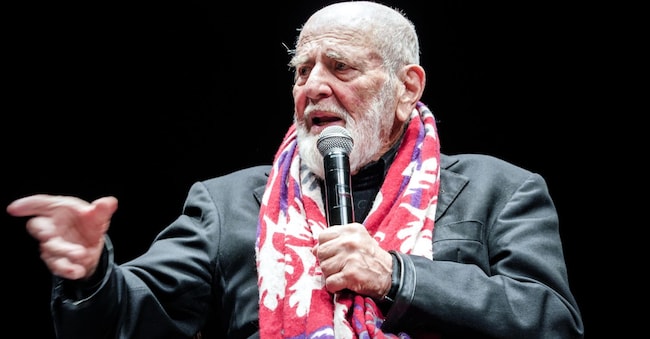
The responsibility of art is the theme of Michelangelo Pistoletto's new exhibition entitled UR-RA, an acronym for Unity of Religions - Responsibility of Art. The exhibition is staged in the Villa Reale in Monza, a place that offers an aesthetic experience in itself. The spirituality, expressed by the artist's works, is combined with the magic of the place: suddenly, the visitor finds himself before the magnificence of a building, whose refined sumptuousness harks back to 1777, the year in which, at the behest of Maria Theresa of Habsburg, the imperial architect Giuseppe Piermarini was commissioned to build it. The Villa Reale becomes a veritable device capable of both hurling us into another era and dialoguing with the immanence of the present through Pistoletto's contemporary works. It is Friday 31 October when I arrive at the vernissage; right at the entrance is the Maestro, who awaits me smiling in his splendid 92 years, bestowing smiles and handshakes on all his guests, flanked by the loving gaze of his wife Maria Pioppi (an artist herself) who discreetly but attentively watches over him, so that those handshakes do not suddenly become too many. I am greeted by Francesco Monico, curator of the exhibition. It is certainly no coincidence that the artist has chosen the Villa Reale as exhibition space. An implicit theme in his artistic production concerns the ability of art to open spaces of freedom and mutual understanding between different religions and cultures, between distant times and places. In this perspective, the rooms of the Villa Reale become living places, capable of welcoming and transforming, spatio-temporal portals that break free from everyday life to provide an elsewhere in which to think and act together. In the mirror paintings that have made the artist famous, the spectator enters the work with his or her subjectivity reflected in the mirror, transforming Umberto Eco's Lector in fabula, that Impliziter Leser of Iserian memory that we have loved so much, into concrete artistic practice. But in doing so, Self-Portrait with Notebook (2017) becomes in turn a spatio-temporal portal, in which time dilates to embrace both the time of realisation of the work itself and all the subsequent times of its fruition; the same applies to space. The aesthetic game desired by the artist in the mirror paintings consists, in this case, in making the wooden walls of certain rooms enter inside his mirror paintings (Sacred Conversation - Anselmo, Zorio, Penone) in a game of continuous cross-references between the end of 1777, his 1974 work and 2025, in which it is I with my subjectivity who crosses the threshold of his time machine. The magic of the place amalgamates with the magnetism of the exhibited works, giving them a further trait: that of an artistic value capable of expressing the universal values of humanity, as the great Czechoslovak art theorist Jan Mukařovský would have liked. The works on display trace the various stages of his artistic production; I am particularly struck by the work entitled Trumpets of Judgement (1968) which, with its sonority, seems to teleport visitors to an elsewhere, where the human condition can be explored. The artist returns with the wisdom that comes with his maturity to question the need for that 'preventive peace' to which he had dedicated the exhibition at the Palazzo Reale in Milan in 2023. Can art build a space of freedom where thought can freely express itself, where religions can dialogue in the interculturality of their mutual sacred symbols? What is the true responsibility of the artist? It consists in producing that imagery that allows the human to transcend its nature to reach the divine. Religion reminds artists that human finiteness can be transcended, to complete the destiny of the human condition itself. For its part, art claims critical freedom and creative capacity. This is the profound meaning of this unusual phrase that the artist entrusts to a huge white panel with a large cursive inscription running across it: 'Is there god? Yes, there is' which, far from being a theological statement, allows the individual to stand on the threshold of the divine mystery. The 'Third Paradise' in the Giardini Reali is made up of one hundred benches, in recycled material, which intertwine to form that symbol, more important today than ever.

