
Places where safari speaks the language of sustainability
Respect for nature and rights are prioritised with careful management of resources, projects dedicated to local communities, tours for the disabled for an increasingly responsible experience
by Sara Magro
4' min read
Key points
4' min read
The safari is the model of the perfect trip. The original meaning of the Swahili term (derived from the Arabic safara 'to travel'), referring to expeditions to Africa to hunt ferocious beasts, has now expanded to describe a slow way of observing places, landscapes and the life that goes on within them. In fact, the definition has now also been adopted for all kinds of adrenalin-pumping adventures, from underwater explorations to off-piste skiing in the Dolomites, all of which share an extreme, strong, dominating nature. What is certain is that 'safari' is an experience that takes one out of the comfort zone and offers a confrontation with something much bigger, a change of perspective in looking at the world, whereby watching a lion mauling its prey together with its cubs can be a lesson in savannah life, not necessarily a gruesome image.
Experiences
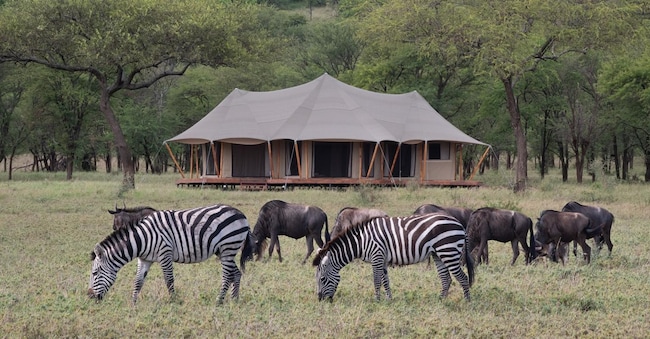
.Safari is also synonymous with sustainable travel: in many lodges, unnecessary luxuries (such as caviar and Champagne) have been done away with without sacrificing the comfort of a hot shower in one's own tent, and the owners are much more aware of the fragility of the environment and fauna, their true heritage and as such to be protected. Those who travel several hours to reach remote places, paying high sums of money, expect to find the enchantment they dream of: wild animals in action, endless horizons, starry skies. And it is a traveller who, more sensitive to environmental urgencies, chooses ethical operators who work with the local population, fight poaching, reduce the consumption of resources, in short, make courageous and innovative choices. The group includes Kantabile Afrika, in the Serengeti National Park in Tanzania. Here, sustainability is ironclad. It all started in 2019 with a strip of land, where Vivian and Godwin Temba moved, to live in a tent without electricity or running water and to travel only by bicycle. Their plan was to offer an essential safari: 'We don't even have a swimming pool so as not to waste water, which is precious for agriculture and for the animals,' Vivian explains. 'We come here to watch the Great Migration, with millions of wildebeests, zebras and antelopes swarming continuously in search of new pastures and, indeed, water. The spectacle begins as soon as you wake up, looking out from the raised tents of the two solar-powered camps, Cherero and Aurari, and continues with off-road tours through grasslands, forests and savannahs. Vivian and Godwin have chosen to have a team of African women in key roles and are part of Regenerative Hotels, whose mission is to empower travellers, businesses and communities to build fair and eco-friendly tourism.
Favouring those with disabilities
As an extreme trip, safari is difficult for those with some form of disability - 15% of the world's population. This is why in 2003 Mike Hill, a ranger since he was 18 years old, founded Endeavour Safaris, which offers accessible expeditions to Namibia, Botswana and South Africa with specially designed tents and off-road vehicles equipped with hydraulic wheelchair lifts. Trips are also organised for people with visual and hearing impairments, who need oxygen and for dialysis patients, with a wider portfolio of facilities as more and more camps and lodges have equipped themselves to accommodate these special travellers.
In addition to famous destinations such as those just mentioned, there are lesser-known but equally fabulous ones, such as Zambia, an economically and politically peaceful country. With 20 national parks and 34 wildlife reserves, it is among the few to have a population of more than a thousand lions, over a hundred leopards and countless wild dogs. The camps, however, are few. Only eight in the immense Lower Zambezi Park, which means that no other tourists come within miles. Among them is Anabezi, founded by Shaun Davy, brother of Chelsy, entrepreneur and ex-girlfriend of Prince Harry: it offers 12 tents without a single wall, is 100% solar powered, is famous for its walking safaris and for its projects dedicated to the local community, such as the 'washing station' where dishes and laundry can be washed without polluting the river, and a regenerative agriculture programme that provides training, the supply of seeds and the guarantee to buy the harvest. The camp is set in an enchanting landscape, between the river and a forest, the result of the reclamation of a marshy area by the construction 65 years ago of a dam on the Zambezi River. Just sit on the veranda and watch a live documentary every day.
Agricultural Conversion
.Tarquin and Lippa Wood's is instead a story of the conversion of farmland into wilderness in Kenya's Masai Mara National Park. Once the fences were removed, the trees grew back and the animals - felines, rhinos, gazelles - returned. The Wood's then rented more land from 700 Maasai families and founded Enonkishu Conservancy, which has already invested more than a million dollars to make ecosystem protection coexist with Maasai agriculture and livestock farming. The estate houses a 10-room lodge by the river (House in the Wild), one on the hill with views as far as Tanzania (Wild Hill) and a number of villas with a swimming pool, tennis court and gymnasium managed on behalf of other owners. A perfect place for those travelling with children, who here, among lion kings, rhinoceroses and other cartoon animals, can see the effect up close.

