Astronomy

Planetary alignment scheduled for 28 February
by Leopoldo Benacchio

4' min read

Translated by AI
Versione italiana

4' min read

Translated by AI
Versione italiana

The sky in this February is prodigious with spectacles: an eclipse of the Sun, which we will only see on TV or via the web, and a spectacle of no less than six planets that will 'dance' in the sky for two three days at the end of this month.

Beware, however: an inaccurate report is being propagated on the Net, namely that the planets will be, in the sky, aligned. Not this time, apart from the fact that the arrangement of stars and planets in the sky is two-dimensional, hence apparent.

Loading...

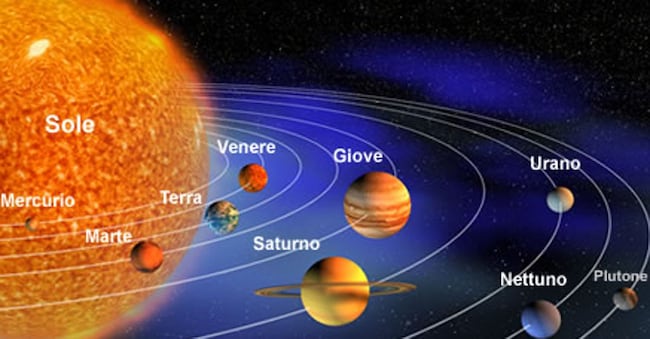
The planets of the solar system do not stand on the same plane, like walnuts on the dining table, they only appear to be aligned at times, but that is the perspective from which we see them. The alignment is therefore an apparent thing, but not a real one, even though it is a situation that astrologers like a lot, it is trivially not true. They all revolve around the Sun, but their orbits are inclined differently from each other.

As far as the parade of planets in the sky on 28 February is concerned, we will have a great absentee: Mars. As we shall see, some will be difficult, but not impossible to see with the eye, but with binoculars we will also be able to enjoy the spectacle of Saturn, for example, with its closest satellites, discovered by Galileo Galilei between 7 and 10 January 1610.

To observe the spectacle, remember the main point. if there are no clouds, it is best to find a slightly dark place from which you can see a fairly clear horizon and wait until dark, the spectacle begins immediately after sunset, so there is no point in looking beforehand.

Now that we have specified the scene, let us see the actors, in order of distance from the Sun: Mercury at the end of the month will be faint in brightness, so difficult to see except with the help of an amateur telescope.

Venus, on the other hand, will be clearly visible; it is still the brightest object after the Sun and Moon. There are several reasons why it is brighter, but not to be forgotten is the decisive effect of the thick atmosphere that makes the planet a veritable greenhouse, with temperatures reaching hundreds of degrees. The solar radiation reaches the ground, but cannot get out: this is the greenhouse effect, which causes warming.

If we have a small telescope, or are in one of the many amateur observatories in Italia, finding Mercury will be easy because, at the end of the month, it will be very close to the shining Venus.

Jupiter, the giant planet, can already be seen at its peak on these nights and as early as January 2026, at sunset on 28 February it will be high and clearly visible to the east, on the side where the Sun has set.

Saturn will be visible at the end of the month above Venus, and thus as we said also Mercury, but it will be low on the horizon; therefore, a clear and unobstructed horizon is recommended, sea or plain better.

To see the magnificent rings of the most elegant planet, you will need a telescope, or a good pair of binoculars, perhaps the mountain ones. Let us remember that even Galileo, with his first telescope, could only glimpse the presence of the rings, but not see them distinctly.

Basically in the west, on the side of the solar sunset, we will see Saturn, Venus and Mercury, with the clarifications we have mentioned.

Uranus, the Solar System's ice giant, will instead be high in the sky in February 2026, just like Jupiter, but difficult to see even for the perfect eye. As consolation, we can say that it will be close to the small group of beautiful Pleiades stars, known to sailors and poets since antiquity.

Neptune is the most distant in the Solar System and is certainly observable, but with great difficulty, since it is very faint due to its great distance from the Sun. However, we can take advantage of the fact that by the end of the month it will be low on the western horizon at sunset, close to Saturn, so easy to spot, provided we have a small telescope and a little practice and patience.

We can take advantage of the fact that, as we move towards the end of the month, the planets will become visible and then we can start to spot them, so we minimise the risk of the clouds playing tricks on us as they sometimes do, preventing us from seeing the show.

The parade of planets will last a short time, say an hour on 28 February if we want to see them all at their best, but we can see them 'in pieces' from mid-month, although Venus and Mercury will be visible at their best towards the end of the month. The spectacle, the Moon will also be there, is still worth the small effort.

All well and good, then, but for the less sky-savvy, we can recommend the use of a virtual planetarium, a programme that shows us what is in the sky at a certain date and time and from a certain point. It suits us, and the advice, of all people, is to install the excellent 'Stellarium', both as an app and as PC software. It is among the best in existence, if not the best; in the basic version, which is already very complete, it is free and, in the smartphone version, it uses the phone's accelerometers to understand what we are looking at with our eyes and show it to us, complete with captions. And it's Italian, what more do we want, it seems.

For the eclipse we mentioned at the beginning, on 17 February there will be an annular one, but visible only from the puta of Africa, Latin America and the South Pole. But let's not lose heart, on 12 August there will be another one, this time total, also visible well from Europe and Italia, from us as partial unfortunately.

Copyright reserved ©
Loading...

Brand connect

Loading...

Newsletter

Notizie e approfondimenti sugli avvenimenti politici, economici e finanziari.

Iscriviti