
Planet farms rises from the ashes Cirimido grows with the algorithm
The new factory built in eight months produces 75,000 packs of salad per dayCo-Ceo Travaglini: The goal is to bring some of the most environmentally friendly crops to the vertical

3' min read
3' min read
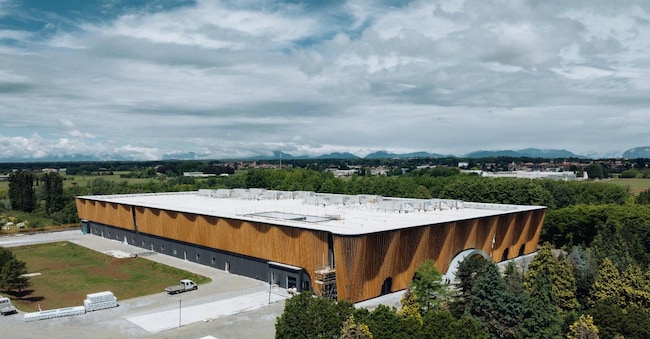
Planet Farms' salads and pestos are back on supermarket shelves. Less than eight months after the fire that had rendered the factory in Cavenago, Brianza, unusable last January, Marco Travaglini and Daniele Benatoff have already restarted the engines of their vertical farm, making operational in record time the new facility in Cirimido, in the province of Como, whose construction had been announced for 2023. The return to the shelves of their products grown above ground, in a controlled environment and without the use of pesticides, has also coincided with the launch of new varieties, which both in Cirimido and Cavenago enter the factory in seed form and leave in the form of ready-to-eat bags.
'The new factory was only supposed to be ready in a year's time, but we made a miracle happen,' says Luca Travaglini, co-founder and co-creator of the Planet Farms group. 'The day the factory in Cavenago caught fire was of unprecedented violence to me. After years of investment and work, things had started to go well, but overnight we found ourselves with the building up in smoke'. Travaglini and his collaborators, however, did not lose heart: 'We received many messages of solidarity and support,' he says, 'which helped us turn that shock into fuel to start again. And we started up again, in record time'.
The new factory in Cirimido, although active, is still under construction: 'It can produce 75 thousand packs per day of salad and 10 thousand of pesto,' explains Travaglini, 'with only six operators: artificial intelligence does the rest. Of the 38 employees at the Cavenago plant, however, no one has been laid off: "We have kept them all," Travaglini points out, "we have not resorted to social shock absorbers, they have been redeployed in the various companies of the group right from the start. Even the large-scale distribution customers have all stayed, 'no one has left, and this has helped us to restart quickly'.
In addition to the restart, the new Cirimido plant has also earned Planet Farms the award for best new vertical farming plant at the Vertical Farming world awards in Frankfurt. Developed on a total area of 40,000 square metres - 11,500 of which are dedicated to the plant - and with a net cultivation area of 20,000 square metres, the Cirimido production centre is in fact one of the largest vertical farms in the world.
In Cavenago, on the other hand, reclamation activities have not yet begun because the insurance companies have not yet finished their work: 'The land on which the factory stood is ours and we will rebuild again in the future,' promises Travaglini. For the time being, however, his group has decided to focus on other goals: 'We will open a vertical farm in London,' he says, 'the building site is almost ready and work will start at the turn of the new year. The next goal will be to open in two different Scandinavian countries. They were the ones who sought us out, these are markets where there is great attention to sustainability and food quality. And they are also rich in green energy sources and at lower prices than in Italy'. On Planet Farms' horizon, however, there are not only new countries: 'We are not a salad company, but a technology company,' says Travaglini. 'Our goal is to bring some of the crops with the greatest environmental impact vertically, to reduce it. In the group's laboratories, agronomists and technicians are already at work.


