
Plant engineering and textiles are driving exports from the province of Teramo
Across the province, businesses are growing despite the challenges facing the Val Vibrata district. Confindustria: ‘The diversity of sectors is helping’

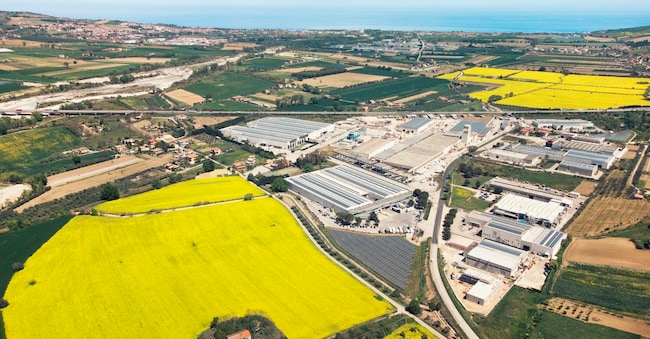
When the crisis in the textile sector made it to the big screen in 2017 – with the feature film “Sfashion” – it seemed to many to be the de profundis for the local economy. Today, the province of Teramo does indeed remain within the ‘Val Vibrata – Valle del Tronto – Piceno”, but – surprisingly – it is also among the provinces with the fastest-growing businesses, according to a Luiss study (see *Il Sole 24 Ore* of 13 August).
The Luiss Report and the reasons behind the growth
The reasons? “First and foremost, diversification,” explains Lorenzo Dattoli, president of Confindustria Abruzzo Medio Adriatico. The diversity of sectors makes the manufacturing base resilient. Crises have bent it, but “never broken it, precisely because of its diversity”. Those who weather the storm emerge stronger. And they grow. Thus, the province – with 34,733 registered businesses and a turnover of 1.321 billion, as calculated by Mediobanca for medium-sized enterprises – proves to be “vibrant”: leading the region in terms of growth in added value over the last five years (+2.8 per cent according to CNA), contributing 1.8 billion to Abruzzo’s exports in 2025, which ranked as “the second region in the first quarter of 2026 – as the head of the industrialists’ association points out – in terms of foreign trade, behind only Tuscany”.
From liquorice to oil fields
From a land where you can already catch a whiff of the sea, but which is by no means easy to reach, come the liquorice sticks used in ice creams all over the world; from here, specialists capable of training those who will work in oil wells set off for Morocco, the Middle East or Mexico; here, clinical reagents destined for 150 countries are developed, alongside more traditional products.
Contributing to this springtime revival in Teramo are “the ZES (Special Economic Zone); the NRRP; Industry 4.0 and 5.0, as well as other regional support”, acknowledges Dattoli, aware “that without capable entrepreneurs, all such support would be wasted”. The insights of the pioneers of the past go hand in hand with the innovations of today’s managers, ensuring ‘a smooth transition from one generation to the next, one of the most critical moments in the history of businesses’.
Family-run businesses for generations
Barberini, founded in ’63 and acquired by Luxottica; Cordivari, established in 1972, specialising in plumbing and heating; Aran Kitchens, spanning three generations; and Maglificio Gran Sasso, also spanning three generations. Menozzi-De Rosa in Atri boasts 180 years of history. “In a niche sector such as liquorice, we are growing thanks in part to technological innovation, greater sustainability and rising exports through diversification and large-scale distribution,” summarises Angelo Menozzi, managing director of the family-run company, which has an average turnover of 6 million. A further boost has come from investments, facilitated by the Transition 5.0 plan, to “purchase electronic dryers and cutters, which allow us to produce more whilst consuming less”. Their factory is located outside the Special Economic Zone (ZES), which now encompasses 14 municipalities in Abruzzo.


