
Fiat Panda, more than a hatchback: the long history of a legendary car
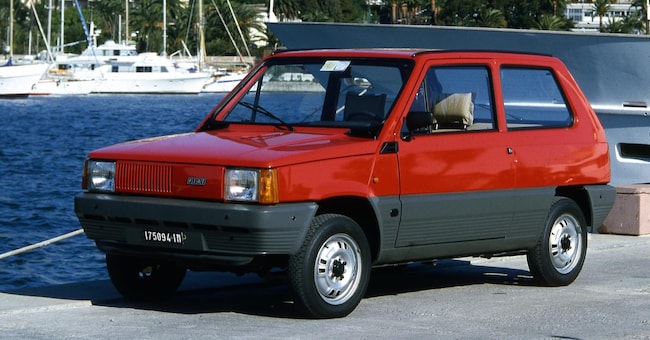
The first Panda was born in 1980 from the pencil of Giorgetto Giugiaro. The first restyling took place in 1986 with the Fire engines
3' min read
3' min read
In 1980, pandemonium shook the small car sector. It was unleashed by Fiat project code 141, later called the Panda. A very apt name inspired by that of the Roman deity Empanda, protector of roads and travellers.
The first Panda had to make life difficult for the Citroën Dyane and the Renault 4, first joining and then replacing the 126 and 127. At Fiat, they entrusted Giorgetto Giugiaro with a specification that had to agree on many factors. The Panda must be small on the outside, large and multifunctional inside, light and inexpensive. Giugiaro designed a car that was 3.38 metres long with a squared-off, sympathetic, minimalist line and an interior that could be configured in many ways. In fact, it has upholstery inspired by suspended canvas deckchairs which, for example, at the rear can form a large storage compartment or a hammock for babies by moving the support tubes into special slots, but also a makeshift bed by sliding the front seats forward and lowering their backs together with the rear one. The tube-cloth 'technology' also inspires the pouch that replaces the dashboard by moving instrumentation, switches and air vents to a panel behind the steering wheel.
The Panda debuted at the Geneva motor show in 1980 in versions 30 with the air-cooled twin-cylinder engine with 30 horsepower of the 126 but moved to the front and 45, which mounted the water-cooled four-cylinder with 45 horsepower of 903 cc of the 127. Produced until 2003, it evolved continuously. In particular, with the iconic 4x4 made with Steyr Puch, with the substantial restyling in 1986 in which it adopted four-cylinder Fire engines and upholstered seats, as well as the Omega rear axle instead of the rigid one on the front-wheel drive versions to offer better comfort. In twenty-three years it offered many new equipment and engines including diesel, the continuously variable Selecta gearbox and even, between 1990 and 1998, two battery-powered variants: the Elettra.
2003 saw the debut of the second series Panda, still called this instead of Gingo as originally planned due to a dispute with Renault who complained of the similarity with Twingo. It was only aligned with its progenitor by the taut features of the bodywork, which, however, was 3.54 metres long and five-door. Based on a platform that will also be taken up by the 500, it has an attractively furnished interior and offers many electronic safety systems. The engine range consists of the four-cylinder 1-litre and 1.2-litre petrol engines as well as the 1.3-litre turbodiesel. Elected Car of the Year 2004, it enriched the range with a 4x4 version, which in 2006 saw the entry of the peppy 100 hp version and the bifuel LPG and CNG versions. After one very slight restyling in 2009, it was retired in 2012.
Replacing it is the Panda 3, updated these days with all the Adas required by law and also declined in Pandina, which reaches 3.65 metres in length as the bodywork is stylistically a rounded evolution of its predecessor. Inside, it merely integrates a shelf into the dashboard inspired by that of the 1980 Panda. The 1.2-litre petrol and 1.3-litre turbodiesel engines, evolutions of those of the previous series, are joined by the 900 cc TwinAir petrol twin-cylinder and a mild-hybrid.

