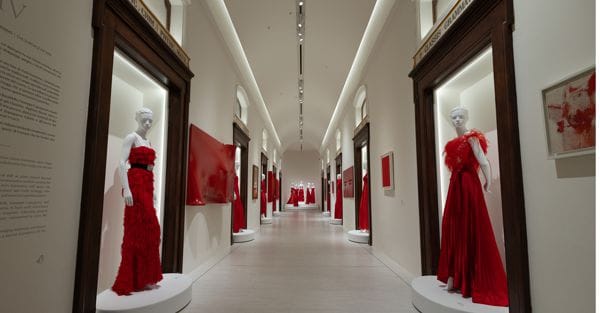
Pm23, the Garavani Giammetti Foundation opens in Rome exploring red
With the exhibition Horizons/Red, the new cultural space desired by Valentino Garavani and Giancarlo Giammetti opens with 50 dresses by the couturier and 30 works of contemporary art. An invitation to look to the future, even from the greatness of the past

3' min read
3' min read
Creating connections between art and fashion, with events or exhibitions, is increasingly common in an industry seeking to give new depth to its products. It is rarer to think and propose the two worlds as autonomous channels of creativity, and to propose a narrative in which clothes and canvases or sculptures meet as a mere aesthetic experiment, of pure creativity. When Valentino Garavani opened his atelier in Rome in 1959, from which the first clothes in his special red came out, their disruptiveness (it was a detested colour, marginalised by the bourgeoisie) was the same as the cuts that Lucio Fontana had begun to inflict on his canvases a year earlier.
The creative, emotional and revolutionary power of red is at the heart of the exhibition Orizzonti | Rosso, which opens in Rome the spaces of the Valentino Garavani and Giancarlo Giammetti Foundation, PM23, acronym of its address (Piazza Mignanelli 23), in a wing of the 18th-century Palazzo Gabrielli Mignanelli. It is the same building that in another area still houses Valentino's heart, his original studio, his atelier, even though the couturier bid farewell to the catwalks in 2008, with a memorable show of dresses all in Valentino red at the Musée Rodin.
It was actually back in 1998 that Garavani and Giammetti sold the ownership of their maison, for 540 billion lire, to Maurizio Romiti's Hdp holding company. After various vicissitudes, since 2012 the maison has been controlled (paid around 700 million euro) by the Qatar fund Mayhoola for Investments (which was joined two years ago by Kering, which will take over 100% of the company by 2028), while the creative leadership has been taken over by Alessandra Facchinetti (for a few months immediately after Garavani's departure), the duo Maria Grazia Chiuri and Pierpaolo Piccioli, then Piccioli alone, and for about a year Alessandro Michele, whose vision has centred on a revisitation of Valentino's own archives. In 2024, the fashion house had a turnover of EUR 1.31 billion, a decrease of 2% compared to the previous year.
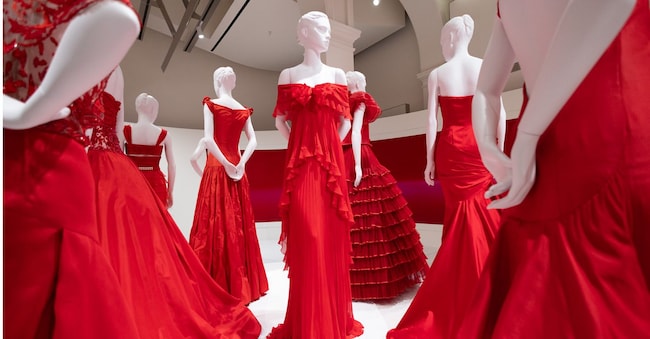
Returning to the exhibition in Rome, there are 50 Valentino red dresses chosen from the rich archive of the maison by curator Pamela Golbin, and 30 works of contemporary art, selected by Anna Coliva, which accompany us along a path that exalts red, a primary and primordial colour, since it was among the first to be used by human beings, for cave paintings as well as for dyeing fabrics. Rare works by Francis Bacon, Basquiat and Warhol (linked by deep bonds of friendship with Valentino and Giammetti), but also by Louise Bourgeois and Damien Hirst; a Pablo Picasso from 1958, the oldest work in the itinerary, dialogues with a creation by Francesco Vezzoli, the most recent, a 15th-century Venetian wooden bust weeping red tears.
Some works come from private collections - including that of Garavani and Giammetti themselves -, others from museums and foundations such as Louis Vuitton and Beyeler, others are site-specific such as the one signed by Thomas Paquet, which wraps the last room in an embrace, where most of Valentino's red dresses are gathered like protagonists of a ball.