
Poesiæuropa and the Future of Language
On Isola Polvese international writers and scientists reconnect literature between astrophysics and religion

3' min read
3' min read
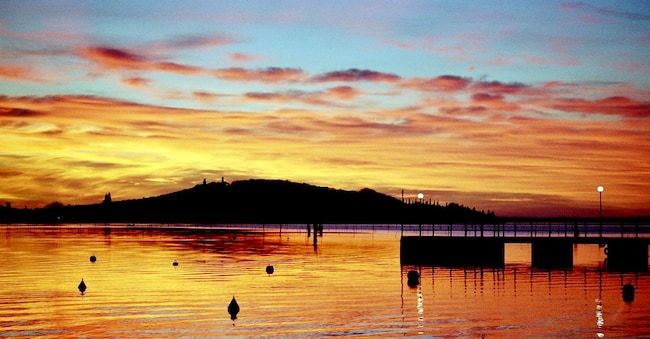
"Will science kill poetry?" This is the emblematic question with which Joe Lockard's speech inaugurated the seventh edition of Poesiæuropa, organised by Arci Spazio Humanities under the high patronage of the European Parliament. For four days, the immersive conference brings together international writers, scholars and scientists on Lake Trasimeno's Isola Polvese, on the border between Umbria and Tuscany, where today's intentions struggle between yesterday's golden remains and tomorrow's hopes.
"Will science kill poetry? Will war kill poetry?" These are the absolute as much as rhetorical questions that Maria Borio, lecturer and artistic director of the conference, took up: "Faced with phenomena such as algorithmic simplification, it seems that our species drags itself into an interactive and undifferentiated present, without past or future, without giving credit to what is authentic and what is not. Poetry is a form of intelligence that urges essential attention to the things that matter. How can we take the present and history into our own hands, through science and poetry, how can we not be killed by disenchantment and disillusionment?"
Science and Metaphorical Thinking
A captivating response came from Luxembourger Guy Helminger, who attempted to position poetry between astrophysics and religion. "Poetry is positioned between these two poles, between knowledge and experience. Science, therefore also astrophysics, always has a defined object of investigation. Poetry, on the other hand, leans in every direction, not because it seeks laws, but, on the contrary, because it aims at the richness of variants. It would never dream of seeking a common origin for all this diversity. Its aim is to detect the most varied phenomena, from the emotions to the Quadrantids, in relation to the human being - which means that there can be no universal law, since different people react differently depending on socialisation, illness, aesthetic training'. In spite of this, poetry aspires to knowledge and at the same time wants to make what is intuited liveable. Poets know they are moving in a field of hypotheses, they do not verify or falsify them, but wander in them, explore every detail and discover doors never imagined in the building, which they open with images and metaphors, with the help of metonyms and anaphora - and thus find themselves in yet another hypothesis, immortalising the infinity of the cosmos verse after verse.
Poetics of Conflict
.The dominance of logical-instrumental thinking, of algorithms over ideologies, has dethroned the traditional habitus of poetry. War has become a kind of intrinsic status for public discourse, from geopolitical clashes to cultural ones. And language has inevitably absorbed an adversarial and disruptive charge, starting with the daily media frenzy. Alongside cogent titles such as the anthology 'The cry is my voice. Poesie da Gaza" (Fazi) edited by Bocchinfuso, Soldaini and Tosti, following Antonio Prete's lectio, poetry remains an act of resistance to oblivion. And not only in the movement that through remembrance gives presence to what is absent, but also in the restitution of life and light to what is hidden, or removed from the gaze of so-called civilised living.
Reconstruction of a civil syntax
.On the other hand, poetry, like the language it is made of and like the silence that inhabits it, cannot stand abstraction, nor generalisations: it lives in the singularity of each of its experiences, which belong to all cultures. With 'Progetto per un paese indefinito', Juan De Salas has tried his hand at writing a collection in the form of a 'simulated archive' of a non-existent country, in which - through the reuse of the languages and printed paper of the Italian Risorgimento - he has relativised and questioned the solemnity, the rigidity of our own national archives, thanks to the poetic capacity to generate or contest political realities. "If it is true that poetry possesses a certain constituent power, often put at the service of exclusion, then it is worth exploring its opposite: the lyrical possibility of dematerialising and dismantling law, homeland and official memory. After all, to write a poem is also to demarcate a field: it is as important what stays in as what stays out'.

