Cycling

Pogacar sets his sights on Paris-Roubaix, the last classic he still lacks

The Slovenian champion aims to complete his palmarès with this legendary race, while Mathieu Van der Poel seeks a fourth consecutive success

by Dario Ceccarelli

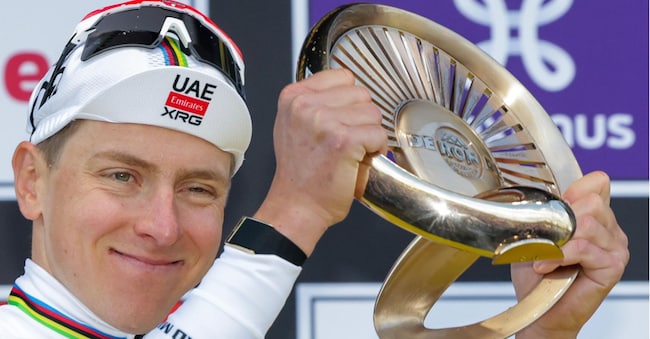
Il ciclista sloveno Tadej Pogacar, dell'UAE Team Emirates XRG, posa sul podio al termine del "Giro delle Fiandre", a Oudenaarde, in Belgio, il 5 aprile 2026.  EPA/OLIVIER MATTHYS EPA

5' min read

Translated by AI
Versione italiana

5' min read

Translated by AI
Versione italiana

Once upon a time, before the reign of Tadej Pogacar began, Paris-Roubaix was a special race.

Where anything could happen. Falls, rain, wind, mud, punctures and many other unforeseen events made it absolutely unpredictable and unpredictable. Even more indecipherable than Milan-Sanremo.

Loading...

It could have been won by a great champion, suited to this lottery of the stones, but it could also have been won by a generous nobody who, from that day on, would no longer be a nobody, because winning a Roubaix, also known as 'the last folly of modern cycling', is enough to enter the history of this sport and of this classic, beloved precisely because of its difficulty and because it represents, with its 30 cobbled sectors (54.8 km out of a total of 258.3), a reckless plunge into the past. In that Hell of the North, towards the Belgian border, so well depicted in the novels of Emile Zola, with its coal mines, its low houses with red bricks, certain bars with wooden counters where on Sundays, after mass, miners and peasants gather in their festive attire to get busy with cards and glasses. These bars have not changed much; they are almost always called 'Terminus' with notices on the walls warning patrons not to spit or get drunk. On spitting, let's say everyone agrees by now. On drunkenness, there is still work to be done.

That digression having been made, let us return to the crux of this Roubaix number 123: the point is that this year Tadej Pogacar, after San Remo and Flanders, absolutely wants to win it. Both because it is the only monumental classic that has so far escaped from his rich palmarès (5 Lombardia, 3 Liège-Bastogne-Liège, 3 Tour of Flanders, 1 Milano-Sanremo), and because, by winning Roubaix as well, he will have a downhill route to make it five in the same season (a feat not even achieved by Eddy Merckx), as Tadej now considers Liège and Lombardia to be his hunting grounds, which he has long since acquired.

In short: Pogacar, with his enormous talent, is about to dispel even the last myth of the Roubaix: that of its elusiveness. If he wins, as is very likely (although Van der Poel will do everything he can to prevent him from doing so), nothing will be precluded to him anymore. Even now, this record-breaking Phenomenon (111 successes, including 4 Tours, a Giro d'Italia, 2 world championships in a row) seems to be launched into a parallel universe of cycling.

Where Tadej goes, he wins, leaving no escape.

Empressive numbers

And not only does he win, but he does so with an ease that leaves one astonished. Admittedly, in Flanders he had to work harder than usual to break Van der Poel, even arriving at the finish line sweating. But that was an exception: when he takes flight, no one stops him any more. No feat eludes him, he has not even lost a race since the World Championships in Rwanda (September 2025). Impressive numbers that project the Slovenian into a dimension that perhaps not even his great and true rival, Eddy Merckx, ever achieved. The comparison, like all those made between champions of different eras, is highly questionable. Not only because of the materials, preparations and roads, but also because of the different timetables. The Belgian raced practically all year round, from February to October, the Slovenian, in order to regenerate, takes breaks that were not foreseen in Merckx's time.

Opponents also count: Eddy had some very strong ones, on all terrain, Pogacar is demolishing them all. In the Grand Tours, Jonas Vingegaard resists him with difficulty. In the one-day races, it is always the usual ones that will be tackling the cobblestones this Sunday, 12 April: Van der Poel, Van Aert, Pedersen, Mohoric, Laporte and our Filippo Ganna, strong after his success at Dwars door Vlaanderen. Belgian Remco Evenepoel, on the other hand, will not be there.

An extra word should be spent on Mathieu Van der Poel: the Dutchman, winner of the last three editions, is certainly in the hunt for a poker that would propel him to the top of the roll of honour alongside Tom Boonen and Roger de Vlaeminck, absolute specialists, as well as our own Francesco Moser (3 successes) and Franco Ballerini (2 successes plus a second and a third place).

The impression is that Van Der Poel absolutely does not want to miss it ('I'm ready for anything, my instinct guides me') and that he has concentrated his preparation on the Roubaix for two good reasons: firstly, because it is 'physically' more congenial to him than to Pogacar; secondly, because by conquering it for the fourth time, he would enter the history of the sport. This prediction, in other times, we would have countersigned it. Now, however, with such an explosive Pogacar, caution is in order. We shall see: Van der Poel is the first of the humans, Pogacar on the other hand is a formidable ET come to Earth to overshadow even the legendary Eddy Merckx, unfortunately in hospital these days for a painful hip infection.

Tadej does the race on the Cannibal, that much is clear. However, he is unlikely to reach his 523 victories with 19 monumental classics, including seven Milan-Sanremo. A duel in time, this one between the Belgian and the Slovenian, however fascinating. Pogacar is only 27 years old, at least five more to race at the highest level. The only uncertainty, having started winning early, is how long he will last. At the moment, however, the topic is not on the agenda.

So let's enjoy this Roubaix and mark, as usual, the section (93 km from the finish) where the Aremberg Forest begins (sector number 19), 2300 metres with a hump-backed surface characterised by the highest degree of difficulty. In the middle there are boulders, on the sides two narrow lanes, sometimes dusty, sometimes muddy, to avoid ending up slumped between the stones.

The problem with the Roubaix is that you must not fall behind. Whoever falls behind is lost: and therefore it is forbidden to puncture or end up on someone who falls in front.

Felice Gimondi, first in 1966, warned: "To win it, you must finish among the first in Aremberg. It's a funnel. After that you have to do everything else. And above all be very lucky. A curiosity: for the last 30 days, goats have also been used to clean the bottom from grass residues.

Finally, not to be forgotten: for the first time, the women's race will take place on a Sunday like the men's. The men's will arrive around 5pm, the women's will start later, around 6.30pm. The winner of the last edition, Pauline Ferrand-Prévot, will not be there. The favourite is Lotte Kopecky. Good chances also for our Elisa Longo Borghini (winner in 2022), Elisa Balsamo and Letizia Borghesi.

Rai: live from 12.45 to 14.45 on Rai Sport. From 2.45pm onwards on Raidue.

Discovery/Eurosport: live from 10.30 a.m. to 6.50 p.m. (men).

From 5pm to 6.45pm on Eurosport 1 (women)

Copyright reserved ©
Loading...

Brand connect

Loading...

Newsletter

Notizie e approfondimenti sugli avvenimenti politici, economici e finanziari.

Iscriviti

Tutto mercato WEB