
Poland: 5 major EU countries in favour of Eurobonds for defence
The announcement was made by Polish Foreign Minister Radoslaw Sikorski at the press conference at the end of the meeting of the foreign ministers of France, Germany, Italy, Poland, Spain plus the United Kingdom

3' min read
3' min read
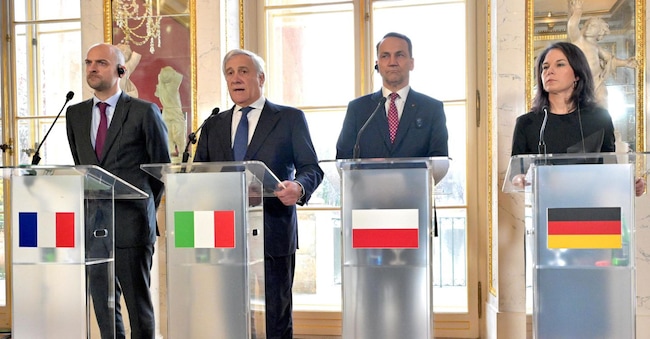
"For the first time five (EU) countries have come out in favour of European bonds to finance defence, this is a real novelty". The announcement was made by Polish Foreign Minister Radoslaw Sikorski at a press conference at the end of the meeting of the foreign ministers of France, Germany, Italy, Poland, Spain and the United Kingdom in Warsaw.
How to finance defence spending
.In the final communiqué of the meeting, it is stated that we want to 'strengthenEurope's security and defence, using all the levers at our disposal, including the economic and financial power of the European Union, and strengthening the European industrial base'. To this end, 'we will discuss innovative financing and remove obstacles to trade and investment in the defence sector'.
At the press conference, only Italian Foreign Minister Antonio Tajani made explicit reference to Eurobonds while the French and German ministers made no mention of them.
"To guarantee in a European way the indebtedness of nations to reach 2%" of GDP to be allocated to defence "seems to me an idea to be welcomed. This would take away from each nation the burden of perhaps having different debt interests and make security and defence a common heritage'. This was said by Defence Minister Guido Crosetto on the sidelines of a meeting with his European counterparts in Brussels, commenting on the hypothesis relaunched by the summit of foreign ministers in Warsaw.
Crosetto: uncoupling defence spending from the EU Pact
"Several governments have pledged to reach 2 per cent but, as you see, every time there is a budget law there is difficulty in increasing the funds,' Crosetto added. 'It is a theme that I have been posing for two years now, the constraints that exist for each country as the impact of defence on the stability pact must be eliminated. Excluding this expenditure from the Stability Pact would become a separate matter and there would be the possibility of reaching 2 per cent'.

