
Polha Varese hothouse of Paralympic medals
Seven swimmers from Italy who are enjoying so much success in France train in the Varese-based club, a model of inclusion

5' min read
5' min read
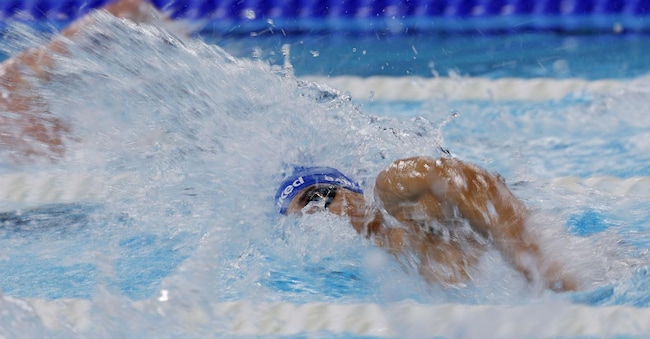
The Défense Arena in Paris is coloured with the tricolour every day: Paralympic swimming Italy is a world-class team and seven of its 28 athletes are part of Polha Varese, a model club for inclusion. Simone Barlaam, Alberto Amodeo, Federico Morlacchi, Arianna Talamona, Giulia Terzi, Alessia Berra and Federico Cristiani are all 'children' of Polha, which in the medal table at the end of the Games would certainly rank much higher than many nations. It is a story that started over forty years ago, the result of intuition and perseverance.
Forty years of projects
.In 1982, when Giacinto Zoccali, a physiotherapist by trade, matures the certainty that sport opens up new lives for the disabled, he is already in the future. On 13 March of that year, he founded Polha (Polisportiva handicappati, later to become Associazione polisportiva dilettantistica per disabili) in Varese and became its president. In those years there were many polymaths looking for answers and the Canadian Arnold Boldt, amputee above the leg, capable of jumping 1.86 metres in the men's high jump offered dream prospects. That's how Polha got started, an intuition, many needs and volunteer work as petrol in the engine. And today it finds itself on the roof of the world with its seven star swimmers in France.
Sports always offers a chance
.The Paris medallists are the brightest point of this association experience that has few equals in the world: 160 members (aged 5 and up) and 90 volunteers, including technicians, physiotherapists and sports psychologists. A complex and beautiful machine: 'From 1982 to today, the philosophy that moves us has not changed, and that is to demonstrate that sport always offers a chance,' says Daniela Colonna-Preti, president since 1993, a degree in biology and a thousand lives lived among mothers and fathers who arrive at Polha almost lost, competition camps, training sessions, minibus journeys to accompany the athletes and now the successes of Paris. Since 1982, the club has structured itself, grown, but never changed its DNA. A spacious headquarters has arrived, in the Avigno district, at the foot of Sacro Monte, obtained on loan from the municipality of Varese and restructured with the arms and willingness of many, businesses and citizens: 'The municipality,' recalls the president, 'like many local realities, has always supported our initiatives and requests, and also because of this we have been able to grow and give answers to the territory. Today, in the 300 square metres of the headquarters, the boccia boys train, Marinetta, head secretary, has a thousand duties, there is space for physiotherapy, the gym, for getting together, for the president's office. Where every journey begins.
The dialogue with families
.Parents arrive with their children in difficulty: 'In the first interview I try to understand what the readiness for sport is, what sport can be on the scale of the disability in front of me, and within a few months, new, more serene people blossom. If they come here, if you approach them, it is impossible for sport not to fascinate them'. The stories that Daniela can tell are endless as she has been attending Polha for forty years: 'By chance one evening, I found the president at the time, Rodolfo Rossi, at a pizza party who was talking about the Italian championships for the disabled in Modena, inviting me to go and see the training sessions. Since that day, at the Varese stadium, Daniela has 'married' Polha, a second family, in addition to her three children and three granddaughters. She has made a job of it, with humility and grit.
The Polha initiates people into sport, tries to explain with facts that sport enhances abilities and not disabilities. It does this thanks to voluntary work, special projects with some companies and the generosity of many. Looking after 160 children means finding coaches, it means having facilities to accommodate those who practise athletics (in Cairate and Varese), boccia (Galilei gymnasium), table football (at the head office), handbikes (Varese stadium), kayaking (Canottieri Varese), swimming (Varese, Jerago and Milan), para ice-hockey (Varese ice rink) sitting volleyball (Galilei gymnasium), snowboarding and table tennis (Galilei gymnasium). Offering these opportunities also means an annual financial commitment of 250,000 euro, 17,000 of which come from membership cards and the others from tenders, foundations, entrepreneurs, institutions, and individual citizens who donate freely. Because they know the company's commitment and the results. From initiation into sport for the youngest children to top-level sport: 'Our club brings seven swimmers and a sprinter (Fabio Bottazzini, ndr) to Paris: only state bodies have more and this is our satisfaction,' confesses the president, who has an overwhelming energy and an all-female concreteness. It was Giovanni Alianelli who made Polha's debut at the Paralympics in 1984 in New York, then in Seoul 1988 (the first Paralympics held in the same facilities as the Games), the first medal with Rodolfo Rossi, bronze in the 4x100 tetraplegics and, following that, Marco Re Calegari in Barcelona 1992 bronze in the 1500 m T54 (today the athlete is in charge of Polha's handbike sector).


