
Political Institutions and the Wealth of Nations: Nobel Laureate James Robinson at Luiss Research Day
The University of Rome invited the British economist to the capital to discuss the link between the organisation of political power and the prosperity of states

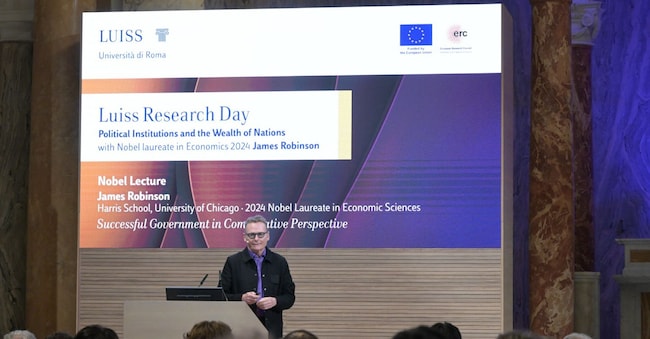
Why have some nations managed to achieve and maintain significant levels of prosperity whilst others have not? This was the question that kicked off this year’s Luiss Research Day, but it is also the question that inspired the research which earned James Robinson, the event’s special guest, the Nobel Prize in Economics. In his speech, Robinson, drawing on specific case studies – South Korea, Rwanda and Great Britain – reflected on the relationship between the organisation of political power within a society and its capacity for economic progress. During the event, held in the Aula Chiesa on the university’s Viale Romania campus in Rome, Luiss Rector Paolo Boccardelli presented the Nobel laureate with the Luiss Research Award.
Forms of government and prosperity
The aim of Research Day, which Stefano Manzocchi, Vice-Rector for Research at Luiss, described as ‘an opportunity to link our areas of research with the international debate and to foster, within our university, a productive dialogue between the social sciences, the humanities, the law faculty and the Department of Artificial Intelligence’, was to explore how to lay the foundations, at a political level, to facilitate the material progress of a society.
Paolo Boccardelli, the University’s Vice-Chancellor, opened the proceedings by emphasising the importance of asking why, if prosperity stems from investment, training and innovation, some societies invest, train and innovate more than others. Understanding how institutions evolve, Boccardelli reiterated, has in fact become central to understanding the drivers of economic development.
The Vice-Chancellor explained that our country is one of the most industrialised in Europe and the world; it is Europe’s second-largest manufacturing nation, the world’s fourth-largest exporter, and has a strong tradition in the fields of technology and science. However, he noted that behind these figures lie limited productivity growth, modest social mobility and substantial regional disparities: ‘It is precisely here that rigorous academic research can make an important contribution,’ he observed, reiterating that ‘the university has a responsibility to advance knowledge’. In addition to Robinson, the Luiss Research Day featured numerous other leading figures from the field of economics, ranging from Raquel Fernandez to Josiah Ober, including Hans-Joachim Voth, Guido Tabellini and Luigi Pascali, a full professor at Luiss.
Robinson’s research
The aim of Robinson’s research is precisely to understand which forms of government facilitate the achievement of prosperity. “We are trying to understand how to create more effective governments in developing countries, and how to establish a state capable of providing the public goods the population needs,” explained the Nobel laureate.

