Art

Pontormo: a superb exhibition celebrating the whimsical genius of the Mannerist period

The major retrospective exhibition Pontormo is on display at the Scuderie del Quirinale until 7 February 2027

Pontormo in una mostra eccelsa alle Scuderie del Quirinale

7' min read

Translated by AI
Versione italiana

7' min read

Translated by AI
Versione italiana

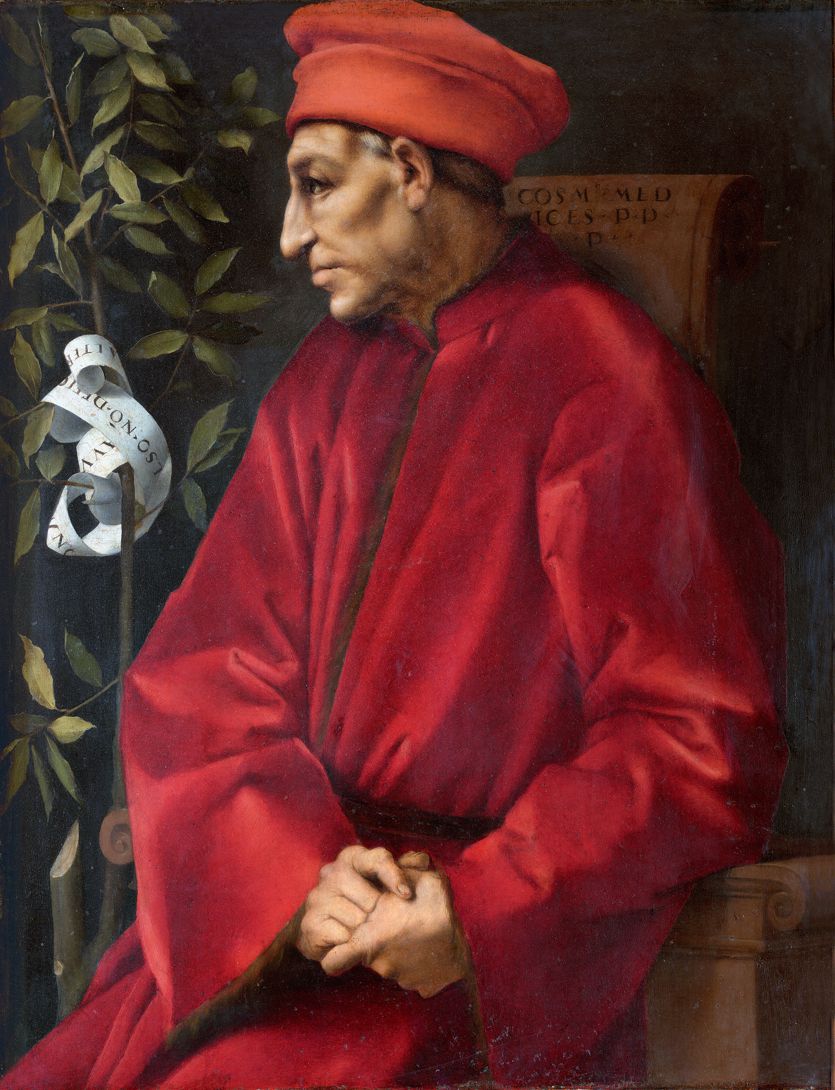
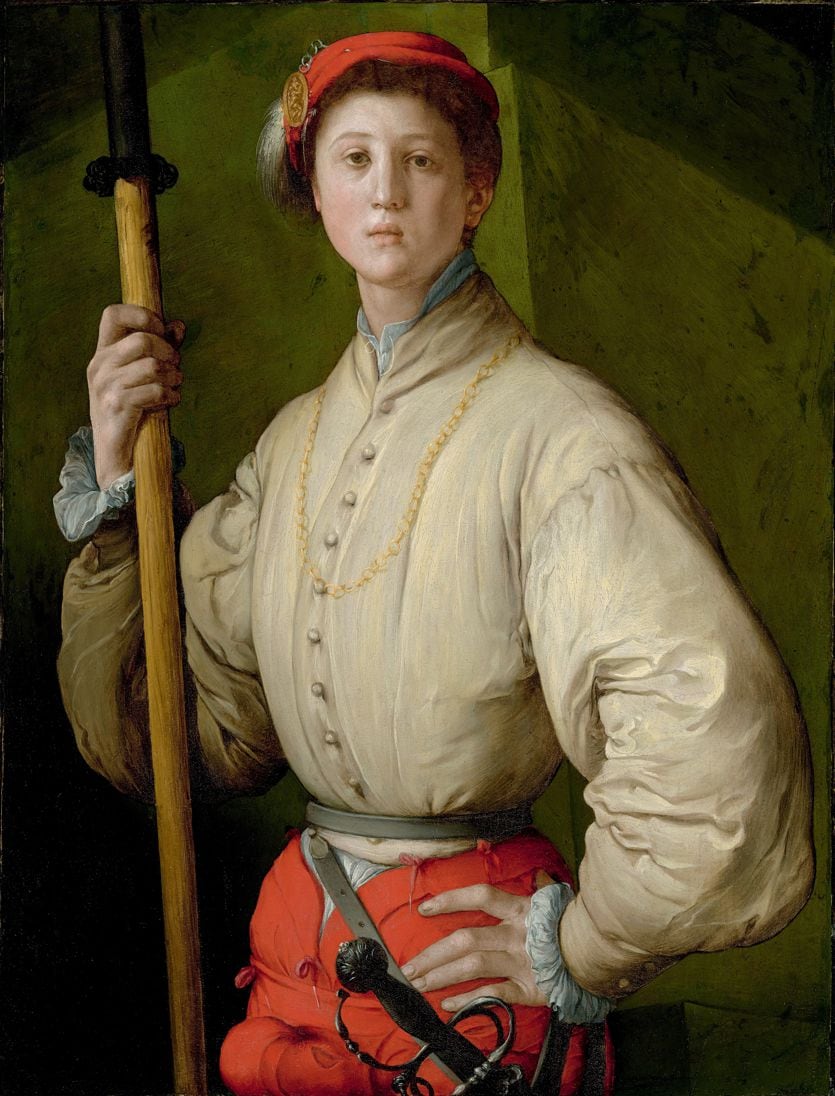
“His colours took flight / in a new radiance,” wrote the poet Mario Luzi of him. And so, yes, the iridescent colours, the famous drapery, the elaborate style, the spasmodic tension, the powerful mastery of drawing and that very personal, refined grace of his: all contributed, with his shadowy character, to making him the master Ghiribizzoso, as Vasari so evocatively defined him. The Scuderie del Quirinale are dedicating an unmissable exhibition to the prince of the Mannerist style, Jacopo Carucci da Pontormo, who has gone down in the annals of Italian art history as Pontormo (Pontorme, Empoli, 1494 – Florence, 1557). And what an exhibition it is – finally a monographic show in the Italian tradition, featuring everything that could be brought to Rome from beyond the borders of Tuscany and from Europe’s greatest museums and beyond, brought together in an itinerary that builds to a crescendo, with, in the foreground, the climax of the Deposition from Santa Felicita and, on the second floor, the ‘Visitation from Carmignano’, passing through the marvellous ‘Portrait of a Goldsmith’ from the Louvre, and the Portrait of a Halberdier from the J. Paul Getty Museum in Los Angeles, or via that of Cosimo the Elder from the Uffizi.
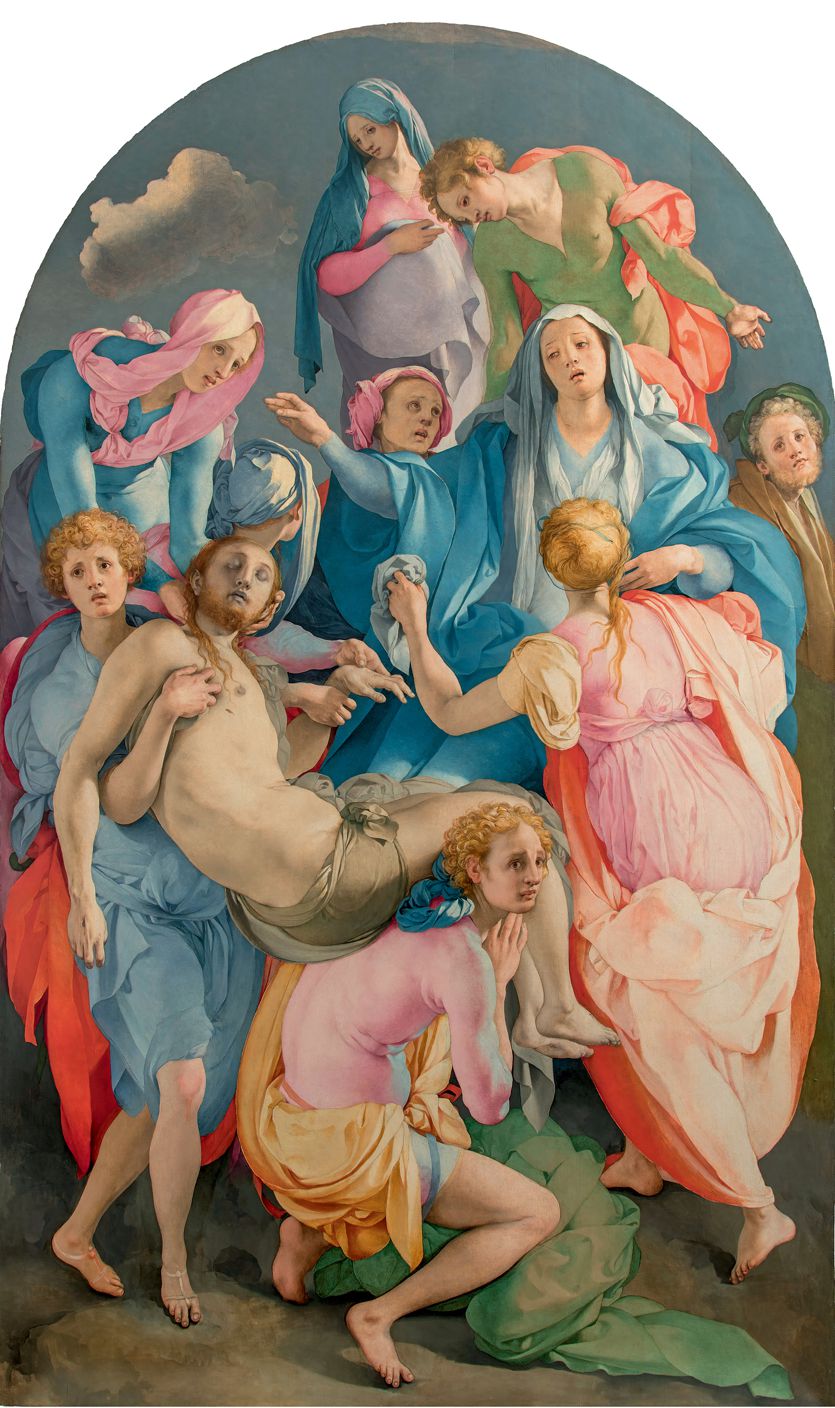
Pontormo (Jacopo da Pontormo). Pala Capponi: Pietà (Trasporto di Cristo), 1525-1528 circa. Olio su tavola, 313 × 192 cm. Firenze, chiesa di Santa Felicita,

La Maniera

A leading figure of the great Florentine 16th-century period that marked the origins of the Mannerist style within the High Renaissance, Pontormo was an original and passionate innovator whose work has inspired countless 20th-century artists.

Loading...

Sought after by museums and collectors all over the world, Jacopo is both popular and much-loved for his restless and magnificent paintings, which speak to us and captivate us across the ages.

Admired even by Michelangelo, who was first a pupil of Mariotto Albertinelli, then of Leonardo and Piero di Cosimo, and subsequently a collaborator of Andrea del Sarto; his indomitable narrative skills were combined with an impetuous dynamism, tinged with colourful, unsettling anxieties, abstraction and naturalism (‘nodes of truth’ according to Longhi) which he, in his own way, rendered with virtuosic mastery through his sublime draughtsmanship.
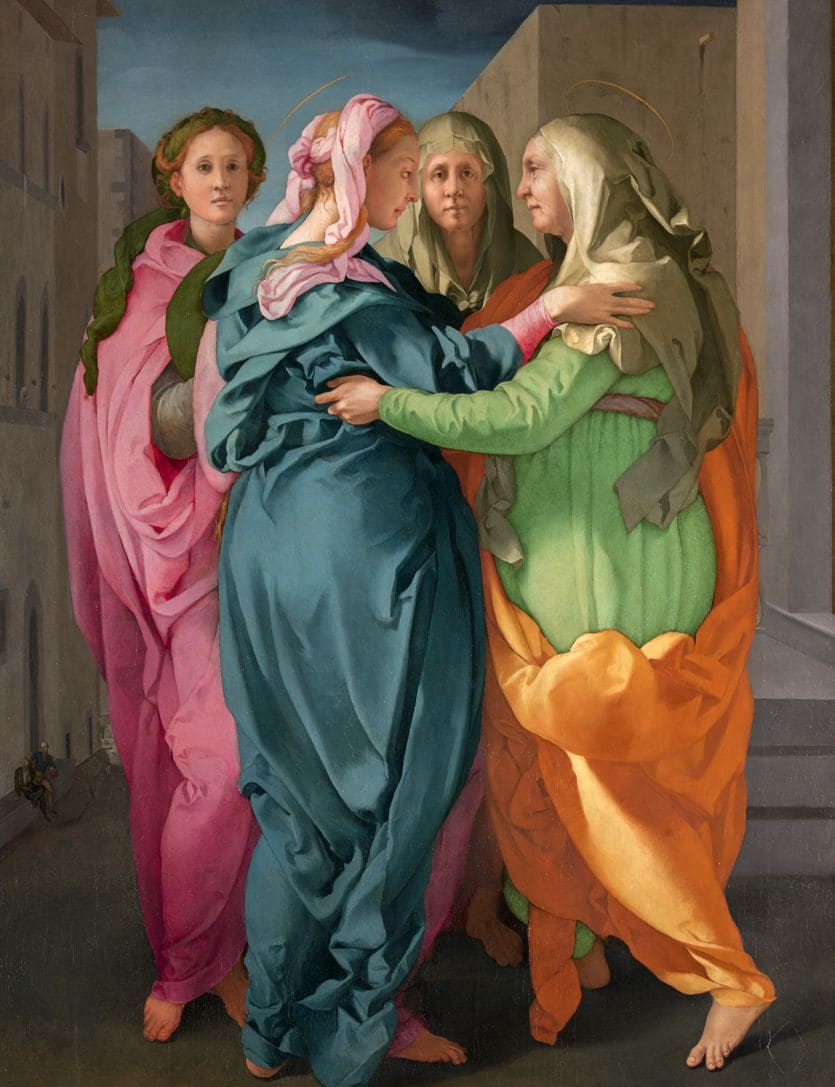
Pontormo (Jacopo da Pontormo). Visitazione, 1528-1532. Olio su tavola, 202 × 156 cm, Carmignano (Prato), pieve di San Michele Arcangelo. Per gentile concessione della Diocesi di Pistoia. Foto: Antonio Quattrone

Accompanied by Professor Cristina Acidini, the curator of this major exhibition, let us begin by taking stock of the great Capponi Altarpiece...a cornerstone of Italian art and a work that has been the subject of controversy ever since its title was first attributed (Pietà? The Carrying of Christ?) ...
“It is a composition that has been frequently praised for its originality. There is no architectural framework, no distinct setting; just the ground and a uniform sky, with a single cloud. The rest, however, forms an architectural arrangement of figures clustering around the Virgin Mary, grieving for the death of her son. And in the foreground we see the body of Christ being carried by two figures, probably wingless angels. This is an innovation that Pontormo introduced into the subject.”

This is precisely what leaves us uncertain as to the moment depicted. Whether Christ is being brought to his mother to rest in her lap, or whether she is taking him away to be carried to the tomb.

It is certainly a moving scene, conveying the universal grief of a mother faced with her dead son, but it is also one of overwhelming beauty, thanks to the poetry of the figures – so skilfully composed in their gestures – and, above all, to the colours, those colours which Giorgio Vasari criticised for lacking sufficient chiaroscuro and which, on the contrary, form a symphony of blues, pinks and iridescent shades that truly make the work a kind of vision.

Pontormo: la grande mostra alle Scuderie del Quirinale

Photogallery22 foto

Let us now turn to a discussion, once again with the most gracious guidance of Acidini, of another great masterpiece, the result of a collaboration with the great Michelangelo, Venus and Cupid, (1533/1534) from the Gallerie dell’Accademia in Florence...

“Venus was intended for Bartolomeo Bettini, who wanted to create a room dedicated to the Tuscan poets who had sung of love in the vernacular and to the goddess of love herself. This is an extraordinarily interesting collaboration between the two great artists. When Michelangelo saw the early works of the twenty-year-old Pontormo, he said: ‘This lad, if he lives, will be a great artist.’ 

Loading...

And so it came to pass that Buonarroti placed his trust in him when Michelangelo was commissioned to create a Venus such as the one on display here, as well as a Noli me tangere (also on display from a private collection, ed.) which was intended for a different purpose. Here, Michelangelo confined himself to providing the cartoon, but chose Pontormo – a master of colour – to paint the panels.

 And this was a great success and a source of great satisfaction. Up to a point, however, because it was precisely this Venus that led to the breakdown of their relationship. The painting was taken from Pontormo, who was in the process of completing it, by Duke Alessandro de’ Medici; Michelangelo never forgave Pontormo for letting it go without a fight and consequently severed ties with him.

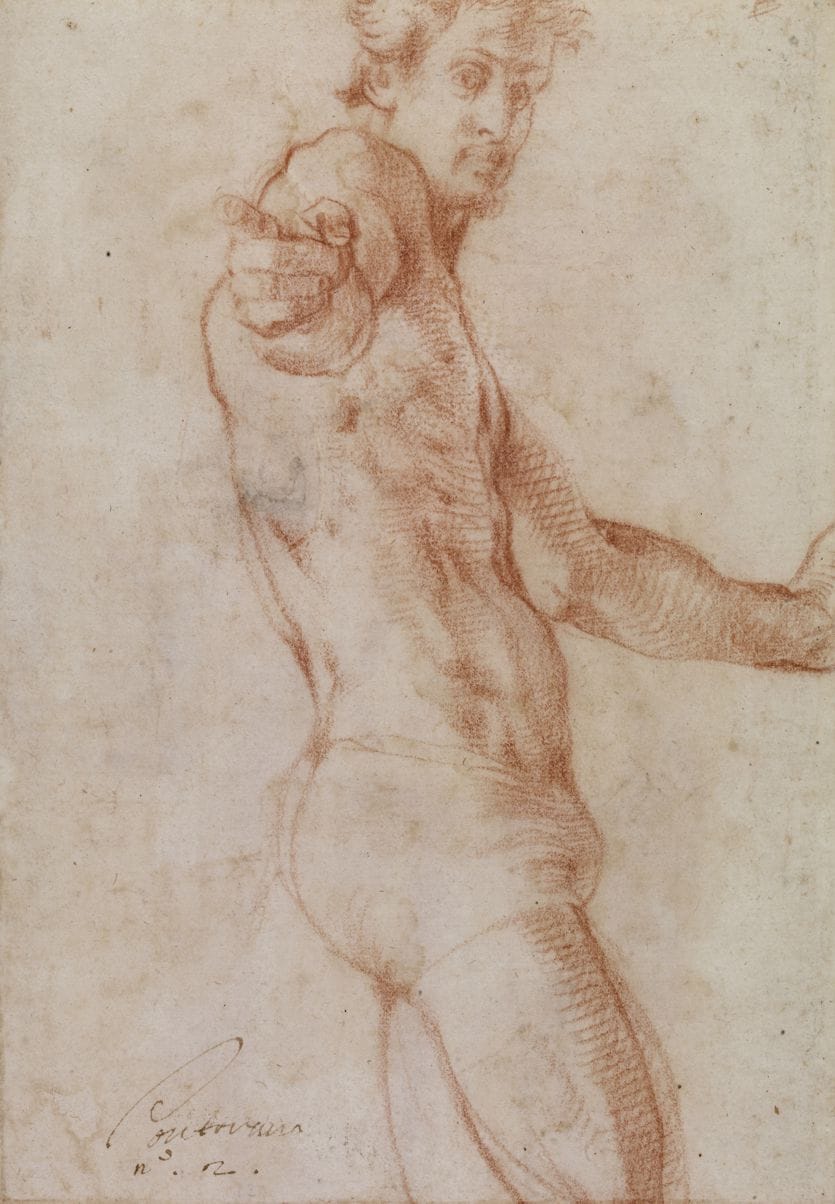
Pontormo (Jacopo da Pontormo). Nudo che alza il braccio (recto), 1525 circa, pietra rossa, pietra rossa in parte inumidita sul verso (?) su carta, 281 × 195 mm.

Among the must-see cameos in this exhibition is the red-stone design, Half-naked man raising his arm, c. 1525, from The British Museum. It is debated whether the portrait of the young man pointing – which is a masterful example of foreshortening – is in fact a self-portrait by Pontormo.

Drawings, and more besides, which made Pontormo so closely attuned to the troubled sensibilities of the twentieth century that it even celebrated him – not to mention others – right from La Ricotta (1963) by Pasolini to The Greeting (1995) by Bill Viola.

We spoke to Carlo Falciani, who is also one of the curators, about one of the major discoveries in the exhibition: the Portrait of Cardinal Giulio de’ Medici...

“It is a painting that was held in the Banca Intesa collections as an anonymous work, as it is clearly a partial copy of the portrait of Cardinal Giulio. The curious thing is that Vasari recalls exactly the portrait of Cardinal Giulio painted by Raphael, which Pontormo executed for the bricklayer who was rebuilding his house after Alessandro de’ Medici had paid him for a restored painting. In the portrait, one can see that the painterly quality – the way it is executed – is that of Pontormo; the Pontormo of the 1530s, and therefore with a style different from that of the Deposition, yet vibrant, creating a portrait of Cardinal Giulio – who later became Pope Clement VII – for the bricklayer who had renovated his house.”

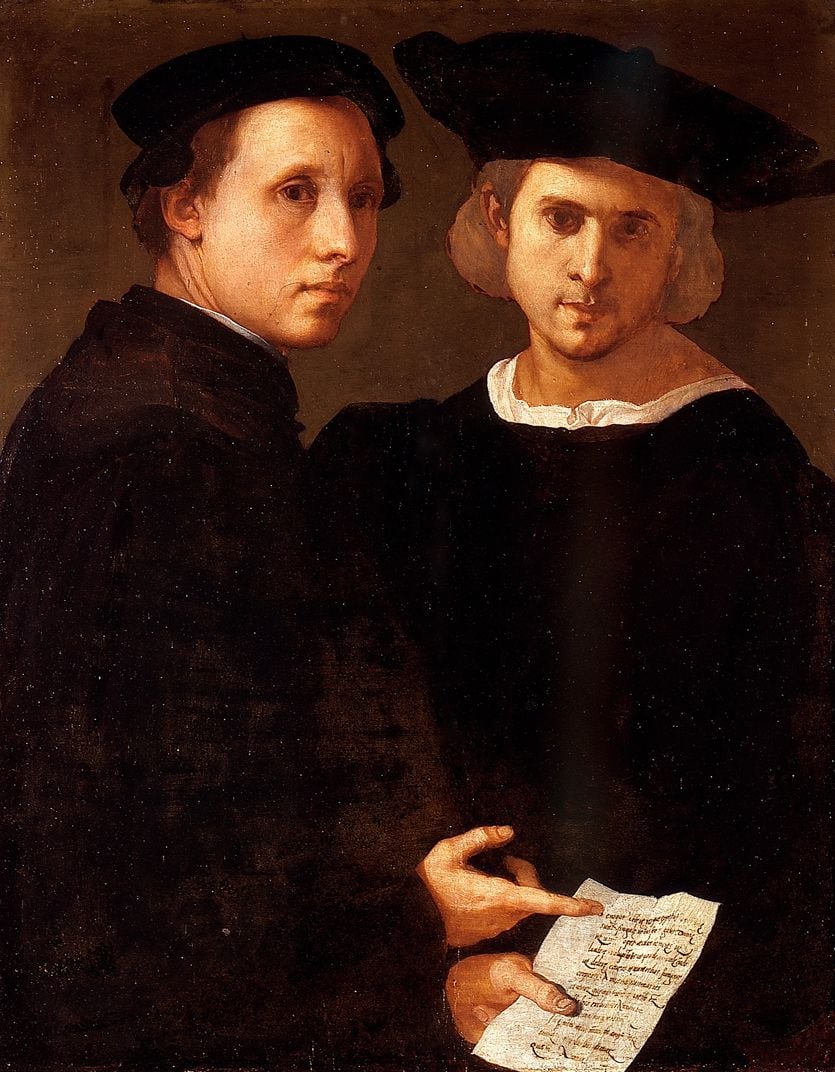
Falciani, let’s take this opportunity to also comment on the Double Portrait, on loan from the Giorgio Cini Foundation in Venice...

“Vasari mentions this portrait, painted for Beccuccio Bicchieraio, stating that he was a master glassmaker. What is interesting is that Vasari says it depicts him alongside a friend, and the painting is a sort of ‘device’, as we would say today, because the two friends, who are positioned very close together, are depicted, are not actually there, and what is on display is a legible letter, a page taken from Cicero’s De amicitia; the moment the reader – that is, the visitor, the person standing before the portrait – observes them looking directly into their eyes… they become the third figure in a triptych. As Alberti also says, friendship is a great force, so great that it brings distant people close together. Friendship is also a political value: in 16th-century Florence, three people would gather whenever the owner passed in front of the painting.”

Pontormo (Jacopo da Pontormo). Doppio ritratto, 1523-1524, olio su tavola, 88 × 67,5 cm. © Fondazione Giorgio Cini onlus, Venezia

Portrait of a Young Man Dressed in Spanish Style, c. 1537

 For this exhibition, we’ve been discussing some truly exceptional loans, drawn from collections scattered all over the world. Among the many works, I have chosen to include as an example in the video (here is the link for our readers, which I strongly recommend you follow, ed.) the wonderfully haughty Portrait of a Young Man Dressed in Spanish Style; fit is thought to be Cosimo de’ Medici. The portrait dates from 1537 and comes from Seattle.

Pontormo (Jacopo da Pontormo). Ritratto di Cosimo il Vecchio, 1519-1520, olio su tavola, 87 × 67 cm. Firenze, Gallerie degli Uffizi. Per gentile concessione del Ministero della Cultura / Gabinetto Fotografico delle Gallerie degli Uffizi, Firenze

However, this – we repeat – exceptional exhibition would not be complete without Pontormo’s other great masterpiece, namely the Visitation of Carmignano. 

Now that we are back with Professor Acidini, we shall take this opportunity to take stock of Pontormo’s highly innovative interpretation of this theme...

“Here too, in this Visitation of Carmignano, Pontormo proves himself to be a great innovator, because the traditional iconography of the meeting between Mary and Elizabeth, as described in the Gospels, depicts two women embracing, with one – Elizabeth – even kneeling before Mary. Here Pontormo has created an extraordinary group of four women: the two main figures in the foreground and two attendants or handmaidens, who stand as silent and impassive witnesses to this extraordinary event in which the two pregnant women recognise in one another the divinity of the children they carry in their wombs; and he has imbued this encounter between women with a sense of solemnity and a profound expression of affection. If we look at the expressions of the two women, who are perhaps seeing each other for the first time in a long while, despite being distant relatives, he has, above all, created a setting that we would today describe as metaphysical: a city street with a dizzying perspective, dominated by a building with regular, silent forms—silent because it has no windows. And far, far away, two small figures conversing with one another, seated on a street bench, and a little donkey parked at the end of the street’. Finally, the catalogue published by Electa is also unmissable, and I would refer readers and visitors to it.

Pontormo (Jacopo da Pontormo). Ritratto di alabardiere, circa 1529-1530, olio su tela; 95,3 × 73 cm. Los Angeles,The J. Paul Getty Museum

Organised by Ales – Scuderie del Quirinale in partnership with the Uffizi Galleries, and produced in collaboration with the publishing house Electa, the exhibition *Pontormo*, curated by Cristina Acidini with Elena Capretti, Philippe Costamagna, Bruce Edelstein and Carlo Falciani, is on display at the Scuderie del Quirinale until 7 February 2027

Copyright reserved ©
Loading...

Brand connect

Loading...

Newsletter

Notizie e approfondimenti sugli avvenimenti politici, economici e finanziari.

Iscriviti