
Pope Leo in Lampedusa: ‘Migrants: Europe faces a historic responsibility’
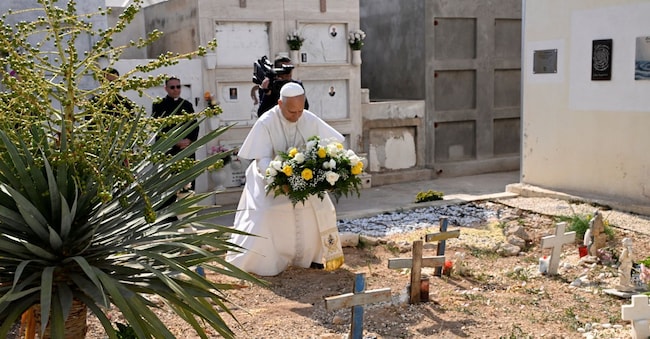
Prevost lays flowers on the graves: even amongst those offering hospitality, there are some who choose not to reach out to others. Around 4,000 people attended Holy Mass

Key points
- The visit on US Independence Day
- The global economic system ‘generates poverty and exclusion’
- He assures the mayor: ‘The Pope encourages you’
- Prevost: when it comes to welcoming others, there are those who choose not to be a neighbour
- “O’ scià”: a call not to let fear get the better of you
- Mantovano: Europe is paying closer attention thanks to Meloni
‘May the world of today and tomorrow be a more humane place for everyone.’ This was the first message delivered by Pope Leo upon his arrival in Lampedusa this morning, with which the Pontiff greeted the citizens gathered at the ‘Arena’ sports ground before preparing for Holy Mass, attended by 4,000 people. But the most poignant remark came afterwards: “Those who have died in this sea are victims both of decisions that were taken and of decisions that were not taken.” Then came the appeal to Europe: given its position and institutional structure, it can “tackle the crisis in a comprehensive manner”. And it must do so “by ensuring that the dignity of every person is respected”. Owing to its history and culture, Europe bears an “epoch-defining responsibility”.
A visit on US Independence Day
Prevost chose to visit Lampedusa – where Pope Francis had been in July 2013 – on the 250th anniversary of US Independence: a highly symbolic gesture distancing himself from Donald Trump’s migration policies. First, he went to the cemetery where migrants who died whilst attempting to reach Europe are buried. He knelt to lay a wreath of flowers in front of a simple grave, marked by a wooden cross, where he remained in prayer. He then went to the ‘Gate of Europe’, a work by Mimmo Paladino, where a young boy read him a note: ‘Dear Pope, I’m so excited to meet you! Ten years ago, my story began here in Lampedusa. I was alone and had lost everything, especially my mum. They tell me I only stopped crying when they gave me a paper ball; since that day, the ball has stayed in my heart and I’ve never stopped playing. I really hope that this ball I’m giving you now will find its way to another child and make them just as happy as it made me. Thank you, Leo.”
The global economic system ‘generates poverty and exclusion’
According to Prevost, a lack of concern for the common good and corruption in people’s countries of origin, a global economic system that generates poverty and exclusion, the fear that fuels prejudice and contempt, the notion that such problems do not concern us, the criminal calculations of those who profit from the suffering of others, and the slow and difficult transition from mere emergency management to the development of comprehensive and shared policies: all of this today mirrors, in the Gospel story, the haste to ‘pass by’.
He assures the mayor: ‘The Pope encourages you’
Prevost thanked the mayor of Lampedusa and Linosa, Filippo Mannino. “The fact that you have chosen to name the Favaloro Pier after Pope Francis,” said Pope Leone, “is a sign of the bond that my predecessor forged with your community and with our migrant brothers and sisters. The Pope has been close to you during this very challenging time for you. And today I am here to tell you that the Pope continues to walk alongside you, supporting and encouraging you.’ For his part, the mayor quoted Claudio Baglioni, an honorary citizen of Lampedusa who was sitting in the front row. ‘At a time when the world is still torn apart by wars, violence, divisions and fears,’ said the mayor, ‘Lampedusa feels an even stronger need to shine a light. The light of those who do not give in to indifference. The light of those who continue to believe that every human life is sacred. The light of those who still cling to ‘a radio to hear that the war is over’, to use the words of a wonderful song by Maestro Baglioni on the miracle of life.”
Prevost: when it comes to welcoming others, there are those who choose not to be a neighbour
The Pope wished to address, above all, those who are working to welcome others on the island. “Thank you, brothers and sisters,” he said, “because there is nothing to be taken for granted in your reaching out to others; nothing is automatic. The parable tells us this: love is always a matter of freedom, and freedom lies in our decisions. There are also those who choose not to reach out to others, and those who decide not to decide.’ “Yes, because amongst you it is love that has taken shape,” he added, “that love of which compassion—which sees a brother or sister at sea—is like the first stirrings, the deep call to dare to do what you would never have thought of. “I greet the migrants who are here: they themselves have not only received,” the Pope emphasised, “but have often shown solidarity on their journey, as the poor helping the poorest.”


