
Population and food: the technological factor
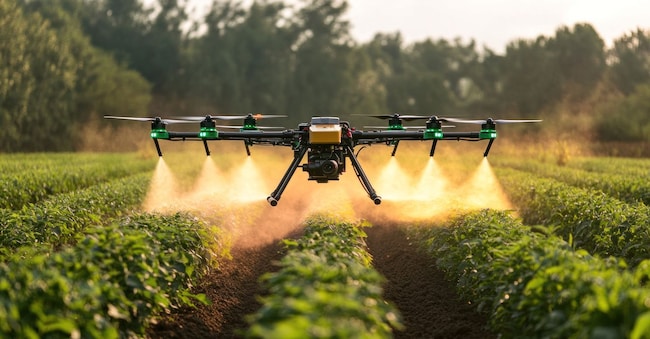
These innovations have made it possible to feed the world’s population, which is set to decline as a result of demographic change and increased life expectancy

Key points
Despite a deep-rooted prejudice dating back to the time of Thomas Malthus, a surprising trend has emerged over the last seventy-five years: even though the population has grown at a rate never before seen in history – with around five billion more people on the planet – food production has grown at an even faster rate. The Malthusian trap, formulated in the late 18th century, has not held true since the mid-20th century because technology has changed in the meantime.
The population will begin to decline
Over the next seventy-five years, according to leading demographic research institutes, the world’s population will begin to decline: not because of a lack of food, but rather due to the widespread nature of the demographic transition and the end of population growth resulting from increased life expectancy.
Mega trends with transformative potential
This is a megatrend – that is, a trend that permeates society and shapes the future because it possesses key characteristics: it is broad, systemic and long-lasting, and has great transformative power and a significant impact, as explained in a brief produced by the Italian Institute for the Future for Ecosistema Futuro. The European Commission’s Joint Research Centre has identified several megatrends, such as: technological acceleration, resource scarcity, changes in the nature of work, urbanisation, rising inequality, the growing importance of migration flows, and so on.
As can be seen, megatrends are not predictions, but phenomena that originate and develop over a fairly long period of time and can therefore form the context within which the future is envisaged. And it is within that context that expectations are situated, which, as the brief makes clear, has fundamental implications for the choices made by human societies: ‘Observing the possible evolution of megatrends is an essential exercise for those called upon to make decisions that will have an impact in the coming years’.
Making decisions with a view to the future
Amid the uncertainty of the present, the growing reliance on the study of megatrends is, in itself, a megatrend. In fact, predictions about the future answer the wrong question: the issue is not to describe the future – an exercise likely to be fraught with error – but to prepare society to make forward-looking decisions, considering the possible scenarios in which those choices will have their consequences. And megatrends help us to envisage those scenarios. According to the Italian Institute for the Future, the way in which information is gathered and topics are categorised influences the vision of the future that emerges. Megatrend themes are organised around four key areas: geopolitical, socio-economic, technological and environmental. They can never be considered in isolation, but must always be viewed in terms of how they interact with one another.


