
Porsche 911, what the first Stuttgart hybrid looks and feels like
The Zuffenhausen icon also gets electrified, but without betraying its own nature, on the contrary!

6' min read
6' min read
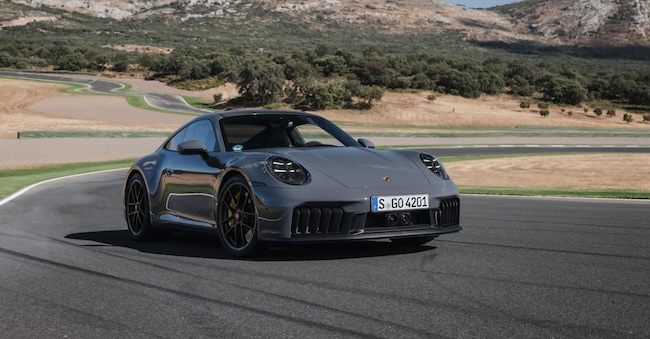
MIJAS - Always the same, but always different and improved. The Porsche 911 reaches the 992.2 generation and is preparing to once again launch a new wave of versions starting with the Carrera and, surprisingly, the Carrera GTS. The latter had never before accompanied the debut of a new 911, always arriving later, but this time it has been entrusted with a major responsibility: to debut the first hybrid 911 in history. And precisely 50 years after the debut of the first Turbo. But let's go in order.
The new Porsche 911 is aesthetically a restyling and Zuffenhausen has decided to emphasise the differences between the versions even more. The new front light clusters allow all the lights to be collected, freeing up the bumpers completely, and there are also HD LED matrix lights with no less than 16,384 microdiodes per headlamp, which help night driving and safety by drawing the light beam with surgical precision and 'shooting' it up to 600 metres without ever dazzling. The rear light clusters are also different, the position of the number plate and exhaust tailpipes is new, and the air intakes on the rear bonnet are also new. The GTS in this case differs precisely in these two elements and adds two additional intakes while at the front the two side ones have become elements of active aerodynamics thanks to six bulkheads on each side that open when required. When they do, two small hatches open at the bottom to limit the loss of downforce on the front axle.
There are also new body colours, new personalisation possibilities with the Porsche Exclusive Manufaktur programme - all customers get at least two items from the catalogue - and even the possibility of custom configuring a titanium chronograph made in Switzerland by choosing the dial rim in the same colour as the bodywork, the strap in the same leather as the seats and the inertia rotor in the same design as the rims. The instrumentation is also new, now digital on a 12.6" curved panel that can be configured as desired, and the possibilities offered by the info-telematic system with a 10.9" screen are wider. Improved integration with Apple Carplay now makes it possible to use the Siri voice assistant to control certain car functions such as climate control and audio. In the safety features, previously on-demand devices are now standard, adding others such as speed limit assist, lane change assist, parking assist and even ParkAssist for manoeuvring out of the car, night vision and an alert when the door is opening and a car is approaching from behind.
The chassis has also been revised, starting with the suspension, which can be fitted with active anti-roll bars with electro-hydraulic actuators instead of electromechanical ones, as well as a new lifting system that now increases the car's ground clearance by a good 40 mm. The GTS has a 10 mm lower stance, four-wheel steering with independent actuators for the rear wheels and larger brakes: the Carrera has 350 mm discs (+20 mm) with 6-piston front callipers and 4-piston rear callipers; 408 mm front and 380 mm rear for the GTS with the possibility of having the system with 420 mm (+10 mm) carboceramic discs at the front with 10-piston callipers and 410 mm (+10 mm) at the rear. The Carrera retains the twin-turbocharged 3-litre 6-cylinder boxer with slightly increased power (394 hp, +9 hp) and torque of 450 Nm, again with 8-speed PDK dual-clutch gearbox. The big news is the all-new 3.6-litre hybrid. The thermal unit is not simply the 3-litre with increased stroke and bore, but has been modified precisely for electrification, starting with the services which are now all electrically pumped and do not need a belt.
The result is that the 6-boxer is now a good 110 mm slimmer and lower, creating a space that has been used to house the current distributor, AC/DC converter and inverter required for the electrical part of the hybrid system. The latter consists of a 40 kW and 150 Nm motor-generator sandwiched between the gearbox and thermal unit with a diameter of 286 mm and a thickness of 55 mm that also acts as a starter. The liquid-cooled battery consists of 216 cylindrical cells, weighs 27 kg, has a capacity of 1.9 kWh and is positioned on the front axle. The 12-volt 40 Ah service battery is Lithium-Iron-Phosphate (LiFePO4) and weighs 7 kg, a third of a comparable conventional lead-acid battery. The most innovative part is the supercharging with a single electric turbocharger, i.e. equipped with a 400 Volt 20 kW motor-generator coaxial to the shaft connecting the turbine and compressor. Its function is to accelerate the impeller up to 120,000 rpm all the 1.3 bars of pressure expected in a few hundredths of a second, adjusting them without the need for the wastegate valve. Once the optimum engine speed is reached, the turbocharger stops pushing and recovers the kinetic energy of the exhaust gases up to 11 kW by sending them to the battery or directly to the MGU-K in the gearbox. This is a scheme conceptually identical to that of a Formula 1 power unit, which collects energy both in the braking and release phases, like other hybrids, and in the acceleration phases. However, the Porsche 911 GTS, despite having full-hybrid power, cannot run on electric power, so conceptually it is a high-power mild-hybrid.

