Test drive

Porsche Cayenne Electric and Turbo Electric, the test of the lithium-ion super suv

The German manufacturer's new electric model proves capable of high performance and driving pleasure

by Fabrizio Albergati

7' min read

Translated by AI
Versione italiana

7' min read

Translated by AI
Versione italiana

Porsche Cayenne Electric, exaggerated in everything from performance and technology that manages to hide the size and weight of the new Stuttgart creature. We tested it on the road and off-road in the 'Electric' and 'Turbo Electric' versions.

There are some cars that don't just preside over a segment, but end up defining it. The Porsche Cayenne belongs to this category: when it arrived, it moved the bar on what an SUV could be, paving the way for a generation of high-performance models that now account for a significant share of the premium market. It was not a foregone conclusion. At the beginning of the 2000s, the very idea of a high-wheel Porsche was perceived as an anomaly, almost a departure from the brand's tradition. In the space of just a few years, however, that choice turned into a standard: high power, large masses, evolved all-wheel drive and a level of versatility that made these models usable every day, without sacrificing benchmark performance.

Loading...

Today, the context has changed. Electrification, an increase in weight and an ever-increasing technical complexity demand continuous evolution. After more than 1.5 million units sold, the Cayenne thus finds itself having to play a different role than in the past: no longer a forerunner, but a balance between performance, efficiency and sustainability. A delicate transition, because the risk is to lose precisely that radicality that had made it a reference. Then there is the road, which remains the real test bench, and it is here that the Cayenne amazes, really amazes.

We tested it, in its basic version and in the 'Turbo' version, on the roads of Catalonia and on the off-road ring on which Porsche has developed the Cayenne's off-road capabilities. The new electric course has not diluted the character of the Cayenne; on the contrary, it has enhanced its dual soul as a quiet family car for everyday use and as a high-performance, ultra-high performance car.

Porsche Cayenne Electric, tutte le foto

Photogallery8 foto

Hypercar performance and chassis for the Turbo, even for everyday use

The two versions of the electric Cayenne share a common technical approach based on an 800 V architecture and a 113 kWh lithium-ion battery, integrated in the floorpan and liquid-cooled, combined with two permanent magnet synchronous motors and electronically managed all-wheel drive. The Cayenne Electric develops up to 300 kW (408 hp), rising to 325 kW (442 hp) with overboost, with a maximum torque of 835 Nm. Acceleration from 0 to 100 km/h takes 4.8 seconds, while the top speed is 230 km/h. Declared consumption is between 19.7 and 21.8 kWh/100 km, with a WLTP range of up to 643 km, extended to over 800 km in urban areas.

The Cayenne Turbo Electric uses the same technical basis but with a profoundly different calibration of the propulsion system, bringing power up to 630 kW (857 hp) in standard conditions and up to 850 kW (1,156 hp) with overboost, accompanied by a maximum torque of 1,500 Nm. Performance is at typical supercar levels: 0-100 km/h in 2.5 seconds and a top speed of 260 km/h. Declared consumption varies between 20.4 and 22.4 kWh/100 km, with a WLTP range of between 564 and 624 km.

Both versions support DC charging up to 400 kW, with a 10 to 80 per cent changeover in about 16 minutes under optimum conditions, and are equipped with an 11 kW on-board charger for AC. As an optional extra, 11 kW inductive wireless charging is available for the first time on a production car.

Chassis-wise, it adopts twin-chamber adaptive air suspension with PASM electronic management, aluminium five-link front and rear axles, electromechanical variable-ratio steering and a steered rear axle. The Turbo introduces a more advanced handling dynamics thanks to Porsche Torque Vectoring Plus and a more advanced control of torque distribution, with an approach geared towards maximum traction and precision under acceleration. What makes a big difference, however, is the 'Porsche Active Ride' active chassis system, which relies on dual-chamber adaptive air suspension integrated with the PASM electronic control system, continuously adjusting shock absorber response according to speed, load and driving conditions. In the most advanced configuration it introduces active management of body movements, acting on roll, pitch and load transfers in real time to keep the stance as stable as possible. The result is a dynamic variation between comfort and control: high absorption on bumps and, at the same time, greater precision and support during acceleration, braking and cornering. The result is a car that is always "flat", with no load transfer or roll when cornering, capable of hiding the Cayenne's weight, especially when the pace is increased, making the behaviour of this over 2.7 tonne SUV similar to that of a sports saloon.

All new, in the Cayenne tradition

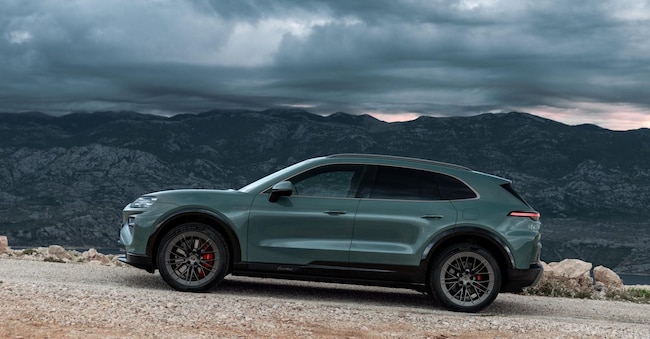
Approaching the electric Cayenne we find familiar proportions, but with cleaner surfaces and a lower front end, where slim headlamp clusters and airflow management contribute to a more aerodynamic stance. The side retains pronounced wheel arches and introduces frameless doors, while the roof drops with a more distended line towards the rear. At the rear, the continuous light band and three-dimensional elements define a more technical rather than decorative layout. On the Turbo Electric, certain details become more pronounced: the specific trim and, above all, the active rear 'aeroblades', integrated into the edges of the body, which extend according to speed to manage aerodynamic flows and improve performance and range. A visible element that distinguishes the highest performing version even at a glance and which brings it a coefficient of 0.25, truly surprising for an SUV of this size.

Entering the car, one immediately perceives a strongly digitally oriented approach, but set in a context of high level finishes, with materials and assembly that recall a premium environment rather than a strictly technological one. In front of the driver, the instrument panel is completely digital, while in the centre is a curved display that concentrates most of the vehicle's functions, reducing traditional physical controls to a minimum. The third screen, dedicated to the passenger, allows all data relating to the journey to be displayed, as well as multimedia content, invisible to the driver to avoid distraction.

The interface is based on an Android Automotive platform with proprietary development, with configurable screen and widget management, application integration and updates over time. The system also supports advanced voice commands, while the centre console integrates a hand rest that makes interaction with the touchscreen more stable.

The front seats offer electric adjustments and various configurations, with ventilation and massage functions in the more comprehensive versions, while in the rear, space benefits from a longer wheelbase than in the thermal versions. The second row is also electrically adjustable and allows the ratio of passenger comfort to load capacity to be modulated, with a luggage compartment that reaches over 1,500 litres by folding down the backrests.

Driving: different twins

At the wheel, the electric Porsche Cayenne embodies that dual soul of wolf and lamb that has always distinguished it, and it does so even more strongly than the endothermic versions. It seems to have been designed specifically to change the minds of all those who think that an electric car is no fun or that, given the masses involved, you lose driving pleasure, performance or efficiency in the corners;

We tested the Turbo Electric version first and, on the drive from Barcelona airport to the hotel, the Cayenne behaved like a perfect family car: comfortable, spacious and with a well-integrated infotainment system. The car in Normal mode is comfortable, the throttle response is immediate and the biggest difficulty is not exceeding the speed limit. Right from the start, the active chassis and steered rear wheels hide mass and size, so much so that it doesn't feel like driving a five-metre SUV.

The Turbo Electric under test was equipped with Porsche Active Ride, an option not present on the Electric version, and this radically changes the car's behaviour. It completely masks the weight and eliminates load transfers and lateral leaning, especially in sportier driving. Coming off the motorway, on mountain roads with hairpin bends and curves in succession, the Cayenne is at its best: by switching to Sport and Sport+ modes, the perception of distances is noticeably shortened. When cornering, the steered rear axle offers hypercar-like quickness and rigour, while hairpin bends are tackled with surprising ease. We then tested the launch control: acceleration from 0 to 100 km/h in 2.5 seconds is comparable to that of a Formula 1 car, with impressive and immediate thrust. But even more impressive than the pure performance is the almost total absence of roll and pitch thanks to the dynamic chassis management offered by Porsche Active Ride, which makes driving extremely efficient and low-fatigue even at high speeds.

Once at Bassella, the Cayenne also showed its off-road capabilities. This is not just a simple gravel road, but a demanding route with technical passages not normally associated with an SUV of this type. With the off-road package, the Cayenne achieves a ground clearance of 245 mm and significant angles of attack (25 degrees at the front and 22.7 at the rear). Despite road tyres, the handling was convincing.

The Cayenne Electric puts the experience back on a more balanced plane. Without the Porsche Active Ride, more mass and load transfer emerge, and the lower power makes the ride more progressive. It is still very efficient, but with more predictable and less extreme behaviour. Precisely for this reason it is also more suitable for everyday use.

A note on consumption: the Turbo, driven very dynamically, exceeded 42 kWh/100 km, while in more realistic use it is around 30 kWh/100 km. The Electric stays closer to the declared values, between 25 and 30 kWh/100 km.

The prices of the electric Cayenne reflect the model's positioning: in Germany, the Cayenne Electric starts at around EUR 103,000, while the Turbo Electric starts at around EUR 166,500, with plenty of room for growth depending on optional extras, including Porsche Active Ride.

Copyright reserved ©
Loading...

Brand connect

Loading...

Newsletter

Notizie e approfondimenti sugli avvenimenti politici, economici e finanziari.

Iscriviti