Service/Test Drive

Porsche Macan GTS, what the powerful new version of the electric SUV looks and feels like

Just as in the families of other Porsches, the badge in the Macan identifies a proposition that is just slightly below the most powerful of all

by Massimo Mambretti

Porsche Macan GTS, la prova del suv elettrico che fa la granturismo

4' min read

Translated by AI
Versione italiana

4' min read

Translated by AI
Versione italiana

The GTS badge brings the fifth version to the Macan while advancing Porsche's electric range. The new version with 571 horsepower sits between the 4S with 449 horsepower and the Turbo with 585 horsepower, also offering all-wheel drive. On sale for 110,000 euros, it is pitted against, for example, the Audi SQ6 e-tron, the Maserati Grecale Folgore, and the higher performance versions of the new Bmw iX3 and Mercedes GLC Eq.

Check out our price list

Loading...

The videos of Motori 24

Porsche Macan GTS, cocktail of new and familiar ingredients

The fourth electric Macan with all-wheel drive, remembering that the version at the base of the range is rear-wheel drive, the GTS is powered by a powertrain that develops 516 horsepower as a base in which the rear electric motor inherited from the Turbo plays an important role but which, with the overboost function, delivers 571 horsepower together with a torque of 955 Nm. The system generates a continuously variable all-wheel drive system and is mated to a gearbox which, as in the case of all other Macans, has a specific gear ratio. The electric heart that propels the Macan GTS up to 250 km/h self-limited and to 100 km/h in 3"8 against an average consumption of 20.5 kWh/100 km is powered by the same 100 kWh lithium-ion battery (gross) as the other versions with 800 V voltage, which is fully recharged in ten hours with the 11 kW alternating current and 10 to 80 per cent, in half an hour with the 150 kW direct current, and in around twenty minutes with the 270 kWe direct current, which promises a range of almost 590 kilometres. To tune the power with the dynamism of the GTS, this version has a specifically calibrated set-up that is lowered by 10 millimetres compared to that of the other Macans, supplemented by 21" wheels and adaptive air suspension that can move the Macan's ground clearance by up to 34 centimetres to cope with off-road conditions and active anti-roll bars, by the electronically managed self-locking differential placed behind the rear engine to favour greater weight distribution on the rear axle for sports car behaviour. On request there is the Sport Chrono package with Track mode that sets the SUV appropriately for sporty driving by also increasing the battery cooling level to prevent performance degradation and integrates a telemetry app into the infotainment display.

Porsche Macan GTS, tutte le foto della prova

Photogallery14 foto

Porsche Macan GTS, customised outside and inside

With the exception of the height that drops 1.61 metres and the length that grows slightly to 4.80 metres, the GTS retains the 1.95 metre width and 2.89 metre wheelbase of the other Macans but is immediately recognisable. In fact, this generation's outfit, which Porsche did not want to be so different from that of the previous series, is harmonically customised by some gloss black superstructures, bumper shields defined by the Sport Design package available on request for the other Macans, enlarged skirts at the rear and a wider rear diffuser. The customisation is completed by headlamps with 'shaded' lenses.
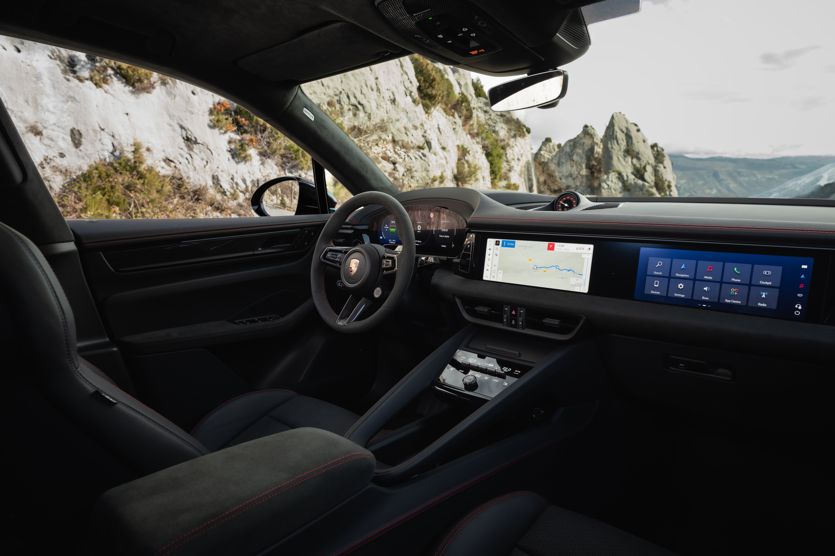
The cabin features electrically adjustable front seat covers in Race-Tex fabric with leather detailing and much of the upholstery, the GTS logo on the headrests and in the configurable cockpit and some pages of infotainment that 'runs' Android Automotive OS, which integrates Google, Ai and voice assistant. The digitisation based on the 12.6-inch instrumentation and 10.9-inch infotainment displays can be extended on request by a large head-up display with augmented reality and a display in front of the passenger.

The interior offers a good amount of space and is well finished overall, even if after the first glance one notices some plastic upholstery that is a little underwhelming for the category in which the Macan is placed. Adequate to the car's dimensions is the luggage compartment, which has a capacity ranging from 540 to 1,348 litres, to which is added the 84-litre capacity of the well inside the front bonnet that is useful for storing charging cables.

On request there are many accessories to personalise the GTS inside and out, features to upgrade connectivity and systems to complete the line-up of Level 2 semi-assisted driving Adas, including adaptive cruise.

Porsche Macan GTS, satisfying and always instinctive to drive

This Macan can also be equipped with the useful rear-steer steering as well as 22" wheels, which, in addition to the other technologies dedicated to dynamism, contribute to enhancing the already rigorous basic behaviour of this Porsche, to increasing agility in the succession of bends and, in the end, to confident handling in every driving situation. A characteristic that in committed use is supported by solutions typical of sports cars such as the low centre of gravity and the 'unbalanced' weight distribution on the rear axle, by the promptness of the steering and the speed with which the all-wheel drive distributes the drive to the rear axle, as well as by the suspension setting. In short, the Macan GTS behaves smoothly and is manageable when needed without any nervous breakdowns. All in all, it feels more compact than it actually is even if, in any case, you can always sense that it is not in the featherweight category. Regardless of this, from the driver's seat one appreciates the correct tuning between the demands of the accelerator and the responses of the propulsion system, both in normal use and when suddenly exploiting the power and instant torque with the Sport and Sport Plus configurations, with which specific but artificial sounds also emerge. In fact, the exact 'charge' required always arrives gradually at the wheels. This is thanks to the well-balanced electronic management that optimises not only the delivery but also the range with a rational expenditure of energy and strong recovery capacity in slowdowns that cannot be managed in steps through paddles on the steering wheel, but is automatic and in strong decelerations very intense. In terms of consumption in the 170-kilometre test exclusively on winding mountain roads, we found an average of close to 25 KWh/100 km and drained 35 per cent of the battery charge.

Copyright reserved ©
Loading...

Brand connect

Loading...

Newsletter

Notizie e approfondimenti sugli avvenimenti politici, economici e finanziari.

Iscriviti