
Does Porsche's retreat on electrics anticipate a change of direction for European manufacturers? What is happening
The electric car crisis could change the scenario of the European automotive industry

3' min read
3' min read
"Electric mobility and Porsche are a perfect match. Not only because they share a high-efficiency approach, but above all because of their sporty character. By 2022 we will invest more than six billion euros in electric mobility and by 2025 50 per cent of all new models could have an electric motor." Those were the words of Oliver Blume in February 2019, at the time chairman of the board of Porsche AG and today number one of the entire Volkswagen Group. A statement that came together with the announcement of the electric Macan expected in 2022 on the road, a date that in reality translated into the latter part of 2024. All this combined with a veritable tsunami in the field of electrics, with homeopathic sales figures capable of changing many announcements made starting with Porsche itself; in Stuttgart, it no longer seems like science fiction to review the future range and bring back an internal combustion Macan. A choice that would be on the table of many different automotive boards, the same ones that went all-in on the electric a few years ago
Porsche has second thoughts on electrics?
While there has been no lack of investment in electrics at Porsche, there has been no lack of customer response. Because despite the usual triumphalist announcements at every budget conference, 100% electric has not convinced the Zuffenhausen brand's customers, as underlined by sales and even worse by the Taycan's low residual value. And after last summer's review of its electric strategy ('the target of 80 per cent electric sales in 2030 is confirmed provided there is adequate customer demand and the necessary enabling conditions for plug-in mobility are in place'), at the presentation of the quarterly results Finance Director Lutz Meschke opened the way for a change of course. 'We are looking into the possibility that vehicles originally planned as fully electric will have a hybrid drive or combustion engine in the future. What is clear is that we will have combustion engines for a long time to come.
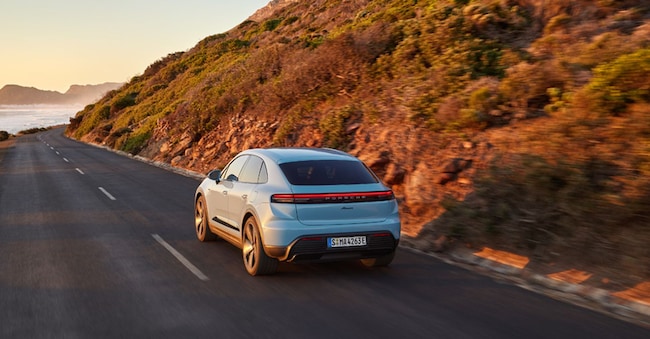
And if the Cayenne and Panamera continue to be offered in internal combustion versions, there could be a change of strategy on the Macan despite the fact that the current model is based on the native electric EPP platform developed in collaboration with Audi. "As far as our electrified range is concerned, we are very flexible on the production side: we can build combustion engine, plug-in hybrid and electrified cars on one assembly line in Leipzig," he says. "We will also see more flexibility in the coming years: we will develop new derivatives of our Bevs with combustion engines to meet customer demand. Translated? A petrol Macan will be made from the electric one. Entering the realm of hypothesis, the recent PPC platform brought out by the Audi A5 (and developed for electrified thermal models) could be used instead of modifying the EPP.
Waterfall effect
.As we have written several times, no insider imagines a total upheaval in the way of electricity. The scenario 'we joked. We will go back to making only thermal cars' is not even remotely conceivable because it would lead to the immediate collapse of the European car industry. The reason for this is the billion-dollar investments made, which to date have not been recovered even in the slightest despite double-digit percentage price increases. A perfect example? The Porsche 911 GT3, which went from 176,855 euros for the first generation 992 GT3 in 2021 to the current 215,543 euros for the restyled GT3, still powered by the 510-horsepower 4.0 aspirated engine.
And the automotive system, especially the German one, is showing unprecedented criticality, starting with the Volkswagen group ready to close plants in Germany and go against the trade unions.

